
Overview of Legal Issues Regarding Foreign Employees Working in China (Part 1)

Once foreign employees obtain the necessary permits and are legally employed in China, they are protected by Chinese labor laws and regulations. Issues concerning their remuneration, tax payments, and social insurance/housing fund contributions are governed by Chinese law.
1. Remuneration Issues
Remuneration is the compensation received by workers in exchange for their physical or mental labor, reflecting the social value they create. According to relevant provisions of China's "Labor Law," foreign employees who have obtained work permits and have signed labor contracts with employers within China, thereby establishing a labor relationship, enjoy the right to receive remuneration. Employers must not deduct wages without cause or delay payment unjustifiably.
According to Article 17 of the "Labor Contract Law," employers must sign labor contracts with employees. Specific details regarding remuneration, such as the exact wage amount and payment schedule, should be agreed upon in the labor contract signed between the employer and the employee.
Furthermore, Article 21 of the "Provisions on the Administration of Employment of Foreigners in China" specifically emphasizes: "The wages paid by an employer to hired foreigners shall not be lower than the local minimum wage standard."
Regarding the fulfillment of remuneration obligations, Article 30 of the "Labor Contract Law" stipulates that employers must pay labor remuneration to employees in full and on time, in accordance with the labor contract and national regulations. Apart from labor arbitration procedures, if there are no other debt disputes between the employee and the employer and a payment order can be served to the employer, the employee may apply to the court for a payment order, requiring the employer to pay the full remuneration within 15 days of receiving the order. If the employer neither raises an objection nor fulfills the payment order within fifteen days of receipt, the employee may directly apply to the People's Court for enforcement.
A payment order is part of the summary procedure conducted by the court under the Civil Procedure Law. It does not require labor arbitration as a prerequisite and can handle simple creditor-debtor relationships quickly, timely, conveniently, and effectively. However, based on the author's research, perhaps because employees and employers often hold differing views on labor disputes, making it difficult for courts to determine the nature of the case directly, there are few cases where labor disputes are resolved through court-issued payment orders.
2. Tax Issues for Foreign Employees
According to Article 3, Paragraph 1 of the "Regulations on the Implementation of the Individual Income Tax Law," wages and salaries derived from providing services within China due to employment, engagement, or contract performance (hereinafter referred to as "labor remuneration") are considered income sourced within China, regardless of whether the place of payment is within China, unless otherwise stipulated by the financial and tax authorities of the State Council. Therefore, they are subject to taxation under Chinese law. Consequently, foreign employees working in China also bear tax obligations. This section will address the criteria for becoming a tax subject, the scope of taxation, and the tax exemption threshold, in conjunction with the "Individual Income Tax Law" revised in 2018 (the "New IIT Law").
(1) Tax Subjects and Scope of Taxation
The New IIT Law introduces the concepts of "resident individuals" and "non-resident individuals," further clarifying tax subjects and the scope of taxation. According to Article 1 of the "Individual Income Tax Law":
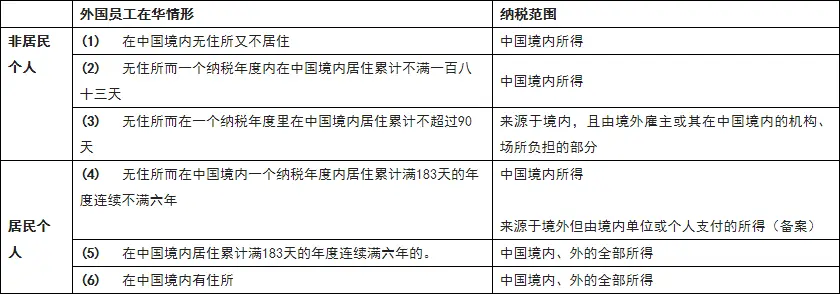
- An individual constitutes a "resident individual" if one of the following conditions is met:
Scenario 1: Having a domicile within China.
Scenario 2: Not having a domicile but residing cumulatively in China for 183 days or more within a single tax year.
However, for resident individuals meeting "Scenario 2" above, according to Article 4 of the "Regulations on the Implementation of the Individual Income Tax Law," if filed with the competent tax authority, income sourced outside China and paid by overseas entities or individuals is exempt from individual income tax. However, if in any year where the cumulative residence in China reaches 183 days, there is a single departure exceeding 30 days, the consecutive years count resets.
Therefore, if a foreign employee qualifies as a "resident individual," their income from both within and outside China (i.e., global income) is subject to individual income tax. However, if they meet the conditions of Article 4 of the "Regulations on the Implementation of the Individual Income Tax Law" and complete the filing, they may be exempt from tax on foreign-sourced personal income.
- An individual constitutes a "non-resident individual" if one of the following conditions is met:
Scenario 1: Having no domicile in China and not residing in China.
Scenario 2: Not having a domicile and residing cumulatively in China for less than 183 days within a single tax year.
For non-resident individuals, income derived from within China is subject to individual income tax.
According to Article 5 of the "Regulations on the Implementation of the Individual Income Tax Law," for individuals with no domicile in China who reside cumulatively in China for no more than 90 days within a single tax year, the portion of their China-sourced income that is paid by an overseas employer and not borne by the employer's institutions or establishments within China is exempt from individual income tax.
Therefore, if a foreign employee qualifies as a "non-resident individual," they pay individual income tax on China-sourced income. However, if they meet the conditions of Article 5 of the "Regulations on the Implementation of the Individual Income Tax Law," they are exempt from tax on China-sourced income.
In summary, the possible scenarios for foreign employees are summarized as follows:
- Priority Application of Bilateral Tax Treaties
In addition to the above laws defining tax subjects and scopes, issues regarding foreigners working in China should also consider bilateral tax treaties signed and effective between China and other countries.
For example, the "Agreement Between the Government of the People's Republic of China and the Government of the United States of America for the Avoidance of Double Taxation and the Prevention of Fiscal Evasion with Respect to Taxes on Income" stipulates that, except for directors' fees, pensions, government service remuneration, and remuneration for teachers, students, or trainees, salaries, wages, and other similar remuneration derived by a resident of one contracting state from employment shall be taxable only in that contracting state, unless the employment is exercised in the other contracting state.
Even if a resident of one contracting state derives remuneration from employment exercised in the other contracting state, such remuneration shall be taxable only in the first-mentioned state if all three of the following conditions are met:
(1) The recipient is present in the other contracting state for a period or periods not exceeding 183 days in aggregate in the calendar year [i];
(2) The remuneration is paid by, or on behalf of, an employer who is not a resident of the other contracting state;
(3) The remuneration is not borne by a permanent establishment or a fixed base which the employer has in the other contracting state."
China's tax law stipulates that the condition for taxing remuneration paid by overseas employers is that a non-resident individual resides cumulatively in China for more than 90 days within a tax year, whereas the aforementioned provision in the China-US tax treaty sets this threshold at more than 183 days. Based on the principle of "pacta sunt servanda" (treaties must be observed), when a tax treaty conflicts with domestic tax law, the provisions of the tax treaty prevail in the administration of foreign-related tax collection. Therefore, for US employees working in China for more than 90 days but not exceeding 183 days in a tax year, who receive remuneration paid by an overseas employer, Article 5 of the "Regulations on the Implementation of the Individual Income Tax Law" does not apply; instead, foreign-sourced income is not taxed in accordance with the China-US tax agreement.
In conclusion, tax issues for foreign employees working in China should comprehensively consider bilateral agreements, China's individual income tax regulations regarding tax subjects, the scope of taxation, and exemption provisions.