
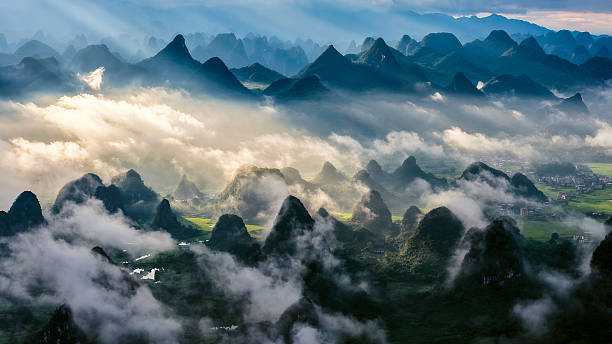
If you’re planning a trip to China and want to get beyond the big cities, the China Mountains – or Wuyue – are worth your attention. These are the sacred peaks that have drawn emperors, poets, and pilgrims for over three thousand years. Each one sits in a different direction – east, south, center, north, and west – and each has its own personality, its own legends, and its own way of testing your legs. This guide takes you from east to west, telling you what to expect, when to go, and why each mountain is worth the climb.
Mount Tai Eastern Peak
Start in Shandong province with Mount Tai, the most revered of the China Mountains. The Chinese call it Dongyue, and it’s been a worship site since long before Confucius. The philosopher himself climbed it and said that looking down made the world seem small. Tang poet Du Fu said something similar – all other mountains become tiny once you stand on its peak.
The real draw, though, is the imperial history. Twelve emperors made the pilgrimage to perform the fengshan ceremonies, announcing their rule to heaven and earth. UNESCO listed it as a World Heritage site in 1987, describing it as having “exceptional historic, cultural, aesthetic and scientific value” and noting that it “has been worshipped continuously throughout the last three millennia” – you can read the full UNESCO description.
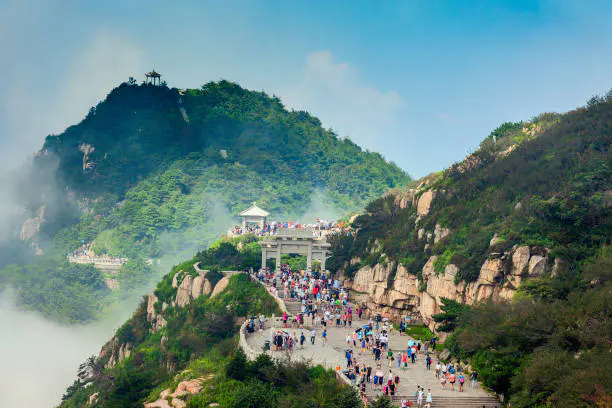
The climb is no walk in the park. The Eighteen Bends – a staircase of 1,600 steps – will make your thighs burn, but the payoff from South Heaven Gate is worth every step. If you can time your hike for sunrise, you might catch the “Yellow River Golden Belt,” a line of light on the horizon that feels like a reward.
When should you go? Spring (April–May) and autumn (September–October) give you the clearest skies and the best temperatures. Winter brings rime ice and snow – beautiful but cold. Summer can be rainy, especially August, so you might want to avoid that month if you don’t like slippery trails.
Mount Heng Southern Peak
Head south to Hunan province, where the Southern Mountain – Nanyue – rises gently through the mist. This one is often called the most scenic of the China Mountains. It’s lush and green, with over 200 temples, monasteries, and shrines scattered across its slopes – a testament to its importance in both Taoism and Buddhism.
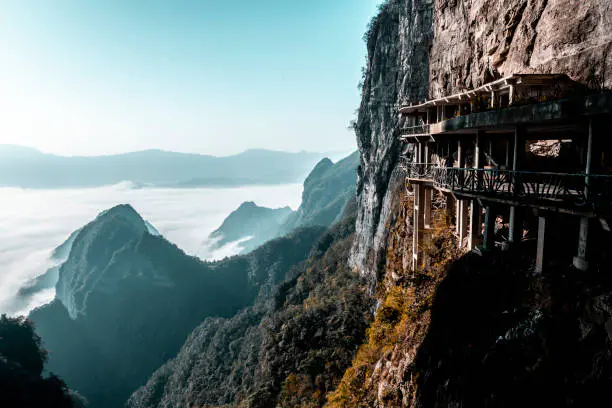
The main summit is Zhurong Peak, named after the fire god of Chinese mythology. Ancient emperors Tang Yao and Yu Shun supposedly performed sacrifices here, so you’re walking in some very old footsteps. The mountain also goes by “China’s Mountain of Longevity,” and you’ll see plenty of elderly pilgrims making the trip, moving slowly but with determined smiles.
Don’t miss the Nanyue Grand Temple at the base – it’s one of the few places where Buddhist, Taoist, and Confucian rituals all happen under the same roof. The incense smoke is thick, and the chanting fills the air from multiple directions.
Best time to go? You can visit year-round, but spring (March–April) gives you cherry blossoms and azaleas. Late summer and early autumn (August–October) offer cooler weather and dramatic cloud formations. Autumn foliage peaks around September and October, and winter (December–February) gives you a rare treat for southern China: rime ice that turns trees into crystal sculptures. Keep in mind that the seventh and eighth lunar months, plus Chinese New Year, bring huge crowds of pilgrims.
Mount Song Central Peak
Travel north and slightly west to Henan province, where the central mountain – Songshan – sits on the south bank of the Yellow River. Its position has made it a crossroads for all three of China’s main philosophies: Confucianism, Buddhism, and Taoism.
You’ve probably heard of its biggest attraction: the Shaolin Temple, founded in 495 CE. It’s considered the birthplace of Zen (Chan) Buddhism and the home of Shaolin Kung Fu. If you visit when the monks are training, you’ll hear the rhythmic thuds of bodies hitting the ground and the clack of staffs. The temple complex became a UNESCO World Heritage site in 2010 as part of the “Dengfeng Historic Monuments” – details here.
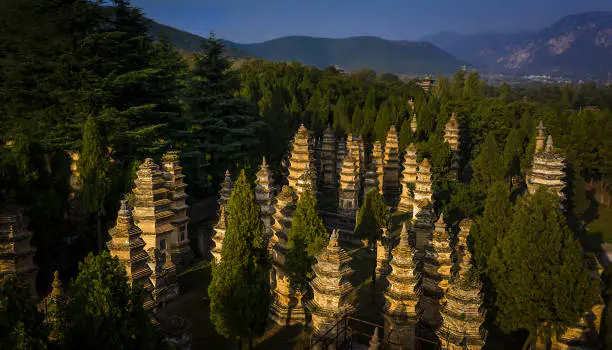
But there’s more than martial arts. The Zhongyue Temple is the largest and best-preserved Taoist complex among the China Mountains, and it’s much quieter than Shaolin. You can also visit the Songyang Academy, a Confucian school that produced generations of scholars, and a Yuan dynasty observatory built by Guo Shoujing – the oldest surviving astronomical observatory in China.
For timing, spring and autumn (April–May, September–October) are your best bets. Mild temperatures and colorful foliage – the red leaves on Mount Song are especially striking around October 10 to 25. Summer is cooler at altitude, with frequent sea-of-clouds views, but winter can be bitterly cold.
Mount Heng Northern Peak
Continue north into Shanxi province, where the Northern Mountain – Beiyue – has the longest recorded history of worship among the China Mountains, dating back to the Zhou Dynasty. It’s also the most rugged – a stark landscape of steep cliffs and windswept ridges that feels like the edge of the world.
The standout feature here isn’t the mountain itself – it’s the Hanging Temple, or Xuankong Temple, built into a sheer cliff 75 meters above the ground over 1,500 years ago. It’s the only existing temple in China that enshrines Buddhist, Taoist, and Confucian deities together, and it’s an engineering marvel. Wooden beams drilled into the rock support the entire structure – walking along its narrow corridors, you’ll wonder how anyone built it without modern scaffolding.
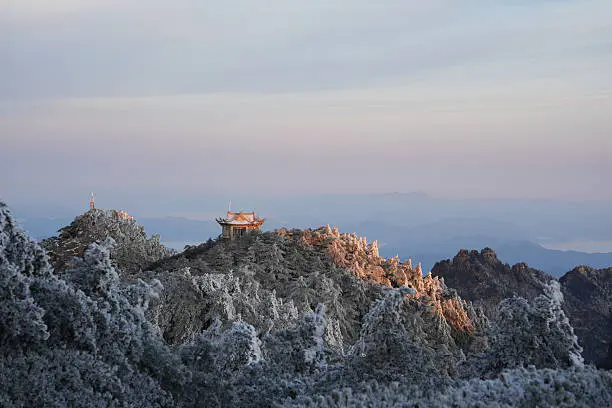
Plan your visit for summer or early autumn (May to October). September and October give you the clearest skies and richest autumn colors. Spring has wildflowers, but winters are brutal – freezing winds and heavy snow make the roads treacherous. If you can, go on a weekday; weekends and holidays are packed, and the narrow walkways get uncomfortably crowded.
Mount Hua Western Peak
Finally, head west to Shaanxi province, where Mount Hua – Huashan – stands as the tallest and most daunting of all the China Mountains. Its South Peak rises to 2,154.9 meters, and it’s earned a reputation as “the most precipitous mountain under heaven.” The character Hua is the same one used in Zhonghua (China) and Huaxia (the Chinese people), so you’re standing on ground that’s linguistically and culturally at the very heart of Chinese identity.
The hiking trails are legendary. The classic route, known as “the only path since ancient times,” includes the Thousand-Foot Cliff – a Han dynasty staircase of 370 steps that requires you to use both hands and feet while clinging to iron chains. And then there’s the Plank Walk in the Sky – wooden planks bolted to a vertical cliff face. If heights make you nervous, this one is best skipped.
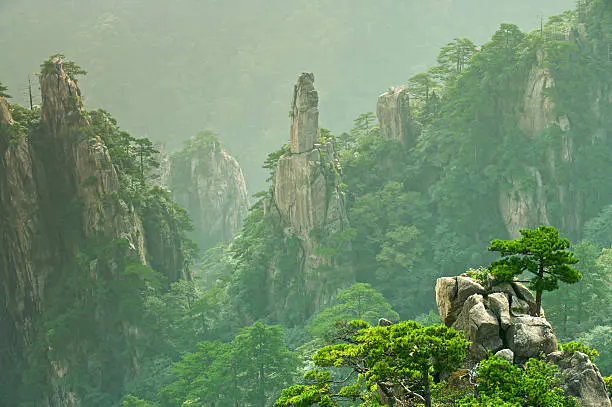
The mountain has been a Taoist center for thousands of years, with a temple here since at least the 2nd century BC. It’s also famous in pop culture as the setting for the martial arts duels in Jin Yong’s The Legend of the Condor Heroes – so if you’re a fan, you’ll recognize the scenery.
When should you attempt it? April to June and September to October are your windows. Spring offers temperatures around 10–20°C and blooming wildflowers, while autumn paints the cliffs in red and gold. Winter is spectacular but dangerous – snow and ice can cover the trails, so only experienced climbers should try. Avoid Labour Day (May 1) and National Day (October 1) holidays unless you enjoy queuing on a sheer cliff.
Practical Tips for Your Journey
If you’re aiming to visit all five, budget at least two weeks and invest in good hiking boots. Train travel between provinces is easy, but you’ll need to plan the transfers from the stations to the mountains. Each peak offers something different – endurance tests on Tai, nerve tests on Hua, scenic beauty on Heng (Hunan), historical depth on Song, and that unique temple experience on Heng (Shanxi).
Don’t rush them. Give each mountain two days – one for the climb, one for exploring the temples and villages around the base. A local guide or a good map helps, but the trails are well-marked. The real rewards are the stories carved into stone, the incense smoke, and the faces of the pilgrims you’ll meet along the way.
Final Thoughts
The China Mountains are more than just geological features – they’re a living museum of Chinese civilization, where you can trace the evolution of religion, philosophy, and imperial ambition through the stones and the rituals that still take place there. From the imperial grandeur of Mount Tai to the adrenaline-pumping heights of Mount Hua, each peak opens a different window onto the soul of this ancient land. Whether you’re into history, nature, or just a good physical challenge, the Wuyue won’t disappoint. Just pack good shoes, plenty of water, and a sense of adventure.