
This guide explores marketing manager positions in China (focus on digital/e-commerce), covering core positioning, market demand, key responsibilities, urgent need for overseas talents, application tips, and enterprise support—ideal for global talents to leverage expertise in China’s dynamic market.
Introduction
Amid the rapid development of the global digital economy, the Chinese market has become a core battleground for enterprises worldwide, thanks to its massive consumer base, vibrant e-commerce ecosystem, and continuously innovative digital marketing technologies. Against this backdrop, marketing manager positions are gradually emerging as key roles connecting enterprises with the market and driving business growth—their strategic value is particularly prominent in the digital and e-commerce sectors. For enterprises eager to expand global business and deepen their presence in the Chinese market, high-caliber candidates for marketing manager positions are not only the core force to achieve marketing goals but also a crucial support for enterprises to gain a foothold in the digital era. Meanwhile, as Chinese enterprises deepen their “going global” strategy and overseas brands attach greater importance to the Chinese market, the demand for overseas talents with an international perspective and proficiency in digital and e-commerce operations has become increasingly urgent. Consequently, marketing manager positions have become an important platform to attract marketing elites worldwide.
Core Positioning and Market Demand for Marketing Manager Positions in China
In China’s current business environment, marketing manager positions have long transcended the traditional scope of “promotion and publicity” and evolved into comprehensive roles integrating strategic planning, digital operations, e-commerce management, and data analysis. According to relevant industry reports, the scale of China’s digital marketing market exceeded RMB 1.5 trillion in 2024, and the total e-commerce transaction volume surpassed RMB 45 trillion. This massive market scale has directly driven strong demand for marketing manager positions. Whether it is domestic internet giants, digital transformation projects of traditional enterprises, or overseas brands entering the Chinese market, all regard marketing manager positions as a key link in building core competitiveness.
From an industry distribution perspective, the e-commerce, technology, fast-moving consumer goods (FMCG), and cross-border trade sectors have the most prominent demand for marketing manager positions. Taking the e-commerce industry as an example, leading platforms such as Taobao, JD, and Pinduoduo, as well as cross-border e-commerce enterprises like Shein and Temu, recruit a large number of professionals for marketing manager positions each year. These roles are responsible for store operations on platforms, digital advertising placement, and formulating user growth strategies. In the technology industry, enterprises such as Huawei, Xiaomi, and ByteDance require candidates for marketing manager positions to lead digital marketing promotions for their products—using social media, content marketing, SEO/SEM, and other methods to enhance product visibility and market share. This cross-industry demand growth has kept marketing manager positions in short supply in China’s job market; in particular, candidates with professional digital and e-commerce capabilities have become the focus of enterprise competition.
For overseas talents, the appeal of marketing manager positions in China lies not only in the broad market space but also in the speed of innovation in China’s digital marketing and e-commerce sectors. China leads the world in the development of live-streaming e-commerce, social e-commerce, and private domain traffic operations. Examples include Douyin E-commerce’s “interest-driven e-commerce” model and Xiaohongshu’s “content seeding” ecosystem—these innovative models provide rich practical scenarios for marketing manager positions. If overseas talents join teams for marketing manager positions in China, they can not only integrate advanced international marketing concepts with the actual conditions of the Chinese market but also enhance their professional capabilities in a rapidly iterating environment, maximizing their career value.
Core Responsibilities of Marketing Manager Positions in the Digital Sector

As a core module of marketing manager positions, digital marketing operation capabilities directly determine an enterprise’s market competitiveness in the digital era. In this field, the responsibilities of marketing manager positions cover multiple dimensions, and each link—from strategy formulation to implementation—requires professional knowledge and rich experience.
First, marketing manager positions need to lead the formulation and implementation of digital marketing strategies. This involves developing integrated digital marketing plans covering multiple channels (such as social media marketing, content marketing, SEO (Search Engine Optimization), SEM (Search Engine Marketing), email marketing, and short-video marketing) based on the enterprise’s business goals, target audience characteristics, and market trends. For instance, when targeting young consumer groups, marketing manager positions need to focus on deploying resources on social platforms like Douyin and Xiaohongshu, and enhance brand exposure through short-video content creation, KOL/KOC collaborations, and live interactive sessions. For enterprises with cross-border needs, marketing manager positions need to develop digital marketing strategies for overseas markets, using tools such as Google Ads, Facebook Business Manager, and Instagram Marketing to accurately reach international users and drive cross-border product sales.
Second, data analysis and performance optimization are another key responsibility of marketing manager positions in the digital sector. During digital marketing campaigns, a large amount of real-time data is generated, including core metrics such as Click-Through Rate (CTR), Conversion Rate (CVR), Average Order Value (AOV), and User Retention Rate. Marketing manager positions require proficiency in data analysis tools such as Google Analytics, Baidu Statistics, Tableau, and Power BI to conduct in-depth mining and analysis of this data—understanding campaign performance, user behavior preferences, and existing issues. For example, by analyzing user data from a live-streaming e-commerce campaign, marketing manager positions can identify peak user activity periods, products with the highest conversion rates, and interactive sessions that most attract users. Based on these insights, they can then optimize subsequent marketing plans to improve Marketing Return on Investment (ROI).
Additionally, marketing manager positions are responsible for managing and coordinating digital marketing teams. This includes setting team work objectives and performance evaluation criteria, guiding team members in specific marketing tasks, and coordinating collaboration with other departments (such as product, technology, and sales departments) to ensure that digital marketing activities are seamlessly integrated with the enterprise’s overall business processes. For example, when launching a new product, marketing manager positions need to communicate with the product department to clarify the product’s core selling points and target users, coordinate with the technology department on the construction of digital marketing platforms and data integration, and work with the sales department to develop linked promotion strategies—thus forming a “product-marketing-sales” closed loop to drive the product’s market promotion.
In terms of digital marketing tool application, marketing manager positions require proficiency in operating various digital marketing tools. In addition to the aforementioned data analysis tools and advertising platforms, these include SEO optimization tools (such as Ahrefs, Semrush, and 5118), Content Management Systems (CMS), email marketing tools (such as Mailchimp and SendGrid), and social media management tools (such as Hootsuite and Buffer). Proficiency in these tools not only improves the work efficiency of marketing manager positions but also helps them conduct more precise marketing activities and enhance campaign effectiveness. For example, using Ahrefs, marketing manager positions can analyze competitors’ SEO strategies and keyword rankings to develop more targeted SEO optimization plans—improving the enterprise’s website ranking on search engines and driving more organic traffic.
Key Work of Marketing Manager Positions in the E-Commerce Sector
With the popularization and development of e-commerce in China, the work content of marketing manager positions in the e-commerce sector has become increasingly rich and important. E-commerce is not only a key channel for enterprises to sell products but also a critical platform for brands to interact with users and enhance user stickiness. Therefore, marketing manager positions need to carry out a series of targeted tasks centered on e-commerce platform operations.
Operation and Management of E-Commerce Platforms
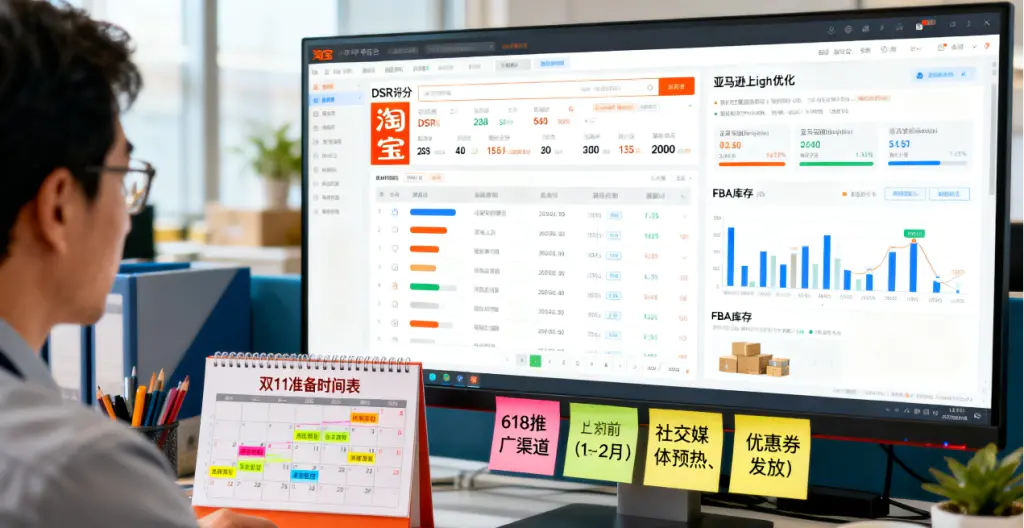
Marketing manager positions are responsible for operating the enterprise’s stores on various e-commerce platforms, including major domestic e-commerce platforms (such as Taobao, JD, Tmall, and Pinduoduo) and cross-border e-commerce platforms (such as Amazon, eBay, Wish, and Shopee). Different e-commerce platforms have distinct user groups, operation rules, and traffic logics—marketing manager positions need to develop differentiated operation strategies based on platform characteristics. For example, on Taobao, marketing manager positions need to focus on store DSR (Detailed Seller Ratings), product rankings, and Zhitongche (Taobao’s paid advertising) placement. They can enhance user shopping experience and conversion rates by optimizing store design, product detail pages, and customer service. On Amazon, however, marketing manager positions need to focus on product Listing optimization, A+ page design, FBA (Fulfillment by Amazon) management, Amazon Advertising (such as Sponsored Products and Sponsored Brands) placement, and responding to platform policy changes and competitor challenges.
In terms of e-commerce platform campaign operations, marketing manager positions need to plan and execute various e-commerce promotion activities—such as major annual shopping festivals like “Double 11” (November 11th) and “618” (June 18th), as well as daily activities like store anniversary celebrations, new product launches, and limited-time discounts. These activities are key to boosting store sales, attracting new users, and reactivating existing users. Therefore, marketing manager positions need to develop detailed activity plans in advance, including activity themes, promotion intensity, promotion channels, activity timelines, and contingency plans. For example, during the “Double 11” campaign, marketing manager positions need to start preparations 1-2 months in advance: communicating with suppliers about inventory, coordinating with platforms for activity resources, developing pre-campaign promotion plans (such as social media preheating, coupon distribution, and pre-order activities), designing in-campaign page layouts and promotion rules, and conducting post-campaign user follow-ups and data analysis to summarize experience for future activities.
Acquisition and Retention of E-Commerce Users
Users are the core of e-commerce operations, so marketing manager positions need to prioritize user acquisition and retention in their e-commerce work. In terms of user acquisition, marketing manager positions need to combine digital marketing methods to attract potential users to e-commerce stores through multiple channels. For example, they can direct users searching for relevant keywords to stores via SEM advertising; attract users to click links to stores by posting product seeding content on platforms like Douyin, Xiaohongshu, and WeChat; or guide users to place orders by showcasing product usage effects in live-streaming e-commerce sessions. At the same time, marketing manager positions need to monitor Customer Acquisition Cost (CAC) and optimize marketing channels and strategies to reduce CAC and improve user acquisition efficiency.
In terms of user retention, marketing manager positions need to establish a comprehensive user retention system and enhance user repurchase rates and loyalty through refined user operations. This includes building user portraits to classify users based on their purchase history, browsing behavior, and preferences—providing differentiated services and marketing content for users at different levels; launching membership system operations to incentivize users to become members and continue consuming by setting membership tiers and benefits (such as point redemption, exclusive discounts, and priority purchase rights); conducting precise user follow-ups to send personalized product recommendations and promotion information to users via email, SMS, or WeChat—reminding them to repurchase; and handling after-sales issues to improve user satisfaction and reduce user churn. For example, marketing manager positions can provide exclusive customer service and customized product recommendations for high-frequency purchasers; for users who have not repurchased for a long time, they can reawaken purchase demand by issuing exclusive coupons or pushing new product information.
Analysis and Application of E-Commerce Data
Similar to the digital marketing sector, data analysis plays a crucial role in e-commerce operations. Marketing manager positions need to optimize operation strategies and improve e-commerce business performance through e-commerce data analysis. E-commerce data mainly includes store data (such as traffic, number of visitors, page views, conversion rates, AOV, and sales volume), product data (such as product sales volume, inventory, positive review rate, and return rate), and user data (such as user gender, age, region, purchase frequency, and consumption amount).
Marketing manager positions need to regularly analyze this data to identify operational issues and opportunities. For example, by analyzing store traffic sources, marketing manager positions can understand which channels drive the most traffic and highest conversion rates—thus increasing investment in these channels and reducing resource waste on inefficient channels. By analyzing product sales volume and positive review rates, marketing manager positions can identify best-selling and slow-moving products—increasing inventory and promotion efforts for best-sellers, and optimizing slow-moving products (such as adjusting prices, improving product detail pages, or launching promotion activities) or removing them from shelves. By analyzing user regional distribution, marketing manager positions can develop differentiated product recommendations and logistics strategies based on the characteristics of users in different regions—enhancing user shopping experience.
Furthermore, marketing manager positions need to use e-commerce data for forecasting and decision-making. For example, by analyzing historical sales data and market trends, they can forecast product sales volume in the coming period to guide suppliers in inventory preparation—avoiding overstocking or stockouts. By analyzing changes in user consumption demand, they can promptly adjust product categories and marketing strategies to meet users’ personalized needs.
Urgent Demand for Overseas Talents in China’s Marketing Manager Positions

Against the backdrop of globalization and the continuous opening-up of the Chinese market, Chinese enterprises’ demand for overseas talents with an international perspective and cross-cultural operation capabilities has become increasingly urgent. Marketing manager positions have emerged as one of the key roles to attract overseas talents. This demand stems mainly from the following aspects:
Deepening of Chinese Enterprises’ “Going Global” Strategy
In recent years, more and more Chinese enterprises have implemented the “going global” strategy to expand their business into global markets. From e-commerce enterprises like Shein and Temu, to technology companies like Huawei and Xiaomi, and FMCG brands like Yuanqi Forest and Perfect Diary—Chinese enterprises’ global footprint continues to expand. During the “going global” process, marketing manager positions are responsible for brand building, product promotion, and user operations in overseas markets. This requires candidates to not only have solid digital marketing and e-commerce operation capabilities but also be familiar with the culture, consumption habits, laws and regulations, and marketing channels of overseas markets. Overseas talents, who have long lived abroad, have in-depth understanding of local markets—enabling them to better grasp the needs of overseas users and market trends, and develop marketing strategies that align with local realities. Consequently, they have become ideal candidates for marketing manager positions in Chinese enterprises’ “going global” efforts.
For example, a Chinese cross-border e-commerce enterprise planning to enter the European market needs to recruit a marketing manager position responsible for the European market. This role requires candidates to be familiar with European e-commerce platforms (such as Amazon Europe and Zalando), social media platforms (such as Facebook, Instagram, and TikTok Europe), data privacy regulations (such as GDPR), and European consumers’ shopping preferences. Overseas talents—especially those with work experience in the European market—have inherent advantages in these areas, allowing them to quickly get up to speed and help the enterprise gain a foothold in the European market.
Need for Integration of Chinese and International Marketing Concepts and Technologies
China leads the world in innovative practices in digital marketing and e-commerce (such as live-streaming e-commerce, private domain traffic, and social e-commerce), while overseas markets have mature experience and technologies in brand marketing, user experience, and data-driven marketing. Marketing manager positions need to integrate China’s innovative models with advanced international concepts to create more competitive marketing plans. The international marketing experience and technologies brought by overseas talents can inject new vitality into China’s marketing manager positions and promote the integration and innovation of Chinese and international marketing concepts.
For example, the “omnichannel marketing” concept familiar to overseas talents emphasizes providing users with a consistent shopping experience across online and offline channels. This concept can be integrated with China’s “private domain traffic operations.” Marketing manager positions can build online private domain communities (such as WeChat groups and WeChat Work groups) and combine them with offline store experience activities—providing users with a full-process service from “seeding” to “purchase” and “repurchase” to enhance user stickiness and loyalty. In addition, overseas talents have rich experience in data analysis and the application of AI-driven marketing tools—helping marketing manager positions better use data to drive marketing decisions and improve the precision and efficiency of marketing.
Need for Cross-Cultural Communication and International Collaboration
In a global business environment, marketing manager positions need to collaborate not only with domestic teams but also communicate and cooperate frequently with overseas partners, suppliers, and users. Cross-cultural communication capabilities have become an important skill for marketing manager positions—and overseas talents have significant advantages in this regard. They are familiar with cultural differences, communication styles, and business etiquette in different countries—enabling them to effectively avoid misunderstandings and conflicts in cross-cultural communication and promote the smooth progress of international collaboration.
For example, when collaborating with overseas KOLs to promote products, marketing manager positions need to communicate in-depth with KOLs to understand their audience groups, content styles, and cooperation needs—developing cooperation plans that benefit both parties. Overseas talents can better understand KOLs’ demands and communicate in local languages and styles—improving the efficiency and success rate of cooperation. Meanwhile, when handling complaints and feedback from overseas users, overseas talents can better understand users’ needs and emotions—providing more thoughtful solutions to enhance user satisfaction and brand image.
To attract more overseas talents to join marketing manager positions, Chinese enterprises are constantly optimizing talent policies and benefit systems. For example, many enterprises offer competitive salaries, housing subsidies, support for children’s education, and cross-cultural training for overseas talents—helping them better adapt to work and life in China. At the same time, enterprises provide broad career development opportunities for marketing manager positions, encouraging overseas talents to participate in core enterprise projects, leverage their professional advantages, and achieve mutual growth between individuals and enterprises.
Skill Requirements and Career Development Paths for Marketing Manager Positions
Core Skill Requirements for Marketing Manager Positions
To be competent in marketing manager positions in China (especially in the digital and e-commerce fields), candidates need to possess a range of hard skills and soft skills—these skills are not only the foundation for carrying out work but also the key to career development.
Hard Skills
- Digital Marketing Skills: Including SEO/SEM optimization, social media marketing, content marketing, short-video marketing, live-streaming e-commerce operations, and advertising placement (such as Google Ads, Facebook Ads, Douyin Ads, and Alimama). Candidates need to be familiar with the characteristics and operation rules of various digital marketing channels, and be able to independently develop and execute digital marketing plans to enhance brand exposure and product conversion rates.
- E-Commerce Operation Skills: Including store operation on e-commerce platforms (such as Taobao, JD, and Amazon), product Listing optimization, campaign planning, inventory management, and customer service. Candidates need to understand the traffic logic and operation techniques of different e-commerce platforms, and be able to improve sales volume and user satisfaction by optimizing store operations.
- Data Analysis Skills: Proficiency in using data analysis tools (such as Google Analytics, Baidu Statistics, Tableau, Power BI, and Excel) to collect, organize, analyze, and interpret marketing and e-commerce data—mining insights behind the data to support marketing decisions and operational optimization.
- Marketing Tool Application Skills: Familiarity with the use of various marketing tools, such as SEO tools (Ahrefs, Semrush), social media management tools (Hootsuite, Buffer), email marketing tools (Mailchimp), and CRM (Customer Relationship Management) systems—using tools to improve work efficiency and marketing effectiveness.
- Language Skills: For marketing manager positions targeting cross-border markets, candidates need to have fluent English communication skills (both written and spoken); some positions also require proficiency in other foreign languages (such as Japanese, German, or Spanish) to better carry out overseas marketing work.
Soft Skills
- Cross-Cultural Communication Skills: Ability to communicate effectively with team members, partners, and users from different cultural backgrounds—understanding cultural differences, avoiding communication conflicts, and promoting smooth cooperation.
- Strategic Thinking Skills: Ability to develop marketing strategies that align with market trends and enterprise realities from the perspective of the enterprise’s overall business goals—possessing a long-term vision and holistic awareness to respond to challenges brought by market changes.
- Project Management Skills: Ability to independently take charge of the planning, execution, and monitoring of marketing projects—rationally allocating resources, coordinating interests of all parties, and ensuring projects are completed on time, with high quality, and in line with expected goals.
- Innovative Thinking Skills: In the digital and e-commerce sectors, market trends and user needs change rapidly. Marketing manager positions need to possess innovative thinking to continuously explore new marketing models, operation methods, and technical tools—bringing new growth opportunities to enterprises.
- Stress Resistance: Marketing work often faces tight deadlines, complex market environments, and high performance pressure. Marketing manager positions need to have strong stress resistance to remain calm under pressure and complete work tasks efficiently.
Career Development Paths for Marketing Manager Positions
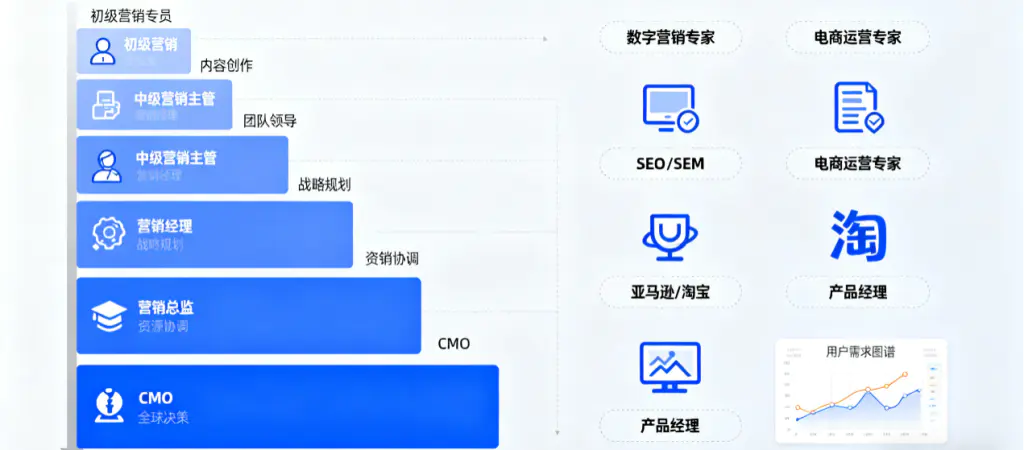
In China, marketing manager positions have clear and broad career development paths. Candidates can choose different development directions based on their interests, abilities, and career goals to achieve career promotion and personal growth.
Vertical Promotion Path
- Junior Marketing Specialist / E-Commerce Operation Specialist: This is the entry point for the marketing manager position field. Responsibilities mainly include assisting in completing specific marketing tasks (such as content creation, advertising execution, and daily e-commerce platform operations) to accumulate basic work experience and professional knowledge.
- Mid-Level Marketing Supervisor / E-Commerce Operation Supervisor: After accumulating certain experience, candidates are promoted to supervisors—leading small teams to carry out marketing work in specific fields (such as social media marketing teams or e-commerce platform operation teams) and participating in marketing strategy formulation and project management.
- Marketing Manager: Upon reaching marketing manager positions, candidates need to take full responsibility for the enterprise’s marketing work—including developing overall marketing strategies, managing marketing teams, coordinating cross-departmental cooperation, monitoring marketing performance, and controlling marketing budgets. They are accountable for the enterprise’s marketing results.
- Marketing Director: After being promoted from marketing manager positions to directors, candidates need to develop long-term marketing strategies from the enterprise’s strategic perspective—coordinating all marketing resources of the enterprise, driving brand building and market expansion, participating in major enterprise decisions, and being accountable for the enterprise’s overall market performance and brand value.
- Chief Marketing Officer (CMO): This is one of the highest positions in the marketing field. CMOs need to take full responsibility for the planning and execution of the enterprise’s marketing strategies, lead marketing innovation, drive business growth and brand globalization, report directly to the CEO, and participate in the enterprise’s strategic decision-making and development planning.
Horizontal Development Path
In addition to vertical promotion, marketing manager positions can also pursue horizontal development to expand their career fields and enhance comprehensive capabilities:
- Specialized Direction: Candidates can focus on a specific sub-field such as digital marketing, e-commerce operations, brand marketing, or cross-border marketing to become experts in that field—such as digital marketing experts, e-commerce operation experts, or cross-border marketing consultants—providing professional consulting services for enterprises.
- Cross-Department Development: Candidates can transition to related departments such as product, sales, or operation departments. For example, from marketing manager positions, they can become product managers (responsible for product market positioning and user demand analysis), sales directors (using marketing experience to drive sales growth), or operation directors (coordinating the enterprise’s overall operations).
- Entrepreneurial Direction: Talents with rich experience in marketing manager positions can also choose to start their own businesses—establishing digital marketing agencies, e-commerce operation service companies, or cross-border e-commerce enterprises—using their professional capabilities and industry resources to expand their business territory.
Industry Development Opportunities
With the continuous development of the digital economy and e-commerce, marketing manager positions have broad development opportunities in multiple industries. In addition to traditional industries such as e-commerce, FMCG, and technology, the demand for marketing manager positions has grown rapidly in emerging industries such as new energy, healthcare, education and training, and culture and entertainment in recent years. These industries have promising development prospects and can provide more career choices and development space for marketing manager positions. For example, in the new energy industry, marketing manager positions need to be responsible for the market promotion and brand building of new energy products (such as electric vehicles and solar products) to promote the popularization of new energy concepts. In the healthcare industry, marketing manager positions need to combine digital marketing methods to carry out health knowledge popularization and medical product promotion to enhance brand visibility and reputation.
How Overseas Talents Can Apply for Marketing Manager Positions in China
For overseas talents eager to join marketing manager positions in China, understanding the application process and precautions can improve their chances of success. The following are specific suggestions for overseas talents applying for marketing manager positions in China:
Finding Suitable Recruitment Channels
Overseas talents can find recruitment information for marketing manager positions in China through the following channels:
- International Recruitment Platforms: Platforms such as LinkedIn (LinkedIn China) are widely used by many Chinese enterprises (especially large enterprises and cross-border enterprises) to post recruitment information for marketing manager positions. Overseas talents can improve their LinkedIn profiles, follow the pages of target enterprises, and promptly obtain recruitment updates.
- Domestic Chinese Recruitment Platforms: Platforms such as Zhaopin, 51job, and BOSS Zhipin are major recruitment channels for Chinese enterprises. Overseas talents can register accounts, filter positions related to “Marketing Manager,” “Digital Marketing Manager,” and “E-Commerce Operation Manager,” and submit resumes. Some platforms also provide English versions for the convenience of overseas talents.
- Enterprise Official Recruitment Websites: Many well-known Chinese enterprises (such as Huawei, Alibaba, Tencent, and ByteDance) have their own official recruitment websites. Overseas talents can visit these websites directly to view recruitment requirements for marketing manager positions and submit resumes online.
- Recruitment Headhunters and Talent Agencies: Headhunting companies and talent agencies specializing in the marketing and e-commerce fields can provide more targeted recommendation services for marketing manager positions to overseas talents. Overseas talents can contact these agencies, introduce their backgrounds and career needs, and obtain exclusive job search guidance and position recommendations.
- Industry Exhibitions and Networking Events: Participating in international marketing exhibitions held in China (such as the Shanghai International Digital Marketing Exhibition and China Cross-Border E-Commerce Fair) or industry networking events allows overseas talents to communicate directly with recruitment managers of Chinese enterprises—understanding the needs for marketing manager positions, building professional connections, and laying the foundation for job applications.
Preparing Targeted Resumes and Application Materials
Resumes are an important tool for overseas talents to apply for marketing manager positions—they need to highlight experience and skills relevant to the position to demonstrate competitiveness:
- Highlight Digital Marketing and E-Commerce Experience: In resumes, detailed describe work experience in digital marketing (such as SEO/SEM, social media marketing, and content marketing) and e-commerce operations (such as platform operations, campaign planning, and data analysis)—including responsible projects, tools used, and achieved results (such as increasing sales volume by a certain percentage, growing user numbers, or improving conversion rates). For example: “Responsible for the operation of a cross-border e-commerce brand’s Amazon platform; optimized Listings and launched Sponsored Products advertising, increasing product sales by 120% and conversion rates by 35% within 6 months.”
- Emphasize International Perspective and Cross-Cultural Experience: Highlight overseas life and work experience, as well as cross-cultural communication capabilities. For example: “With 5 years of digital marketing experience in the European market; familiar with European consumers’ shopping habits and social media platforms (such as Facebook and Instagram); able to independently develop marketing strategies for the European market.”
- Demonstrate Data Analysis Skills and Tool Application: List proficiently used data analysis tools (such as Google Analytics and Tableau), marketing tools (such as Google Ads and Ahrefs), and e-commerce platforms (such as Amazon and Taobao)—and provide examples of how these tools were used to solve practical problems and improve marketing effectiveness.
- Align with Position Requirements: Carefully read the recruitment requirements for marketing manager positions and adjust resume content according to the job description to ensure that experience and skills in the resume are highly aligned with the position requirements. For example, if the position requires “familiarity with Douyin E-commerce and live-streaming operations,” and the candidate has relevant experience, this should be highlighted in the resume.
- Prepare English and Chinese Resumes: Most Chinese enterprises require overseas talents to provide Chinese resumes (especially for marketing manager positions targeting the domestic market), so a professional Chinese resume should be prepared. For positions targeting cross-border markets, English resumes may also be required—so it is recommended to prepare both English and Chinese versions of resumes.
In addition to resumes, some enterprises may require additional application materials such as cover letters, portfolios (such as marketing plans, content creation cases, and data analysis reports), and recommendation letters. Overseas talents need to carefully prepare these materials according to enterprise requirements to demonstrate their professional capabilities and enthusiasm for marketing manager positions.
Preparing for Interviews
Interviews are a critical link for overseas talents applying for marketing manager positions—sufficient preparation in advance is required to demonstrate professional competence and suitability:
- Understand the Chinese Market and Enterprise Background: Before interviews, use enterprise official websites, industry reports, and news sources to understand the latest trends in China’s digital marketing and e-commerce markets (such as the development of live-streaming e-commerce, private domain traffic operations, and cross-border e-commerce policy changes), as well as the target enterprise’s business scope, product characteristics, brand positioning, and corporate culture. For example, understand the enterprise’s main target market (domestic or cross-border), core products (FMCG or technology products), and competitor situation—so that more informed answers can be provided to enterprise-related questions during interviews.
- Prepare for Common Interview Questions: Common interview questions for marketing manager positions include: “How do you develop a digital marketing strategy?” “What was the biggest challenge you faced in e-commerce platform operations, and how did you solve it?” “How do you analyze marketing data and optimize strategies?” “How do you collaborate with cross-cultural teams?” “Why do you want to work in China, and why did you choose our company’s marketing manager position?” Overseas talents need to prepare answers to these questions in advance—combining their own experience and cases to demonstrate professional capabilities and critical thinking.
- Demonstrate Cross-Cultural Adaptability: During interviews, convey signals that you can quickly adapt to work and life in China—such as mentioning interest in Chinese culture, ongoing Chinese language learning, or having Chinese friends or partners. At the same time, you can ask interviewers about the enterprise’s support for overseas talents (such as cross-cultural training and housing assistance) to demonstrate enthusiasm and sincerity.
- Prepare for English and Chinese Interviews: Depending on position requirements, interviews may be conducted in Chinese or English. For positions mainly targeting the domestic market, interviews are usually conducted in Chinese—so overseas talents need to improve their Chinese communication skills to ensure fluent expression of ideas. For positions targeting cross-border markets, there may be English interview sessions—so preparation for English interviews is also necessary.
Understanding China’s Work Visa Policies
Overseas talents applying for marketing manager positions in China need to understand China’s work visa policies and relevant requirements to ensure legal work in China:
- Types of Work Visas: China’s work visas mainly include Z visas (for foreign nationals working in China) and R visas (for high-level foreign talents and urgently needed professionals required by the state). Overseas talents applying for marketing manager positions usually need to apply for Z visas; some high-level talents who meet the requirements can apply for R visas (which enjoy more preferential policies).
- Application Requirements: To apply for a Z visa, certain requirements must be met—such as being between 18 and 60 years old (relaxed in special cases), having professional skills and work experience matching the position, no criminal record, and good health. Enterprises need to issue invitation letters and work permits for overseas talents—who can then apply for Z visas at Chinese embassies or consulates abroad. After entering China, they need to apply for work permits and residence permits.
- Enterprise Support: Most Chinese enterprises provide support and assistance for overseas talents in work visa applications—such as helping prepare application materials and contacting relevant departments. When applying for marketing manager positions, overseas talents can inquire with enterprises about the specific work visa application process and support policies to ensure a smooth application process.
Conclusion
Marketing manager positions in China (with a focus on digital and e-commerce) are playing an increasingly important role in the current business environment. They are not only the core force driving enterprises’ digital transformation and expanding e-commerce business but also a bridge connecting the Chinese market with global talents. With the continuous development of China’s digital economy and e-commerce, the demand for marketing manager positions will continue to grow, and the desire for overseas talents with an international perspective, digital marketing capabilities, and e-commerce operation experience will become even more urgent.
For overseas talents, joining marketing manager positions in China not only provides broad career development space and competitive salaries but also allows them to integrate advanced international marketing concepts with China’s innovative practices in the rapidly developing Chinese market—enhancing professional capabilities and maximizing career value. At the same time, Chinese enterprises are constantly optimizing talent policies to provide better work and living environments for overseas talents—allowing them to work and live in China with peace of mind.
If you are an overseas talent with digital marketing and e-commerce operation experience, an international perspective, and cross-cultural communication skills, then marketing manager positions in China are an unmissable career opportunity. It is believed that in the near future, with the addition of more overseas talents, China’s marketing field will achieve more diversified and international development—and marketing manager positions will play an even more important role in promoting the globalization of Chinese enterprises and global marketing innovation.