
When someone says “China,” the Great Wall is the instant mental image for most Westerners. Makes sense. But only seeing the Wall is like flying to the US, snapping a photo of the Statue of Liberty, and heading home. The country is stupidly big. Mountains that scrape the sky. Deserts that swallow the horizon. Lakes colored like a screensaver. Ancient villages that feel like walking into a history book.
You already paid for that long-haul flight. Add a few days. Skip the third selfie stick to the head. These seven spots are where the real Chinese landscapes hit different—places where you might just forget to check your phone. No restored ramparts. No matching tour caps. Just the kind of scenery that sticks to your ribs.
Related Reading: Must Visit These Beautiful Places In China – hiredchina.com
Mogao Caves: A Thousand Years in the Dark
Out in the Gobi Desert, there’s a cliff that looks unremarkable until you get close. Punched into it are 735 caves, hand-carved and stuffed with Buddhist art from a dozen dynasties. The Mogao Caves.
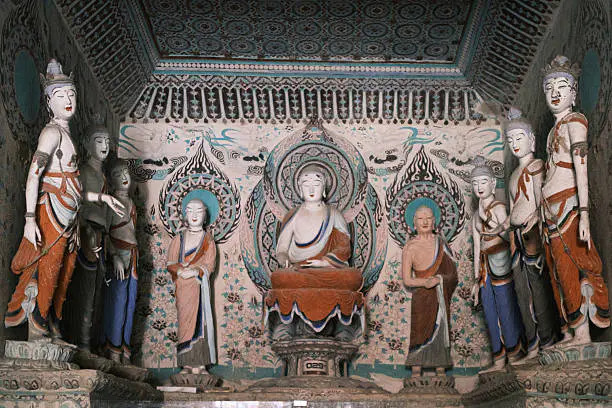
A guide walks your group inside with one small flashlight. You can’t wander off alone. The moment that beam hits a Tang Dynasty mural—gods and celestial beings still glowing after 1,300 years—you’ll probably just stand there, mouth slightly open. The colors are ridiculous. No restoration could match it.
They cap visitors at 6,000 per day. Book a week ahead online, no exceptions. Before you even step into a cave, you’ll sit through two short films at the digital center. One’s a dome projection of grottoes that are closed permanently—the air inside got too fragile for human breath. Of all the china places to visit with genuine historical chills, this one lingers. The dry earth smell, the guide’s light catching a donor portrait no wider than your palm. You’ll leave feeling small in the best way.
Cost: April to November is 238 RMB (about 33 bucks). That covers eight caves, both films, and the shuttle. Winter drops to 140 RMB, and you actually see more caves. Special caverns run 150–200 RMB extra. Worth it.
Jiuzhaigou: Lakes That Look Photoshopped
Tucked in northern Sichuan, Jiuzhaigou’s 114 alpine lakes do something weird to your eyes. You can count logs on the bottom from 20 meters up. The water isn’t just blue—it’s electric turquoise, green, teal. It’s science, not a filter: calcium carbonate and algae. If Banff or Interlaken is your baseline, reset it. Jiuzhaigou’s water is sharper.
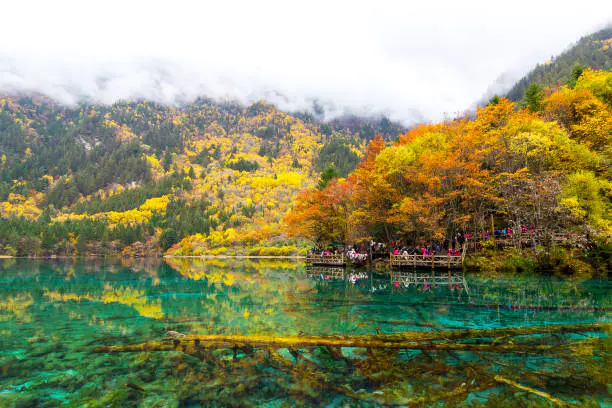
Hit this place in mid-to-late October. The hills go red and orange, and the lakes turn into perfect mirrors. Nuorilang Waterfall—270 meters wide—gets framed by yellow and crimson like nature’s own theater set. The park runs shuttle buses (included) that bounce you between viewpoints. Altitude sits between 2,000 and 4,500 meters. You’ll feel it. Walk slow and chug water.
This is some of the most vivid chinese scenery you’ll ever stand in front of. Boardwalks keep things comfy, but honestly, you’ll probably just want to lean on the railing and stare.
Cost: Peak season is 280 RMB (around 39 USD), entry plus shuttle. November to March slides to 160 RMB. They cap daily visitors at 30,000, so grab your ticket online in advance.
Qinghai: Big Sky and Salty Mirrors
Qinghai Province feels open. Like, proper big-sky open. Long roads, dry wind, mountains way off in the distance. If you’ve driven through Nevada, you know the vibe. Except here, you round a corner and get slammed with bright yellow rapeseed blooms hugging the edge of an impossible blue lake. This is where you snap chinese landscape photos that make friends back home go “wait, that’s China??”
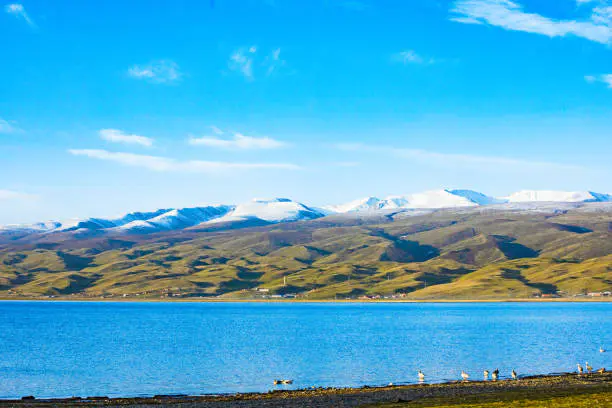
Qinghai Lake sits at 3,200 meters. July and August are the window—the flowers are out, the colors are loud. An hour and a half west, Chaka Salt Lake does a mirror trick on calm days. Shallow brine reflects the entire sky. You walk out in rented shoe covers, and the photos look like you’re standing on clouds. Farther north, the Qilian Mountains roll green in summer. Highway 315 cuts through the Gobi in that long rising curve everyone posts on Instagram.
For nice places to visit in china that don’t feel overrun, Qinghai is a winner. The altitude might give you a dull headache on day one. It passes.
Cost: The main scenic area at Qinghai Lake charges 90 RMB. Local herder-run spots cost 5–20 RMB and are just as pretty. Chaka Salt Lake is 60 RMB. Most desert stretches? Free.
Fujian Tulou: Mud Fortresses Full of Life
In the hills of Fujian, huge round buildings rise out of the rice paddies like something from a fantasy novel. The Hakka people started building these tulou centuries ago—part apartment block, part fortress. Walls 1.5 meters thick. One iron gate. Slit windows up top. From the outside, they look stern. Military.
Step inside, and the mood flips. An ancestral hall sits in the center. Smoke rises from ground-floor kitchens. Laundry hangs from wooden balconies. Chickens peck around. Chengqi Lou is the monster: 73 meters across, 402 rooms, once housed over 800 relatives under one roof. UNESCO listed the tulou in 2008, and rightly so.
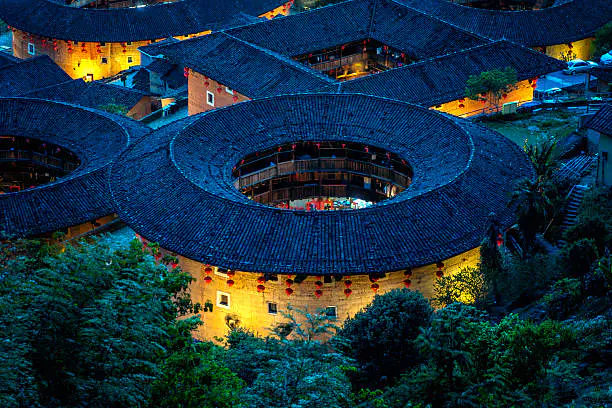
Out of all the places in china to visit, these structures feel the most human. Nobody was trying to impress an emperor. This was practical architecture for migrants who needed safety and community. A single village ticket lets you wander between several tulou. Climb the worn stairs (a resident might ask for a few yuan) and look down on the concentric rings. It’s deeply ordinary and totally alien at the same time.
Cost: One village cluster ticket runs 50–90 RMB (7–13 USD) and gives you access to multiple buildings. Pick one cluster and take your time. No rush.
Guilin and Yangshuo: The 20-Yuan View
You already know this place, even if the name doesn’t click. Those cone-shaped hills, mist snagged in the valleys, a lazy river looping through—it’s the classic chinese scenery on every scroll painting and the back of the 20 RMB note. Guilin and Yangshuo.
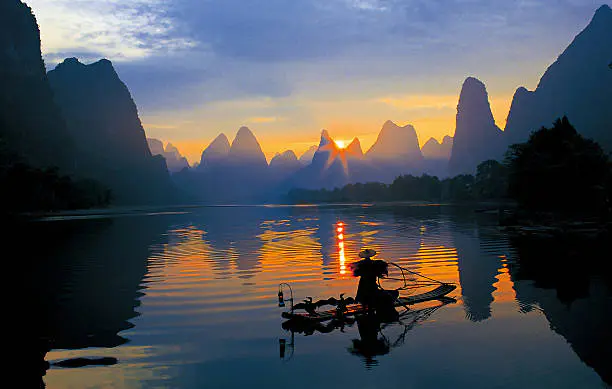
Take a Li River cruise and you’ll drift past bamboo groves, water buffalo in the shallows, fishermen on rafts that look like planks. The best stretch runs from Yangdi to Xingping. In Xingping, find the exact viewpoint from the banknote, hold up a 20-yuan bill, and snap a photo. It’s free and oddly satisfying.
Use Yangshuo town as your base. Rent a bicycle and pedal the Ten-Mile Gallery road—flat, easy, karst peaks on both sides. A couple of hours away, the Longji Rice Terraces climb slopes in thin ribbons. In May and June, the flooded paddies mirror the sky. By September, the mountain turns gold. This is among the best places to travel in china for good reason. It delivers.
Cost: A basic three-star Li River cruise is 215 RMB (around 30 USD). Four-star with lunch is 360 RMB. Bamboo rafts run 160–200 RMB per raft. The 20-yuan spot is free. Longji Terraces costs 80 RMB.
Shangri-La and Lijiang: Mountain High, History Deep
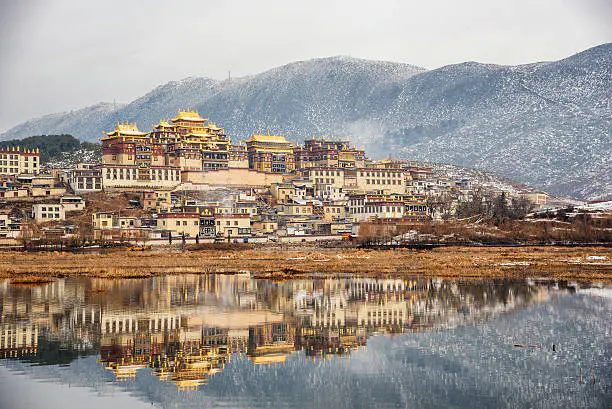
Shangri-La was a fictional valley in a 1933 novel before China slapped the name on a real town in 2001. Today, prayer flags snap above golden monastery roofs. The air smells like juniper smoke. Songzanlin Monastery—the largest Tibetan Buddhist complex in Yunnan—hums with low chanting at dawn. A short drive away, Pudacuo National Park wraps old forest and meadows around a still lake. A boardwalk loops around it. Yaks graze nearby. Snowy peaks sit on the horizon.
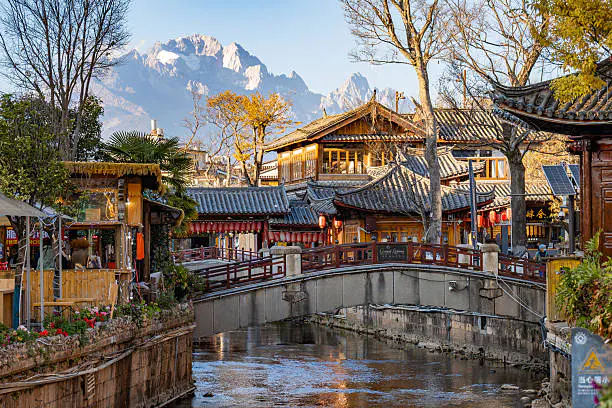
Two hours south by bullet train, Lijiang Old Town is a maze of cobblestones and willow-lined canals. The Naxi people built it. There’s no city wall, and the legend is wild: the ruling Mu family worried that adding walls would trap the Chinese character for “wood” (Mu) inside a box, sealing their doom. At night, lanterns glow and musicians play in the square.
Right outside town, Jade Dragon Snow Mountain tops 5,500 meters. A cable car hauls you to Glacier Park at 4,506 meters—glacier views without any mountaineering. Both towns show up on lists of cool places in china to visit, and the mix of Tibetan, Naxi, and Han influences here feels organic. Not a theme park.
Cost: Songzanlin Monastery (90 RMB) and Pudacuo (100 RMB) include shuttles. Lijiang Old Town charges a maintenance fee of 50 RMB, valid seven days. Jade Dragon Snow Mountain costs 240 RMB (about 34 USD) with cable car and bus.
Quick Tips Before You Go
Timing these places to visit in China can make or break your trip. Jiuzhaigou’s autumn fireworks peak mid-to-late October. Qinghai’s best window is July–August. Guilin works April–June and again September–November. Shangri-La and Lijiang shine in spring and fall—skip the rainy mess of July and August. Dunhuang is pleasant in late spring or early autumn; summers bake, winters bite. Fujian tulou are open year-round, but March–May gives you mild weather and neon-green paddies.
Getting around is less painful than you’d expect. Lijiang to Shangri-La is an hour by high-speed train. Dunhuang to Qinghai takes about five hours. Guilin to Fujian is a longer haul, but crashing overnight in Guangzhou breaks it up nicely. For current train times and entry rules, Travel China Guide has solid, updated info. Also, before you book, make sure your visa situation is sorted—China Discovery’s visa guide breaks down the latest policies without the jargon.
Here’s the cost rundown per day, including on-site transport:
| Destination | Peak Season Daily (USD) | Notes |
|---|---|---|
| Mogao Caves | ~33 (special caves extra) | Heritage heavyweight |
| Jiuzhaigou | ~39 | Shuttle included |
| Qinghai (lake + salt) | ~20–30 | Loads of free areas |
| Fujian Tulou | ~13 per cluster | Ridiculously cheap |
| Li River cruise | ~30–50 | Boat type matters |
| Shangri-La | ~27 (monastery + park) | Solid value |
| Lijiang + Snow Mtn | ~41 (town + cable car) | Cable car is the big spend |
Conclusion
Look, the Great Wall deserves the hype. But China’s Chinese landscapes go way beyond one stone ridge, and you didn’t sit on a plane for 12 hours just to see a postcard. You can stand in a cave where artists painted sixteen centuries ago. Walk around a lake that looks like a melted crayon box. Drive through high desert that feels borrowed from Mars. Sleep in a mud fortress that once held 800 relatives. Watch fog eat karst peaks that have been painted for a thousand years.
Pick two spots. Stay an extra night. Let the place slow you down. You’ll fly home with a different picture of the country in your head—and a stubborn list of spots you still need to see.