
Discover why top international talent is choosing China to accelerate their careers. Explore the opportunities, supportive policies, and dynamic innovation ecosystem that make China a leading destination for international professionals seeking rapid growth and impact.
Introduction
In today’s deeply evolving wave of globalization, the flow patterns of international talent are undergoing a profound transformation. While the traditional movement of talent from East to West, from emerging markets to developed economies, once dominated, a significant trend has emerged in recent years. A growing number of highly-skilled professionals with global perspectives are now charting the next phase of their career development in China. This is not a coincidence but a rational choice driven by China’s unprecedented opportunities, systematic talent policies, and a dynamic innovation ecosystem. For professionals seeking breakthrough growth and eager to participate in shaping the future, China has evolved from an “option” to a “strategic imperative.” This article will delve into the multifaceted reasons behind this shift, illustrating to the global elite how choosing China can inject powerful momentum into their careers.
Global Shifts and China’s Rising Opportunities
The world is undergoing changes of a scale unseen in a century. While growth in traditional economic centers moderates, Asia, and particularly China, with its robust economic resilience, vast market scale, and rapid technological innovation, has become the engine of global growth. For international talent, a golden rule of career development is to “go with the flow”—to align personal skills with the greatest developmental momentum of the era and region. China offers precisely this kind of immense momentum.

The Scale and Diversity of the Economy
First, the scale and diversity of China’s economy provide an unparalleled platform for practice. As the world’s second-largest economy, China boasts a comprehensive industrial system. From advanced manufacturing and the digital economy to green energy and biotech, every sector is undergoing deep transformation and upgrading simultaneously. This means a top AI scientist can work on next-generation humanoid robots in Shenzhen, a sustainable finance expert can explore innovative mechanisms in Shanghai’s carbon trading market, and a biomedical researcher can advance cutting-edge therapies in Suzhou’s BioBay. This breadth and depth ensure that international talent in any field can find a fast-growing track perfectly matched to their expertise.
A Crucible for Business Acumen
Second, the uniqueness and complexity of the Chinese market serve as an excellent crucible for honing business intelligence. China’s digitalization leads the world, consumer behaviors evolve rapidly, and business models iterate at an incredible pace. The successful experience gained here is often highly forward-looking and transferable. International talent who can solve complex problems and win in this challenging environment find that their “China experience” becomes an immensely valuable asset globally. Such experience is increasingly viewed by multinational corporations and global institutions as an indispensable qualification for leadership.
Systemic Policy Support: Paving the Fast Lane for International Talent
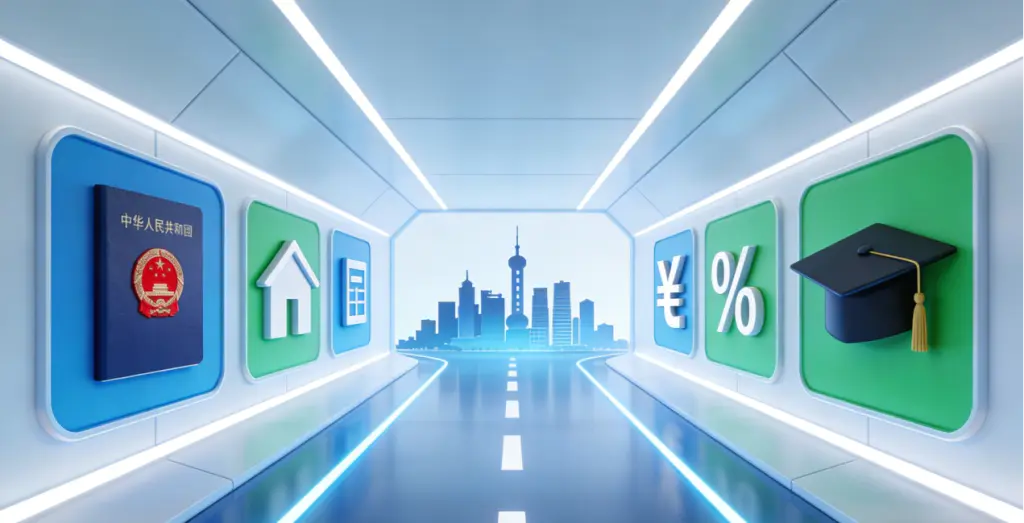
The Chinese government deeply recognizes the critical role of international talent in national innovation and has constructed an increasingly comprehensive, proactive system for attracting and serving talent. These policies are not fragmented perks but represent full-spectrum empowerment covering visas, residency, taxation, and career development.
Facilitated Entry and Residency
Regarding entry and residency facilitation, China continues to ease restrictions. The application thresholds for the “R-Visa” (Talent Visa) for high-end international talent are constantly optimized, offering longer validity and duration of stay for them and their families. Many cities have launched convenient channels for applying for permanent residence (the Chinese “Green Card”) for foreign talent, especially within platforms like Free Trade Zones and National Innovation Demonstration Zones. Leading regions like Shanghai, Beijing, and the Guangdong-Hong Kong-Macao Greater Bay Area (GBA) have formulated highly competitive talent plans, such as Shanghai’s “Returning Talent Program” and the GBA’s “Quality Migrant Admission Scheme.” These plans offer comprehensive support to recognized top international talent, including one-time subsidies, research start-up funds, housing allowances, and schooling arrangements for children.
Competitive Tax Incentives
Tax incentives are another major attraction. For instance, in the nine Pearl River Delta cities within the GBA, eligible high-end and In demand overseas talent (including from Hong Kong, Macau, and Taiwan) can receive government subsidies for the portion of their individual income tax that excesses the tax burn in Hong Kong and Macau. This significantly lowers the actual tax burn, making it comparable to other major international talent hubs and directly increasing the disposable income and quality of life for international talent.
Building an International Living & Working Environment
More importantly, China is committed to building an international living and working environment for international talent. From international communities and hospitals in major cities to the growing number of bilingual or international schools offering high-quality curricula, daily living concerns are being rapidly addressed. Many high-tech parks and development zones are equipped with full-English administrative service counters to help international talent handle affairs efficiently.
The Innovation Ecosystem: A Career Accelerator

For international talent pursuing top-tier professional achievement, China’s core attraction lies in its thriving innovation ecosystem. It is not just a playground for technology application but a breeding ground and testing lab for cutting-edge technologies.
China’s R&D intensity is now among the highest globally, with enterprises being the dominant force in R&D investment. Tech giants like Huawei, Tencent, Alibaba, ByteDance, and BYD, along with countless “unicorns” in fields like AI, new energy, and life sciences, have created a rare global innovation network. Joining these companies or collaborating with them means accessing massive real-world data, participating in projects with hundreds of millions of users, and translating ideas into products at an unprecedented pace. The sense of professional achievement and skill enhancement derived from this scale and speed is hard to match in many other markets.
Furthermore, China’s national strategies signpost areas ripe with opportunity for international talent. Major initiatives like “Made in China 2025,” the “Dual Carbon” goals (carbon peak and neutrality), “Digital China” construction, new infrastructure, and rural revitalization have spawned enormous demand for advanced technology and management expertise. In fields like green tech, smart manufacturing, the digital economy, modern agriculture, and healthcare, international talent with relevant knowledge and experience are highly sought after by governments, enterprises, and investors. They often secure leadership opportunities to helm key projects and build multinational teams.
Career development paths are also more diverse and rapid. In China, flat management structures are common in tech companies, allowing young, capable, and high-achieving talent to rise quickly. Simultaneously, international talent, leveraging their unique cross-cultural background and global perspective, often become critical nodes connecting the Chinese market with global operations. This bridging role holds significant strategic value and can accelerate their promotion to core management.
Cultural Integration & Personal Growth: Rewards Beyond Career

Choosing to develop in China offers rewards that extend far beyond career advancement. For international talent, immersion in the profound and ancient civilization of Chinese culture is a journey of deep personal growth and expanded horizons.
The rapid, daily changes in Chinese society foster exceptional adaptability, learning resilience, and composure in the face of uncertainty. This mindset of “embracing change” is one of the most crucial soft skills for the future world. Meanwhile, the network built in China—including local elites, fellow expatriates, and global partners connected through the Chinese market—becomes a lifelong, invaluable asset.
While language and cultural differences present challenges, the very process of navigating them significantly enhances one’s cross-cultural communication skills, empathy, and global leadership capabilities. Leaders who can successfully switch between Eastern and Western mindsets and integrate the best of both are precisely the kind of talent most needed on the future global stage.
A Forward-Looking Perspective
Looking ahead, China’s development themes will closely revolve around high-quality development, technological self-reliance, and common prosperity. This implies that the demand for technologies and knowledge that enhance productivity, promote social equity, and drive sustainable development will become even more urgent. In frontier interdisciplinary fields such as clean energy, the circular economy, advanced semiconductors, AI ethics and governance, inclusive finance, and smart elderly care, China will open new frontiers. International talent who move early will have the opportunity to become rule-makers and industry pioneers in these future-defining areas.
Seizing the Opportunity: Actionable Advice for International Talent
For international talent considering a move to China, the following steps are recommended:
Precise Positioning: Conduct in-depth research on Chinese national strategies and key industries that align with your expertise. Target high-growth sectors and regions (e.g., Yangtze River Delta, Greater Bay Area, Chengdu-Chongqing Economic Circle).
Proactive Integration: Beyond professional skills, invest time in learning basic Chinese and understanding Chinese culture and business etiquette. This will be key to building deep trust.
Utilize Official Platforms: Actively engage with official foreign talent service platforms, talent recruitment programs in various innovation parks, and international headhunting firms.
Embrace the Ecosystem: Don’t limit yourself to a single employer. Participate actively in industry conferences, innovation forums, and integrate into China’s professional community networks.
Long-Term Planning: View your China chapter as part of a long-term career strategy. Define the core competencies and experience you aim to gain here, while maintaining connections with your global network.
Conclusion
In summary, China offers international talent a comprehensive development platform of grand scale, dynamic evolution, and an increasingly robust support system. It provides not only a stage to address current challenges but also the opportunity to participate in shaping the future. Choosing China means choosing to deeply intertwine one’s personal career trajectory with the world’s most dynamic engine of economic growth and hotspot of innovation. For top global elites dissatisfied with the status quo and eager to make their mark on the tide of the times, China has become more than just a career destination; it is an accelerator for exponential growth and a quantum leap in one’s professional journey. Now is a historic moment for global international talent to reassess the opportunities in China and make a pivotal decision. Seizing this opportunity may well be the most visionary and valuable decision of your career.