
Discover how to find and secure top aerospace jobs in China as a foreign engineer. This complete guide covers high-demand positions, visa strategies, salary insights, and cultural adaptation tips for launching your career in China’s booming aviation and space industry.
Introduction: Why Global Engineers Are Turning Their Eyes to Aerospace Jobs in China
Over the past decade, China has emerged as a major force in the global aerospace industry. With the commercial success of the C919 narrow-body airliner, the batch delivery of ARJ21 regional jets, and the completion of its space station construction, China’s aerospace market is expanding at an unprecedented pace. For foreign engineers seeking international career development, this Eastern land holds a wealth of top-tier aerospace job opportunities.
Compared to mature markets in Europe and the US, aerospace jobs in China not only offer competitive compensation packages but also promise involvement in cutting-edge R&D projects. From commercial aircraft manufacturing to satellite navigation system development, from drone technology to deep-space exploration, various pioneering projects are actively recruiting professionals with an international perspective. However, due to the industry’s specific nature, cultural differences, and complex visa policies, successfully landing an ideal aerospace job requires systematic preparation and deep localization strategies.
This guide will provide foreign engineers with an end-to-end job search roadmap, offering an in-depth analysis of talent demand, the legal framework, and the workplace ecosystem within China’s aerospace industry to ensure you stand out in a competitive field.

The Current State and Talent Demand Analysis of China’s Aerospace Industry
The Massive Talent Gap Behind the Industry’s Soaring Growth
China’s aerospace industry is at a critical juncture, transitioning from “following” to “keeping pace” and even “leading.” According to data from the Ministry of Industry and Information Technology, the industry is expected to face a shortage of over 200,000 professionals in the next five years, with high-end R&D positions and international project management roles being particularly hard to fill. This creates a historic opportunity for foreign engineers seeking aerospace jobs.
Currently, COMAC’s C919 program has entered mass production, and the CR929 wide-body airliner development is steadily progressing. Meanwhile, the China Aerospace Science and Technology Corporation (CASC) and the China Aerospace Science and Industry Corporation (CASIC) are making massive investments in commercial spaceflight and satellite internet (e.g., the “Starlink” project). The advancement of these mega-projects has spurred an urgent demand for engineers with international certifications (such as FAA and EASA qualifications).
The Core Value Proposition for Foreign Engineers
In numerous aerospace job postings, the unique value of foreign engineers is reflected in three dimensions:
First, Technical Standards Alignment Capability.
China’s aviation manufacturing sector is accelerating its efforts to obtain international airworthiness certifications, creating a critical need for experts familiar with FAA Part 25 and EASA CS-25 regulations to guide the certification process. Foreign engineers possessing these qualifications become the bridge connecting Chinese standards with international ones.
Second, Multinational Supply Chain Management Experience.
With the establishment of the C919’s global supply chain system, foreign engineers proficient in international aerospace supply chain management, fluent in English, and possessing cross-cultural communication skills are in high demand for aerospace jobs in project management and supplier quality engineering.
Third, Cutting-Edge R&D Experience.
In fields considered “chokepoints” such as aircraft engines, flight control systems, and composite materials, the technical expertise of foreign engineers with experience at top-tier Western aerospace companies (like Boeing, Airbus, Rolls-Royce, GE) holds immense reference value for Chinese R&D teams.
Types of Aerospace Jobs in China and Analysis of Popular Positions
Commercial Aircraft Manufacturing
COMAC and its supplier network currently offer the most aerospace job opportunities. Typical positions include:
Airworthiness Certification Engineer:
Responsible for coordinating Type Certificate (TC) and Production Certificate (PC) applications, requiring a deep understanding of CAAC regulations and international aviation laws. These aerospace jobs typically demand 5+ years of certification experience and familiarity with certification basis development and compliance verification methods.
Structural Design & Analysis Engineer:
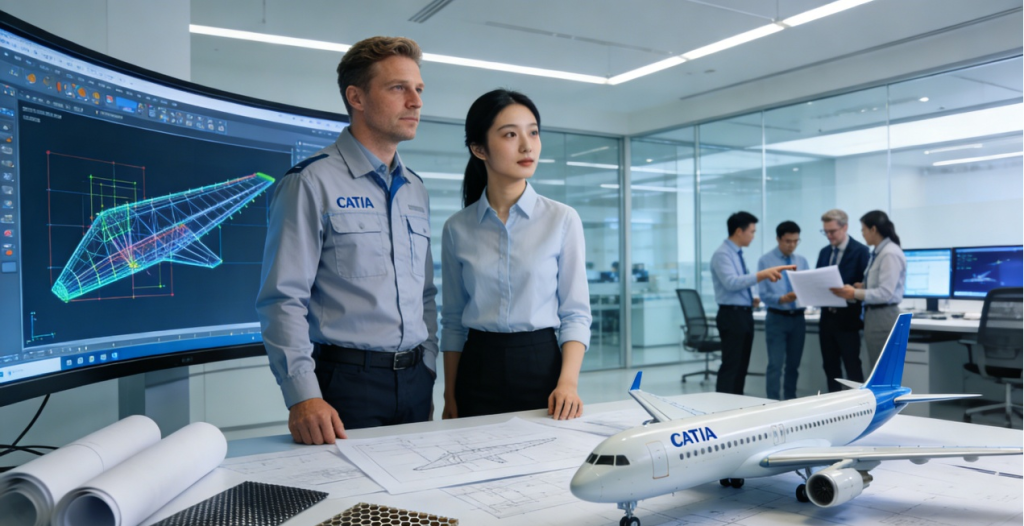
Involved in the detailed design of airframe, wings, and other structural components, conducting strength analysis using software like CATIA and ABAQUS. For foreign engineers, experience in composite structure design (especially CFRP applications) provides a significant competitive edge for these aerospace jobs.
Systems Engineering & Integration Engineer:
Responsible for the architecture design and interface management of various aircraft systems (avionics, flight controls, hydraulics, environmental control). These aerospace jobs emphasize a holistic view and interface control capability, often requiring familiarity with standards like ARP 4754A and DO-178C.
Space Technology & Defense
While some defense projects have restrictions for foreigners, aerospace jobs in commercial spaceflight and satellite applications are open to international talent:
Satellite Payload Engineer:
Involved in the design and testing of payloads for communication and remote sensing satellites. With the rise of LEO constellations (e.g., Galaxy Space, Chang Guang Satellite), foreign engineers with small satellite design experience are in high demand for these aerospace jobs.
Rocket Propulsion System Engineer:
Private space companies (e.g., LandSpace, i-Space, Galactic Energy) are fiercely competing in commercial launch vehicles, creating urgent need for liquid engine R&D talent. Foreign engineers with backgrounds at companies like SpaceX or Blue Origin have strong bargaining power for these aerospace jobs.
Flight Control Algorithm Engineer:
Responsible for rocket attitude control and guidance algorithm development, requiring proficiency in Matlab/Simulink, C++, and real-time embedded systems. These aerospace jobs usually require a Ph.D. or extensive practical experience in flight controls.
Aviation Maintenance & MRO
With China’s fleet size surpassing 4,000 aircraft, the Aviation Maintenance, Repair, and Overhaul (MRO) market is experiencing explosive growth, offering numerous technically intensive aerospace jobs for foreign engineers:
Line Maintenance Engineer:
Engineers holding a CAAC-66 license or FAA A&P certificate can find these aerospace jobs at major airlines (Air China, China Eastern, China Southern) and MRO companies (e.g., Ameco, STARCO).
Engine Overhaul Engineer:
Positions involving in-depth maintenance of popular engines like the CFM56 and LEAP-1C, requiring familiarity with borescope inspection, module replacement, etc. These aerospace jobs have high technical barriers and offer excellent compensation.
Targeting Top Employers – A Panoramic View of China’s Aerospace Enterprises
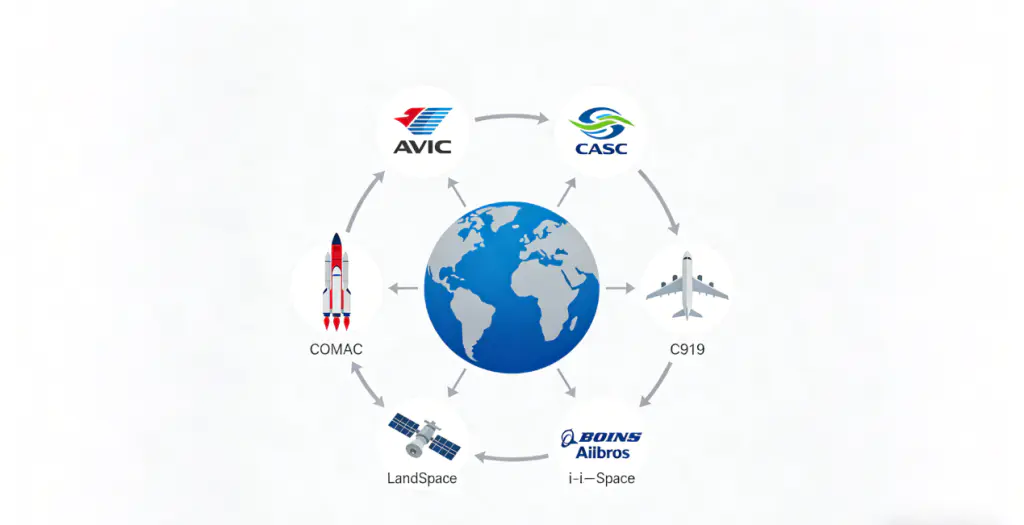
National Champions: Aviation Industry Corporation of China (AVIC) & China Aerospace Science and Technology Corporation (CASC)
Aviation Industry Corporation of China (AVIC):
As a Fortune 500 company, AVIC has over 200 member units like FEIYO, XAC, CAC, and SAC, offering aerospace jobs across the entire chain from complete aircraft manufacturing to components. Foreign talent is often concentrated in the civil aircraft sector (e.g., AVIC’s Civil Aircraft Engineering Center) and international cooperation departments.
China Aerospace Science and Technology Corporation (CASC):
Responsible for national key projects like the Long March rockets, Shenzhou spacecraft, and the space station, while also conducting commercial space business through listed companies like China Satellite and China Rocket. Foreign engineers can seek non-confidential aerospace job opportunities within its commercial space subsidiaries.
Pioneer in Civil Aviation Manufacturing: COMAC
As the manufacturer of the C919 and ARJ21, COMAC and its design and R&D center (Shanghai Aircraft Design and Research Institute) are among the enterprises with the highest concentration of foreign engineers. The company has a specialized “Overseas High-Level Talent Recruitment Program,” offering customized aerospace job positions for experts in aeromechanics, flight control, avionics, etc.
New Forces in Private Spaceflight
In recent years, Chinese private space companies have become a major channel for absorbing international talent:
LandSpace: Focuses on liquid oxygen/methane rocket R&D; its “Tianque” engine’s thrust ranks among the world’s best.
i-Space: The first Chinese private company to achieve orbit; developing reusable launch vehicles.
Geely’s Geespace: Leveraging Geely Group resources to build an LEO satellite communication network.
The atmosphere of aerospace jobs at these companies is closer to Silicon Valley startups, with English-friendly work environments and flexible equity incentive mechanisms, suitable for foreign engineers pursuing innovation speed.
R&D Centers of Multinational Corporations in China
Multinational institutions like the Boeing China R&D Center, Airbus China Innovation Centre (ACIC), and Safran China Research Institute provide transitional aerospace job options for foreign engineers who prefer not to completely leave the international corporate system. These roles usually require bilingual proficiency (English/Chinese) and act as a technical bridge between headquarters and the Chinese supply chain.
Practical Job Search Strategies for Foreign Engineers
Qualification Certification & Localization Conversion
To secure an aerospace job in China, foreign engineers must prioritize qualification conversion:
Airworthiness Qualification Reciprocity:
Although China has signed bilateral airworthiness agreements with some countries, FAA or EASA licenses are not directly valid for practice in China. It is advisable to take the CAAC license conversion exams or obtain the Chinese Civil Aviation Aircraft Maintenance Personnel License (CCAR-66), which significantly improves chances of getting an aerospace job.
Academic Credential Verification:
The Certification of Foreign Academic Degrees from the Chinese Service Center for Scholarly Exchange is a mandatory document for job applications. Top-tier companies often require this for aerospace job recruitment.
Resume Optimization & Job Search Channels
Keyword Optimization:
On platforms like LinkedIn and Liepin International, ensure your profile includes keywords like “aerospace jobs,” “aviation engineer,” “airworthiness certification,” and highlights any connection to Chinese projects (e.g., past collaboration with Chinese suppliers).
Collaboration with High-End Recruiters:
For senior-level aerospace jobs, it’s recommended to connect with international recruiting firms like Michael Page, Hays, and Robert Walters, which often manage international recruitment projects for SOEs like AVIC and COMAC.
Academic Network Penetration:
Attend industry events like Airshow China (Zhuhai) and academic conferences of the Chinese Society of Aeronautics and Astronautics to network directly with hiring managers. Many sensitive aerospace job opportunities are not publicly advertised but filled through internal academic referrals.
Key Interview Preparation Points
Interviews for aerospace jobs at Chinese companies typically include a technical interview, English oral test, and HR comprehensive assessment:
Technical Interview:
Focuses on problem-solving abilities for practical engineering issues, e.g., “How to reduce porosity in composite laminates?” or “Principles of flight control system redundancy design.” Prepare to emphasize quantifiable achievements from past projects, like “reduced component weight by 15% through process optimization.”
Cultural Fit Assessment:
Interviewers at SOEs often assess a candidate’s willingness for teamwork and long-term stability. Expressing genuine interest in long-term development in China and understanding core Chinese manufacturing values like “craftsman spirit” can earn you bonus points in aerospace job interviews.
Visas, Work Permits, and Legal Compliance
Types of Work Visas Explained
After receiving an aerospace job offer, foreign engineers need to apply for a Z Visa (Work Visa). The process involves three key agencies: the State Administration of Foreign Experts Affairs (now under MOST), the Exit-Entry Administration, and the employing unit.
R Visa (Talent Visa):
For high-end talents, such as foreign engineers with Ph.D.s in aerospace or former technical executives from Fortune 500 companies, a 5-10 year multiple-entry visa with fast-track service is available. This visa is particularly advantageous for candidates applying for top-tier aerospace jobs.
Work Permit Points-Based System
China implements a points-based system for foreign work permits, categorized as A (High-End Talent), B (Professional Talent), and C (Ordinary Personnel). Aerospace jobs typically fall under B or A class. Scoring is based on:
- Salary Level: High scores for salaries over 6 times the local average.
- Educational Background: Master’s degree or above, especially in STEM fields.
- Work Experience: Points for every two years of relevant experience.
- Chinese Language Proficiency: HSK certificates can add points. While not mandatory, basic Chinese aids team integration for aerospace jobs.
Non-Disclosure Agreements & Compliance Risks
The aerospace industry involves national security. Foreign engineers must sign strict Non-Disclosure Agreements (NDAs) upon employment. Some aerospace jobs related to defense projects are restricted to Chinese citizens. Foreign engineers should proactively confirm if a position is open to foreigners to avoid legal risk.
Furthermore, Intellectual Property clauses are crucial. When applying for aerospace jobs, clarify ownership boundaries for past patents and work-related inventions. Consulting a specialized immigration lawyer to review contracts is advisable.
In-Depth Analysis of Compensation, Benefits, and Quality of Life
Salary Structure & Negotiation Strategy
Compensation for aerospace jobs in first-tier Chinese cities (Shanghai, Beijing, Xi’an, Chengdu) is highly competitive:
Senior Engineer (8-15 years experience): Total annual compensation typically ranges from 400,000 to 800,000 RMB (~$55k – $110k USD), including base salary, project bonuses, and various allowances.
Technical Director/Chief Engineer: Annual compensation can reach 1 to 2 million RMB, with some private companies offering equity incentives.
Foreign engineers should note the concept of a “compensation package” during negotiations. Beyond base salary, strive for benefits like:
- Housing allowance (typically 30%-50% of monthly salary)
- International school tuition subsidy for children (100k-200k RMB/year)
- Two round-trip tickets home per year
- Individual income tax subsidies (some areas like Shanghai FTZ and GBA have preferential tax policies for foreign talent)
Work Intensity & Life Balance
Work intensity at Chinese aerospace companies, especially in project teams during critical development phases, may be higher than at Western counterparts. While “996” (9 am-9 pm, 6 days/week) is not common in aerospace, overtime culture before project milestones does exist. Foreign engineers seeking aerospace jobs should clarify working hours and compensatory time-off policies during interviews.
Living Support for Expats
Major aerospace hubs have international schools (e.g., Shanghai American School, Beijing International School), international medical centers, and expat communities. Areas like Zhangjiang Hi-Tech Park in Pudong, Shanghai (where COMAC is based), and Xi’an High-Tech Zone (where AVIC units cluster) are well-equipped with expat facilities.
Regarding language support, while technical documentation for aerospace jobs is mostly in English, basic Chinese proficiency (HSK Level 3-4) greatly facilitates daily life and cross-departmental collaboration.
Cross-Cultural Adaptation & Advanced Career Development
Decoding Chinese Workplace Culture
Working in aerospace jobs in China requires understanding hierarchy and the concept of “face”:
Decision-Making Process:
Compared to flat Western management, decision chains in Chinese aerospace firms are longer; major technical solutions require multiple layers of approval. Foreign engineers need patience and should learn to conduct informal “pre-meetings” to facilitate decisions.
Communication Style:
Indirect communication is common. Being told “this proposal might need further study” often indicates substantive concerns. In aerospace jobs, one must keenly discern such委婉 (euphemistic) expressions.
Relationship Building (Guanxi):
Technical and business relationships are closely intertwined. Participating in team-building activities (like group meals, KTV) is essential for building trust and integrating into aerospace job teams.
Technical Skill Enhancement Paths
China’s aerospace industry has unique technical pathways:
Airworthiness Certification Capability:
Gaining experience in CAAC’s certification process and accumulating type certification knowledge based on Chinese regulations is a core competency for foreign engineers to build irreplaceability in Chinese aerospace jobs.
Localized Supply Chain Knowledge:
Deeply understanding the Chinese aerospace supply chain system and mastering the technical characteristics and quality levels of local suppliers is highly valuable knowledge for foreign engineers stationed from headquarters.
Long-Term Career Planning
For foreign engineers planning long-term development in China, consider these paths:
Technical Expert Route:
Aim for government talent programs like the “Recruitment Program of Foreign Experts,” gaining research funding support and tax benefits, transitioning to roles like Chief Scientist or Technical Consultant.
Management Route:
Progress from Senior Engineer to Project Manager, Department Director, and eventually into corporate management. Note that management-track aerospace jobs usually require higher Chinese proficiency and deep understanding of the Chinese business environment.
Entrepreneurship Route:
The openness of China’s commercial space sector provides fertile ground for tech entrepreneurship. Some foreign engineers choose to co-found aerospace component design consultancies or MRO enterprises with Chinese partners.
Success Case Studies & Common Pitfalls to Avoid
Typical Success Profiles
Case A:
A former Airbus A350 structural engineer joined COMAC in 2018, leading the C919 composite wing-body fairing optimization project. By integrating European design concepts with local processes, a successful 8% weight reduction was achieved. He now serves as a Deputy Chief Project Engineer. His key to success was localizing international experience, not simply copying European models.
Case B:
An American flight control engineer joined a private Chinese space company responsible for guidance algorithm development for reusable rockets. Leveraging agile development experience from a US small-satellite company, he helped the Chinese team shorten the R&D cycle by 30% and received equity rewards.
Common Job Search Pitfalls
Pitfall 1: Fake Job Listings.
Some agencies charge high fees for so-called “high-end aerospace jobs” but provide positions that don’t match the description. Apply directly through company websites or reputable recruiters.
Pitfall 2: Unfulfilled Salary Promises.
Verbally promised housing allowances or bonuses might not be in the contract. Before accepting an aerospace job offer, ensure all benefit terms are legally binding.
Pitfall 3: Underestimating Culture Shock.
Some candidates focus only on technical fit, overlooking cultural adaptation difficulty. Consider an on-site visit or short-term trial before formally accepting an aerospace job.
Future Trends & Industry Outlook
Green Aviation & Electric Flight
China is actively developing Electric Vertical Take-Off and Landing (eVTOL) aircraft and Sustainable Aviation Fuel (SAF). Companies like EHang and AutoFlight are leading in Urban Air Mobility (UAM), opening new aerospace job avenues for foreign engineers with experience in electric propulsion systems or battery management.
Deepening International Cooperation
With the advancement of the CR929 wide-body airliner project, the Sino-Russian joint development team requires many multilingual talents proficient in English and technology (or Russian). Such aerospace jobs offer foreign engineers the chance to play key roles in Sino-Russian technical collaboration.
Digital Transformation Opportunities
The application of digital twins and AI in aviation manufacturing is accelerating. Foreign engineers with interdisciplinary backgrounds in AI algorithms and aerospace engineering will have a first-mover advantage in emerging aerospace job areas like smart manufacturing and predictive maintenance.
Conclusion: Begin Your Aerospace Career Journey in China
China’s aerospace job market is in a golden era, welcoming foreign engineers with technical excellence and strong cultural adaptability. From the roar of commercial aircraft to deep-space exploration, from traditional manufacturing to commercial space innovation, it holds limitless potential to transform your career.
Successfully landing your ideal aerospace job requires strategic preparation: precisely positioning your strengths (international airworthiness experience, cross-cultural technology transfer ability), systematically converting qualifications, deeply understanding Chinese workplace culture, and choosing employer types that align with your career goals (SOE stability, private firm flexibility, or MNC transition).
More importantly, maintain an open, learning mindset. Pursuing aerospace jobs in China is not just a career choice but a historic opportunity to participate deeply in reshaping the global aerospace industry landscape. As the C919 soars in skies worldwide and the Chinese Space Station welcomes more international astronauts, you will be not just a witness, but a creator.
Start preparing your application materials now, update your LinkedIn profile, attend the next Airshow China, and connect with Chinese recruiters. Your aerospace job opportunity in the East awaits.
Action Checklist:
Complete CAAC license conversion or HSK Chinese proficiency test.
Optimize your resume with relevant Chinese keywords (C919, ARJ21, airworthiness certification).
Contact 3-5 target companies or recruitment agencies.
Develop a 6-12 month job search timeline and a Plan B.
The future of China’s aviation industry needs global wisdom, and your future might just be in its sky full of opportunities.