
For decades, the Chinese dream was synonymous with the gleaming skyscrapers of Beijing, Shanghai, and Shenzhen. Millions of young graduates pour into these megacities every year, chasing higher salaries, better opportunities, and the prestige of “making it” in a tier-1 city. But that script is being rewritten. In 2026, a striking reversal is underway: young professionals, college graduates, and even overseas returnees are packing their bags and heading back to county-level cities and small towns — a phenomenon that economists and policymakers now call the “return migration economy,” or guiyan jingji in Chinese.

The numbers tell a compelling story. According to official statistics, by early 2025, over 12 million people had returned to rural and county areas across China to launch ventures. Beijing alone saw its resident population aged 20–34 shrink by 1.21 million over just four years — a decline of more than 20 percent across every age bracket within that demographic. Meanwhile, small cities are gaining ground: a single county like Xinyi in Guangdong province has added approximately 43,000 returning residents in recent years, while the city of Xinyang in Henan has attracted over 117,000 returning talent through its “Wild Geese Return” policy initiative.
What’s driving this massive reorientation of talent flows? Why are young Chinese — including those with overseas degrees — choosing county seats over cosmopolitan capitals? This article unpacks the push forces from tier-1 cities, the pull factors of county economies, and the deeper structural shifts that are redrawing China’s talent map.
Part 1: The Push — Why Young Chinese Are Done with Megacities
Crushing Costs and the Collapse of the Housing Myth
For a generation, the logic of staying in Beijing or Shanghai was simple: the high cost of living was offset by rapid wage growth and, most importantly, soaring property values. But that calculus has collapsed. Since 2021, housing prices in Beijing and Shanghai have fallen sharply, erasing years of paper wealth and shattering the belief that real estate would “always go up.” Some buyers now face losses equivalent to several years of income plus their parents‘ entire savings.
Even without homeownership, the day-to-day cost burden is staggering. A premium one-bedroom apartment in central Beijing or Shanghai can easily run $2,500 to $3,000 USD per month. In Shanghai, a single room in a shared apartment in a central district starts at around 5,000 RMB per month, with sought-after locations pushing closer to 7,000 RMB. When housing consumes well over half of a young professional’s take-home pay, the math simply stops working. As one study noted, young Chinese are increasingly adopting a “geographic arbitrage” strategy — earning in high-cost areas but shifting their consumption to low-cost regions.
The Brutal Math of 12.7 Million Graduates
If high costs are the economic push, hyper-competition is the psychological one. In 2026, China will see 12.7 million new college graduates enter the job market — the largest cohort in history. With the economy cooling and white-collar job creation slowing, the supply-demand gap has become punishing. The youth unemployment rate for 16- to 24-year-olds recently surged to 16.5 percent, reflecting how fiercely young people must compete for even entry-level positions.
Meanwhile, the “996” culture — working 9 a.m. to 9 p.m., six days a week — remains entrenched in many urban industries. A 28-year-old former finance worker in Shanghai who recently relocated to a small coastal town captured the sentiment for many: “I never believed that work is the meaning of life. My ideal state of life is not to work and stay at places that I like.” For a generation raised on stories of economic miracles, the grind is increasingly failing to justify the sacrifice.
Part 2: The Pull — Why County Towns Are Suddenly “Winning”
Industry Isn’t Just in Cities Anymore
Perhaps the most important — and least understood — shift is that high-value industries are no longer the exclusive domain of tier-1 cities. County economies across China are undergoing a quiet industrial transformation, fueled by the national push for “new quality productive forces” — a policy priority that emphasizes innovation, digitalization, and green technology.
Take Gui‘an in Guizhou province as an example. Once a sleepy district, it now hosts 27 major data centers, including facilities for Tencent and Apple, alongside China’s three national telecom carriers. Public records show the district added 22,300 new permanent residents in 2025 alone. Similarly, Shexian County in Anhui has attracted AI-related businesses, with data annotation firms employing workers whose average age is just 24 — and many of them work remotely from home.

This industrial diffusion means that a young engineer or product manager no longer needs to live in Shenzhen or Hangzhou to work in tech. The jobs are increasingly coming to them.
Policy “Red Envelopes”: Real Money for Returning Home
Local governments, acutely aware of the talent vacuum created by decades of out-migration, are rolling out aggressive incentive packages to woo their prodigal sons and daughters home.
In Xinyang, Henan, the “Wild Geese Return” initiative offers a comprehensive suite of benefits: housing subsidies, guaranteed school enrollment for children, and up to 300,000 RMB in government-backed loans for individual entrepreneurs, with interest fully subsidized. Since the program’s launch, 11.7 million people have returned to Xinyang, including 16,000 who have launched their own businesses, creating over 48,000 local jobs.
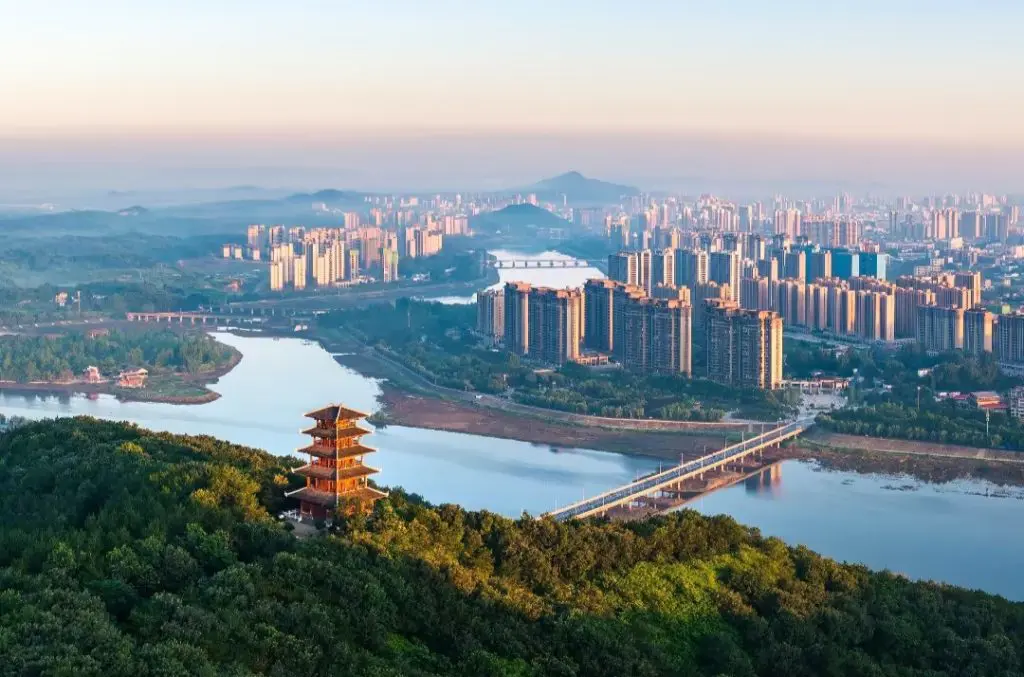
In Tianmen, Hubei, the story is even more dramatic. Since the start of 2025, the city’s “Return to Hometown” campaign has attracted 128 high-quality projects with total investment exceeding 50 billion RMB. The city compiled a database of over 12,000 local talents working abroad or in major cities — including 500 overseas high-level professionals — and methodically courted them back. One returnee, Li Bin, had spent a decade in Guangzhou’s e-commerce sector before moving his apparel business to Tianmen.
His verdict: “In Guangzhou, getting a clothing sample made took three days. In Tianmen, it’s done the same day. Orders placed online ship nationwide by the next morning.” Tianmen offered him five years of rent-free factory space and a complete supply chain ecosystem, from fabric sourcing to live-streaming sales.
The Quality-of-Life Equation
Beyond jobs and subsidies, there is a simpler, more visceral draw: a life that actually feels livable. In a county town, the average commute might be 10 minutes by scooter instead of an hour on a packed subway. Rents are a fraction of those in Shanghai — in some cases, 200 to 250 percent cheaper for comparable square footage. Parks are less crowded, air is cleaner, and the pace of life leaves room for hobbies, family, and rest.
This is not just about saving money. It’s about reclaiming time and agency. A recent report from a Chinese think tank observed that young people are increasingly “pursuing a rational quality of life” rather than blindly chasing urban prestige. The “lying flat” phenomenon — a deliberate rejection of relentless careerism — has found its natural habitat in China’s small cities, where a modest income buys a genuinely comfortable existence.
Part 3: Real Stories — Four Faces of the Return Migration Wave
Behind the macro data are real people making deliberate, often brave choices. Here are four stories that illustrate the diversity of China‘s returning talent.
Xiao Xiongfue, Xinyi, Guangdong. Xiao and his brother left manufacturing jobs in the Pearl River Delta to return to their hometown of Ma’an Village in Xinyi County. They opened a small bed-and-breakfast and café, tapping into the growing rural tourism market. The bet paid off: their business now generates over 600,000 RMB in annual revenue, and during peak travel seasons, the rooms are fully booked. Across Ma‘an Village, more than 200 young people have returned in recent years, bringing new energy — and new economic models — to a once-depopulating countryside.
Zhou Zhen, Xinyang, Henan. Zhou earned his bachelor’s and master‘s degrees in the United Kingdom and built a successful business abroad. But when his hometown of Huangchuan County launched its “Wild Geese Return” initiative, he felt the pull. He returned to establish the Dabie Mountain Youth Entrepreneurship Park, a 46,000-square-meter complex dedicated to rural e-commerce.

To date, the park has trained over 2,100 people in e-commerce skills, incubated 100 online brands, and cultivated 1,000 livestream hosts. Cumulative sales have surpassed 70 million RMB, and more than 800 local jobs have been created. Zhou’s story is a powerful counterpoint to the narrative that overseas returnees belong only in Shanghai or Shenzhen.
Wu Xiansheng, Lanshan, Hunan. Wu spent years as a factory worker in Guangdong before returning to Lanshan County to start a wooden products workshop. Today, his small factory employs over 30 villagers, and annual per capita income for those workers has risen by about 40,000 RMB. In 2025 alone, Lanshan County added 1,440 new returning-entrepreneur businesses, collectively creating over 3,000 local jobs. Wu‘s story — one person returning and lifting a whole village — has become a replicable model across central and western China.
Huang Yuqi, Tianmen, Hubei. After earning her PhD in France, Huang had job offers in Wuhan, the provincial capital. She chose Tianmen — her hometown — instead. The decision wasn’t without friction: navigating household registration, social security, and project applications required visits to multiple government departments. Then she discovered “Tiancai Ma,” a WeChat mini-program that consolidates all talent services — degree allowances, housing subsidies, startup loans — into a single digital portal. “Everything can be submitted online with one click,” she says.
The platform even offers perks like free access to gyms and tourist sites for registered talent. For Huang, the combination of family proximity, lower living costs, and streamlined government support made Tianmen the smarter choice.
Part 4: Overseas Returnees Are Also “Going Downward”
The return migration wave isn‘t limited to domestic graduates. Chinese students who studied abroad are increasingly part of this trend.
In 2025, a record 535,600 Chinese students returned from overseas studies, up by 40,600 from the previous year and by 120,000 from 2023. More striking is where they are choosing to work. According to Zhaopin’s 2025 Returnee Employment Report, job applications from overseas graduates to third- and fourth-tier cities grew at a rate far exceeding those to Beijing, Shanghai, or Shenzhen — with applications to fifth-tier cities surging over 30 percent year-on-year.
This “returnee downgrading” reflects several converging factors. First, new first-tier cities like Hangzhou, Chengdu, and Suzhou are now attracting nearly 38 percent of all returnee job applications — virtually on par with the traditional trio of Beijing, Shanghai, and Shenzhen. Second, the industries that most need international talent — new materials, photonics, robotics, artificial intelligence — are increasingly distributed across regional hubs rather than concentrated in a handful of megacities. Returnee applications to these high-tech sectors grew by over 90 percent in 2025.
The deeper insight is that companies hiring overseas graduates have changed what they value. In the past, English fluency and a foreign degree alone could open doors. Today, employers are looking for a more demanding combination: genuine technical expertise, real international work experience, and the ability to adapt global knowledge to local market realities.

Part 5: The Deeper Logic — Three Structural Drivers
1. Industrial Decentralization and National Strategy
China‘s economic policy is shifting from coastal concentration toward regional balance. “New quality productive forces” — a term that appears repeatedly in national planning documents — emphasizes technological innovation, digital transformation, and green development. Crucially, this agenda is not confined to megacities. National pilot programs supporting returning entrepreneurs have been rolled out in 341 counties since 2016. The message from Beijing is clear: the next wave of growth will be more geographically distributed.
2. Generational Value Shifts
The Generation Z entering China’s workforce today has different metrics for success. They are less likely to measure their worth by square footage owned in a first-tier city and more likely to prioritize “emotional value,” work-life balance, and time with family. A 2026 survey of graduates found that 34.7 percent actively prefer to work in second-tier cities or below — a jump of 4.6 percentage points from the previous year. The dream of “making it in Beijing” has been replaced, for many, by the more modest but tangible goal of “living well at home.”
3. The “Space-Time Compression” of Infrastructure
China‘s high-speed rail network, now the world’s largest, has dramatically shrunk the effective distance between county towns and urban centers. A small city that was once a six-hour bus ride from the provincial capital is now a 90-minute train trip. Combined with near-universal 5G coverage and maturing logistics networks, this infrastructure has made it possible to run a sophisticated business — or hold a skilled job — from a location that would have been considered remote just a decade ago.
Conclusion
The rise of China‘s return migration economy does not signal the death of Beijing or Shanghai. Tier-1 cities remain global hubs of finance, technology, and culture, and they will continue to attract ambitious talent from across China and around the world. But they are no longer the only viable path to a good life — or a good career.
What this phenomenon reveals is a fundamental rebalancing of China’s talent geography. As small cities build real industrial capacity, offer genuine policy support, and provide a quality of life that megacities cannot match, the choice of where to live and work becomes more nuanced. For some, the answer will still be Shanghai. For a growing number of young Chinese — including those with overseas degrees and global ambitions — the answer is a county town they once left behind.
The return migration economy is not about escaping failure. It is about recognizing that opportunity, in 2026 China, is no longer confined to a handful of postcodes. And for millions of young professionals, that recognition is leading them home.