
Learn how foreign export quality talents enhance China’s quality inspection work, improve export quality, and align with global standards. Explore status, talent advantages, practical paths, cases, and trends for optimized quality inspection work in export trade.
Introduction
In the context of global trade integration, China’s status as the world’s largest exporter has made quality inspection work a critical cornerstone of maintaining international market trust and safeguarding industrial competitiveness. As Chinese export products expand from traditional commodities to high-value sectors like new energy vehicles, biomedicine, and smart electronics, the complexity of meeting diverse international quality standards has intensified—making the role of quality inspection work more indispensable than ever. However, discrepancies in global regulatory frameworks, evolving technical requirements (such as the EU’s REACH Regulation or the U.S. FDA’s QSR 820), and the rise of fast-paced models like cross-border e-commerce have exposed gaps in domestic quality inspection work capabilities. To bridge these gaps, enhance export quality, and align Chinese quality inspection work with global best practices, the integration of foreign export quality talents—professionals with deep expertise in international standards, process optimization, and intelligent testing technologies—has emerged as a strategic priority. This article explores the current state of quality inspection work in China, the unique value of foreign export quality talents in elevating these efforts, practical paths for talent collaboration, real-world case studies of successful integration, and future trends to guide sustained improvement in quality inspection work and export quality.
Development Status of Quality Inspection Work in China and Its Core Position in Export Trade
System Construction and Core Functions of Quality Inspection Work in China
In recent years, as China has become the world’s largest exporter, quality inspection work has emerged as a core link in ensuring the stability of export trade and safeguarding the country’s economic reputation. The system of quality inspection work in China is based on the legal framework of the Law of the People’s Republic of China on Product Quality and the Law of the People’s Republic of China on Import and Export Commodity Inspection, forming a multi-level structure characterized by “government leadership, enterprise main responsibility, and third-party supplementation”. At the government level, the Entry-Exit Inspection and Quarantine Department of the General Administration of Customs undertakes the overall management of national quality inspection work for import and export commodities, responsible for formulating unified quality inspection work standards and conducting cross-regional supervision of quality inspection work. At the enterprise level, export-oriented enterprises must establish internal quality inspection work mechanisms covering the entire process from raw material procurement and production process monitoring to finished product inspection before delivery. Third-party quality inspection institutions (such as China Certification & Inspection Group, CCIC) serve as independent entities, providing professional technical support for quality inspection work and helping enterprises avoid export risks.
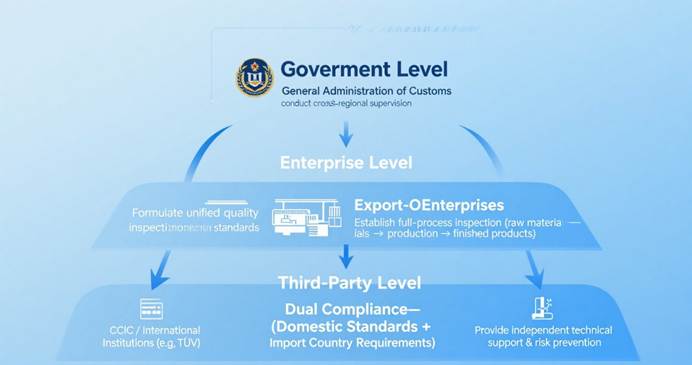
In terms of functions, the core goal of quality inspection work in China is “dual compliance” — it must not only meet domestic quality and safety standards but also align with the technical regulatory requirements of importing countries. For instance, in the field of food exports, quality inspection work involves more than 20 processes, including pesticide residue testing, microbial index screening, and label compliance review. In the field of electronic and electrical product exports, quality inspection work focuses on testing indicators such as electromagnetic compatibility (EMC), energy efficiency levels, and restrictions on hazardous substances (RoHS). The strict implementation of these quality inspection work links directly determines whether export products can smoothly enter the international market, serving as the first line of defense for ensuring export quality.
New Requirements for Quality Inspection Work in China Driven by Export Trade Growth
With the continuous expansion of China’s export trade scale (in 2023, China’s total goods exports reached 2.95 trillion US dollars, covering more than 190 countries and regions worldwide), the categories of export products have expanded from traditional textiles and machinery to high-end equipment, new energy vehicles, and biomedicine. This has placed higher professional and international demands on quality inspection work. On one hand, there are significant differences in quality inspection work standards across different countries and regions: the European Union (EU) has imposed restrictions on more than 1,000 substances of very high concern (SVHCs) for quality inspection work through the REACH Regulation; the U.S. Food and Drug Administration (FDA) requires detailed clinical verification data for quality inspection work of medical devices; and Southeast Asian countries emphasize pest and disease prevention indicators in quality inspection work of agricultural products. If quality inspection work fails to accurately align with these international standards, export products are highly likely to be detained, returned, or even notified, resulting in not only economic losses but also damage to the international reputation of Chinese export products.
On the other hand, the rise of new export models such as cross-border e-commerce has posed challenges to the timeliness of quality inspection work. The traditional quality inspection work process typically takes 3 to 7 days, while cross-border e-commerce orders, characterized by “small batches and high frequency”, require quality inspection work to be completed within 1 to 2 days. This necessitates the optimization of quality inspection work processes, the introduction of efficient testing technologies, and a deeper understanding of quality inspection work rules of cross-border e-commerce platforms (such as Amazon’s “Global Logistics Quality Inspection Standards” and Alibaba International Station’s “Factory Audit Certification Requirements”). Against this backdrop, relying solely on domestic quality inspection work experience is no longer sufficient to meet the demands. The introduction of foreign export quality talents who are familiar with international rules has become a key measure to enhance the level of quality inspection work in China and ensure export quality.
Professional Advantages of Foreign Export Quality Talents and Their Empowering Role in Quality Inspection Work
Advantages of Foreign Export Quality Talents in Understanding International Standards
Foreign export quality talents (especially professionals with more than 5 years of quality inspection work experience in developed economies such as Europe, the United States, Japan, and South Korea) possess a core advantage in their in-depth understanding and practical experience of international quality inspection work standards. These talents have long participated in the standard-setting processes of institutions such as the International Organization for Standardization (ISO) and the International Electrotechnical Commission (IEC), and are familiar with general quality inspection work frameworks including ISO 9001 (Quality Management System), ISO 17025 (Laboratory Accreditation Standard), and ISO 22000 (Food Safety Management System).
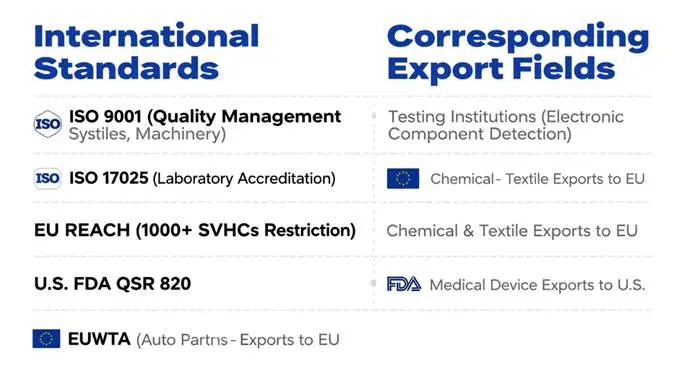
They can accurately interpret the specific quality inspection work requirements of different countries.
For example, in the field of auto parts exports, foreign export quality talents from Germany are well-versed in the details of quality inspection work under the EU’s Whole Vehicle Type Approval (WVTA) system — they not only understand the strength testing standards for car seats but also grasp the basis for setting key parameters such as “simulated collision angle” and “load application method” during testing. In the field of medical device exports, foreign export quality talents from the United States are familiar with the requirements of the FDA’s QSR 820 regulation for quality inspection work and can guide enterprises in establishing a full-chain quality inspection work system covering “design control, process verification, and finished product inspection”, avoiding quality inspection work omissions caused by misunderstandings of standards. This professional capability helps Chinese quality inspection work teams break free from the limitation of “only implementing domestic standards”, achieve seamless alignment between quality inspection work and international rules, and fundamentally improve export quality.
Furthermore, foreign export quality talents keep abreast of updates to international quality inspection work standards. International quality inspection work standards are usually revised every 3 to 5 years (e.g., ISO 9001 underwent its latest revision in 2015). Through industry associations and professional forums, foreign talents can obtain revision information in a timely manner and adjust quality inspection work plans in advance. For example, in 2024, the EU updated the energy efficiency quality inspection work standards for electronic and electrical products (under the ERP Directive), requiring the standby power consumption of products to be reduced from 0.5W to 0.3W. A Chinese home appliance enterprise, under the guidance of foreign export quality talents, optimized the energy efficiency testing indicators in quality inspection work three months in advance, avoiding product backlogs in EU markets due to standard updates and ensuring the stability of export quality.
Practical Experience of Foreign Talents in Optimizing Quality Inspection Work Processes and Driving Technological Innovation
Beyond their understanding of standards, foreign export quality talents can also bring advanced process methods and technology application experience to quality inspection work in China. In terms of quality inspection work process optimization, developed countries in Europe and the United States widely adopt models such as “Lean Quality Inspection” and “Risk-Based Inspection”, which can significantly improve efficiency while ensuring the accuracy of quality inspection work.
Taking Lean Quality Inspection as an example, foreign export quality talents will guide enterprises to identify redundant links in quality inspection work through “value stream mapping analysis”. For a traditional electronics enterprise, finished products were first sent to a laboratory for appearance testing and then transferred to another department for performance testing, with the entire quality inspection work process taking 48 hours. After optimization by foreign talents, appearance testing and performance testing were integrated into a “one-stop workstation”, and portable testing equipment was introduced, reducing the quality inspection work time to 12 hours and increasing efficiency by 75%. In terms of Risk-Based Inspection, foreign talents classify quality inspection work into three levels (A, B, and C) based on the “severity of failure consequences” and “probability of defect occurrence”: 100% full inspection (Level A) is conducted for core components (such as batteries of new energy vehicles), while 10% random inspection (Level C) is implemented for non-core components (such as snaps for automotive interiors). This approach not only ensures the effectiveness of quality inspection work but also reduces the testing costs for enterprises.
In terms of quality inspection work technological innovation, foreign export quality talents are familiar with the application scenarios of intelligent testing technologies. For instance, in quality inspection work of garment exports, foreign talents have introduced AI visual inspection systems that automatically identify color differences and defects in fabrics through cameras, achieving a detection accuracy rate of 99.2% — far higher than the 85% accuracy rate of manual inspection. In quality inspection work of mechanical part exports, foreign talents have guided enterprises to use 3D scanning technology to quickly compare the dimensional deviations between parts and design drawings, reducing the dimensional testing time in quality inspection work from 2 hours to 15 minutes. The introduction of these technologies not only improves the accuracy of quality inspection work but also promotes the transformation of quality inspection work in China from “manual-led” to “intelligence-driven”, providing more reliable technical support for export quality.
Practical Paths for Introducing Foreign Export Quality Talents into Quality Inspection Work in China
Mechanisms for Introducing Foreign Quality Inspection Talents Under Policy Guidance
To promote the introduction of foreign talents in the field of quality inspection work, governments at all levels in China have issued a series of supportive policies in recent years, incorporating foreign export quality talents into the “Key Industry Talent Introduction Plan”. At the national level, the Ministry of Science and Technology’s “International Talent Program” provides a “green channel” for foreign quality inspection work experts, simplifying the procedures for visa and residence permit applications and offering research start-up funds of up to 500,000 yuan. At the local level, initiatives such as Shanghai’s “Pujiang Talent Program”, Guangdong’s “Pearl River Talent Program”, and Zhejiang’s “West Lake Talent Program” provide foreign export quality talents with benefits including housing subsidies (up to 1 million yuan), priority arrangements for children’s education, and tax reductions.
In addition, the government has promoted talent exchange by establishing “international cooperation platforms for quality inspection work”. For example, the General Administration of Customs has signed cooperation agreements with international quality inspection institutions such as TÜV Rheinland (Germany) and Bureau Veritas (France) to launch the “Foreign Quality Inspection Talent Exchange Program”, selecting 100 foreign export quality talents each year to provide quality inspection work guidance to Chinese customs and third-party quality inspection institutions for a period of 6 to 12 months. Jiangsu Province has hosted the “International Quality Inspection Talent Matching Conference”, inviting more than 200 foreign export quality talents from the EU, the United States, and Japan to connect with over 300 export-oriented enterprises in the province, helping enterprises accurately introduce talents needed for quality inspection work. These policy measures have lowered the threshold for introducing foreign talents in the field of quality inspection work and provided institutional guarantees for aligning quality inspection work in China with international advanced standards.
Cooperation Models Between Enterprises and Foreign Export Quality Talents
For export-oriented enterprises, the core goal of introducing foreign export quality talents is to solve practical problems in quality inspection work. Therefore, enterprises need to choose flexible cooperation models based on their own needs. Currently, there are three main types of cooperation between enterprises and foreign export quality talents:
The first type is the “full-time employment” model, which is suitable for enterprises with incomplete quality inspection work systems and concentrated export markets. For example, a new energy vehicle export enterprise (with Europe as its main market) fully employed an expert who had previously been responsible for quality inspection work at Volkswagen (Germany) to serve as the director of quality inspection work in the enterprise. This expert not only restructured the enterprise’s quality inspection work system (setting 12 quality inspection nodes from raw material inbound to finished vehicle delivery) but also trained 50 domestic quality inspection work personnel. As a result, the qualification rate of the enterprise’s vehicles exported to Europe increased from 96% to 99.8%, and the export quality was highly recognized by EU customers.
The second type is the “consulting cooperation” model, which is suitable for enterprises with a solid foundation in quality inspection work but needing to adapt to specific markets. For example, a food export enterprise (with export markets covering Southeast Asia and the Middle East) hired foreign export quality talents from Thailand and the United Arab Emirates as quality inspection work consultants, who provided remote guidance twice a month. These consultants helped the enterprise understand the “Halal food quality inspection standards” in Southeast Asia and the “Arabic label compliance requirements” for food in the Middle East. Through this cooperation, the targeting of the enterprise’s quality inspection work was significantly enhanced, and the return rate of export products due to non-compliant quality inspection work decreased from 8% to 2%.
The third type is the “project-based cooperation” model, which is suitable for enterprises with short-term quality inspection work upgrading needs. For example, a medical device enterprise planned to enter the U.S. market and needed to pass the FDA’s quality inspection work certification. Therefore, it signed a “FDA Certification Special Cooperation Agreement” with foreign export quality talents from the United States. Within 3 months, the foreign talents guided the enterprise in completing quality inspection work document sorting, laboratory renovation, and simulated testing, helping the enterprise pass the FDA certification in one attempt. This saved the enterprise 6 months of certification time and enabled it to quickly enter the U.S. market.
Case Studies: How Foreign Export Quality Talents Drive the Upgrade of Quality Inspection Work in China
Case 1: A Textile Enterprise Introduces EU Talents to Solve Quality Inspection Challenges in EU Exports
A large-scale Chinese textile enterprise (with an annual export volume of 1.5 billion yuan and Europe as its main market) had long faced challenges in quality inspection work: the EU’s “ECO-LABEL” standards for quality inspection work of textiles are extremely strict, not only restricting the content of harmful substances such as formaldehyde and heavy metals but also requiring the “washing color fastness” of fabrics to reach Level 4 or above (compared to the domestic standard of Level 3). Previously, the enterprise’s quality inspection work only followed domestic standards, leading to the return of 3 batches of fabrics exported to the EU in 2022 due to substandard color fastness, resulting in a loss of 20 million yuan.
To address this issue, the enterprise introduced Marie, an expert with 10 years of quality inspection work experience at the EU’s textile testing institution (Oeko-Tex®), in 2023. After joining the enterprise, Marie promoted the upgrade of quality inspection work from three dimensions:
Reconstruction of Quality Inspection Work Standards: Marie decomposed the EU ECO-LABEL standards into 128 specific quality inspection work indicators (e.g., formaldehyde content ≤ 16mg/kg, lead content ≤ 0.2mg/kg) and integrated these indicators into the enterprise’s quality inspection work manual, replacing the original domestic standards.
Optimization of Quality Inspection Work Processes: A real-time quality inspection work node was added to the “dyeing link” of fabric production. Using a “spectrophotometer” brought by Marie, the dye concentration was monitored in real time to avoid substandard color fastness caused by uneven dyeing. In the finished product link, EU-standard “washing testing machines” were introduced to simulate the washing habits of EU households (40°C water temperature, 500 revolutions per minute) for quality inspection work, ensuring that the testing results were consistent with actual EU requirements.
Training for Quality Inspection Work Teams: A 2-month quality inspection work training program was launched, covering 50 quality inspection work personnel in the enterprise. The training content included EU standard interpretation, testing equipment operation, and non-conforming product handling procedures, enabling the team to master core skills in international quality inspection work.
Driven by Marie, the level of the enterprise’s quality inspection work was significantly improved: in the second half of 2023, the qualification rate of quality inspection work for fabrics exported to the EU reached 100%, with no further returns. The improvement in export quality also helped the enterprise secure a long-term order from the well-known EU brand Zara, with export volume increasing by 30% year-on-year in the first half of 2024.
Case 2: A Cross-Border E-Commerce Enterprise Introduces U.S. Talents to Optimize Rapid Quality Inspection Processes
A Chinese cross-border e-commerce enterprise (specializing in 3C products and exporting to the United States via Amazon) faced a core challenge of insufficient timeliness in quality inspection work: Amazon requires quality inspection work to be completed before products are stored in warehouses. If quality inspection work is not completed within 48 hours, storage late fees are charged. However, the enterprise’s traditional quality inspection work process (manual appearance and performance testing) took 72 hours, resulting in monthly late fees of approximately 50,000 yuan and affecting order delivery efficiency.
In 2024, the enterprise introduced John, an expert who had previously been responsible for quality inspection work at Amazon’s logistics centers in the United States. Combining his experience in quality inspection work for U.S. cross-border e-commerce, John proposed a “three-step rapid quality inspection method” to promote the transformation of the quality inspection work process:
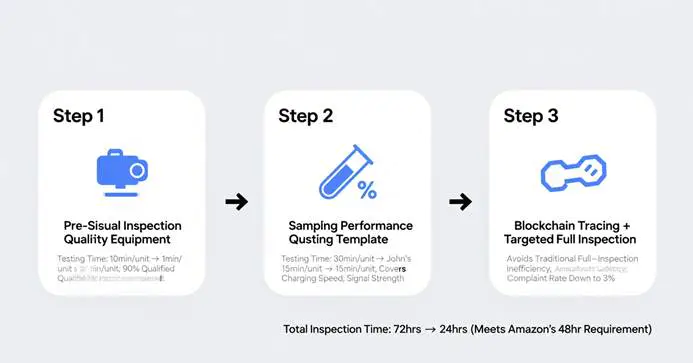
First Step: Pre-Screening Quality Inspection: Using AI visual inspection equipment, the appearance of products (such as screen scratches and housing damage) was quickly scanned upon warehouse entry. The testing time was reduced from 10 minutes per unit to 1 minute per unit, screening out 90% of products with qualified appearance.
Second Step: Sampling Performance Quality Inspection: For products that passed the pre-screening, 5% of samples were selected for quality inspection work using a “performance testing template” designed by John (covering core indicators such as charging speed, signal strength, and compatibility). The sample testing time was reduced from 30 minutes per unit to 15 minutes per unit.
Third Step: Abnormal Tracing Quality Inspection: If non-conforming products were found in the sampling, blockchain technology was used to trace the production links of the batch. Only the products involved in the problematic links were fully inspected, avoiding the inefficiency caused by traditional “full inspection”.
After the implementation of this quality inspection work process, the quality inspection work time of the enterprise was reduced from 72 hours to 24 hours, fully meeting Amazon’s requirements and saving 50,000 yuan in monthly late fees. At the same time, the accuracy of quality inspection work was improved, with the product complaint rate from U.S. customers decreasing from 12% to 3%. The reputation of export quality was significantly enhanced, and the Amazon store rating of the enterprise increased from 4.2 stars to 4.8 stars in the second quarter of 2024, with order volume growing by 45%.
Future Trends: Directions for In-Depth Integration Between Quality Inspection Work in China and Foreign Export Quality Talents
The Technological Leadership Role of Foreign Talents in Digital Quality Inspection Work
In the next five years, quality inspection work in China will accelerate its transformation towards “digitalization and intelligentization”. The experience of foreign export quality talents in the application of intelligent testing technologies will become a key driver of this transformation. For example, in the field of AI-based quality inspection work, foreign talents are familiar with “deep learning model training” and “image annotation standards” and can guide Chinese quality inspection work teams in developing more accurate detection algorithms. In the quality inspection work of semiconductor chips, for instance, foreign talents can help optimize AI models, increasing the detection accuracy of micro-defects (with a diameter of <1μm) on chip surfaces from 95% to 99.9%. In the field of blockchain-based quality inspection work, foreign talents understand the quality inspection work logic of the EU’s “Digital Product Passport (DPP)” and can guide enterprises to upload quality inspection work data (such as raw material testing reports and production process monitoring data) to the blockchain, realizing the full-process traceability of export products “from factory to consumer” and enhancing the trust of importing countries in Chinese export quality.
Furthermore, foreign export quality talents can promote “cross-border mutual recognition of quality inspection data”. Currently, quality inspection work data between China and some countries has not yet achieved mutual recognition (e.g., testing reports from China require secondary review in some EU countries). With their understanding of the quality inspection work standards of both parties, foreign talents can participate in the negotiation and formulation of “data mutual recognition agreements”, helping Chinese quality inspection work data gain international recognition, reducing repeated testing, and lowering the export costs of enterprises.
The “Two-Way Training” System for Foreign Export Quality Talents and Domestic Quality Inspection Teams
With the improvement of the level of quality inspection work in China, the simple “introduction of foreign talents” will gradually shift towards “two-way integration of Chinese and foreign talents”. On one hand, foreign export quality talents need to gain a deep understanding of the local characteristics of quality inspection work in China — for example, China’s “battery safety quality inspection standards” for new energy vehicles are stricter than international standards. Foreign talents need to learn these local requirements to better guide quality inspection work. On the other hand, domestic quality inspection work teams need to absorb international experience and innovate in combination with China’s actual conditions during cooperation with foreign talents, forming an “international quality inspection work model with Chinese characteristics”.
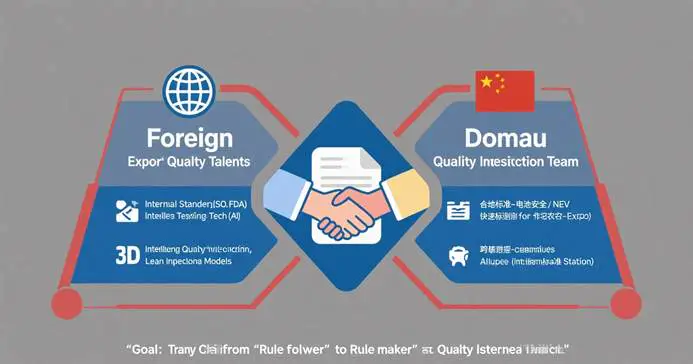
For example, a third-party quality inspection institution has established a “Chinese-Foreign Talent Pairing Training Program”: each foreign export quality talent is paired with 3 domestic quality inspection work personnel. Foreign talents teach international standards and technologies, while domestic personnel share practical experience in Chinese quality inspection work (such as rapid quality inspection work methods for bulk agricultural product exports). Together, they have developed the “China-ASEAN Cross-Border E-Commerce Quality Inspection Guide”, which not only complies with international rules but also adapts to the specific needs of the ASEAN market. This “two-way training” model not only improves the overall level of quality inspection work teams but also reserves talents for China’s participation in the formulation of international quality inspection work standards, promoting China’s transformation from a “follower of quality inspection work rules” to a “rule-maker”.
Conclusion
Quality inspection work in China is a core pillar for ensuring the healthy development of export trade and improving export quality. Foreign export quality talents, with their understanding of international standards, experience in process optimization, and capabilities in technological innovation, have become an important force driving the upgrade of quality inspection work in China. From the introduction of talents under policy guidance to flexible cooperation at the enterprise level, and then to the two-way integration of Chinese and foreign talents, quality inspection work in China is gradually achieving the goal of “aligning with international standards and upgrading to high-end levels” through in-depth collaboration with foreign export quality talents.
In the future, with the application of digital technologies and changes in the global trade pattern, quality inspection work in China needs to further leverage the role of foreign export quality talents while strengthening the capacity building of domestic quality inspection work teams. By forming the dual advantages of “international experience + local innovation”, quality inspection work will not only serve as a “guardian of export quality” but also become a “booster for the international competitiveness of Chinese export products”, providing solid support for China’s transformation from an “export powerhouse” to an “export power”.