
Discover actionable ecosystem career development guides for foreign employees in Hangzhou’s Alibaba Ecosystem. Learn core segments, entry paths, skills & strategies to succeed in cross-border e-commerce, tech, logistics and beyond.
Introduction
As a core hub of China’s e-commerce industry, Hangzhou has become a global gathering place for cross-border e-commerce and digital economy talents, relying on the vast ecosystem built by Alibaba Group. For foreign employees, Hangzhou not only offers the opportunity to engage with the world’s leading e-commerce models but also establishes diversified ecosystem career development channels within the Alibaba Ecosystem. The Alibaba Ecosystem covers multiple segments such as cross-border e-commerce, cloud computing, logistics supply chain, and digital marketing. With their cross-cultural backgrounds, international market experience, and professional skills, foreign employees can find unique career positions in this ecosystem. Ecosystem career development has thus become a core path for foreign employees to settle in Hangzhou long-term and realize their value. Starting from the core composition of the Alibaba Ecosystem, this article will elaborate on the entry points, core paths, skill requirements, and growth opportunities for foreign employees in Hangzhou to pursue ecosystem career development in the e-commerce field. It will also integrate high-ranking Google search keywords (e.g., “Alibaba Hangzhou foreign employee recruitment,” “Alibaba Ecosystem cross-border e-commerce career planning,” “foreign talent Alibaba Ecosystem development guide”) to provide comprehensive and practical ecosystem career development references for foreigners interested in developing their careers in Hangzhou, helping them achieve career breakthroughs within the Alibaba Ecosystem.
Core Composition of Alibaba Ecosystem: Fundamental Framework for Foreign Employees’ Ecosystem Career Development
The Alibaba Ecosystem is not a single e-commerce platform but a collection of interconnected and collaboratively developing business segments. Each segment provides foreign employees with differentiated directions for ecosystem career development. Understanding this ecological framework is the primary prerequisite for foreign employees to plan their ecosystem career development. Its core composition can be divided into the following five segments:
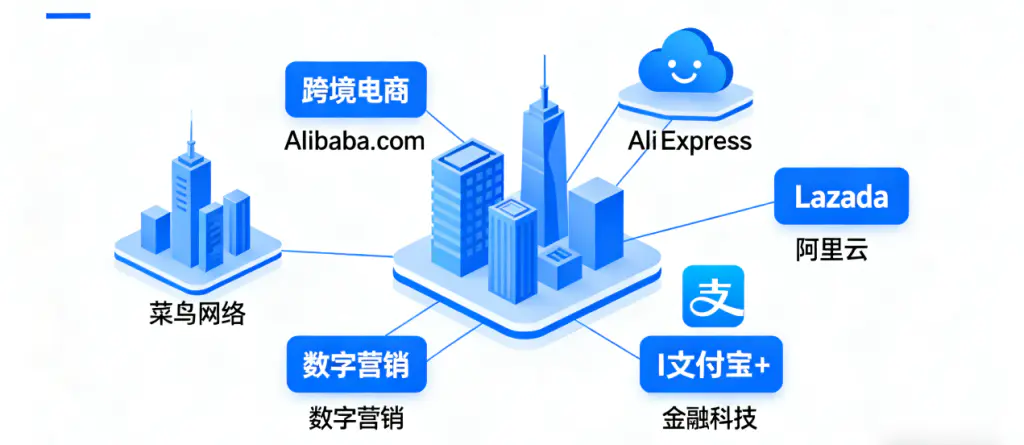
Core Cross-Border E-Commerce Segment: Primary Arena for Foreign Employees’ Ecosystem Career Development
Alibaba’s cross-border e-commerce segment centers on Alibaba, AliExpress, and Lazada, covering markets in more than 200 countries and regions worldwide. It is the most concentrated area for foreign employees and serves as the core carrier for ecosystem career development. The core functions of this segment include international market operation, cross-border supply chain management, and overseas customer service, directly connecting global merchants and consumers. It has clear requirements for foreign employees’ cross-cultural communication skills and international market insight.
For foreign employees, ecosystem career development in the cross-border e-commerce segment can start with entry-level positions. For example, an “Overseas Market Specialist” at Alibaba is responsible for market research and merchant development in specific regions (e.g., Europe, Southeast Asia). By analyzing local consumption trends, they help Chinese suppliers optimize product positioning. Advanced positions may include “Cross-Border E-Commerce Operations Manager,” who oversees traffic operations, campaign planning, and sales target achievement for overseas platforms. For instance, during major promotions like AliExpress’s “Double 11” and “Black Friday,” they coordinate Chinese supply chains and overseas logistics to ensure efficient order fulfillment. The core of this position path for ecosystem career development lies in “deepening regional focus to achieve global coordination.” Leveraging their familiarity with local markets, foreign employees can gradually expand their management scope and become key bridges connecting Chinese supply chains to the global market.
Alibaba Cloud and Digital Technology Segment: Technical Track for Foreign Employees’ Ecosystem Career Development
As the technical cornerstone of the Alibaba Ecosystem, Alibaba Cloud provides global enterprises with digital services such as cloud computing, big data, and artificial intelligence. Particularly in the cross-border e-commerce field, it offers technical support for merchants in areas like order management, user profiling, and risk control. With the expansion of Alibaba Cloud’s international business, the demand for foreign employees with international technical certifications (e.g., AWS, Azure certifications) and familiarity with cross-border e-commerce scenarios has surged, spawning a technical-oriented path for ecosystem career development.
Foreign employees‘ ecosystem career development in the Alibaba Cloud segment can be divided into two directions: “technical services” and “solutions.” The technical services direction includes roles like “Alibaba Cloud International Technical Support Engineer,” who addresses cloud computing deployment and system operation issues for overseas e-commerce clients. For example, they help e-commerce platforms in Southeast Asia build stable cloud server architectures to ensure system capacity during peak promotion periods. The solutions direction includes roles like “Cross-Border E-Commerce Digital Solutions Consultant,” who combines Alibaba Cloud technology with e-commerce business scenarios to design customized solutions. For instance, they provide European cross-border merchants with a “cloud + data” inventory management system to achieve real-time global inventory synchronization. The core of this ecosystem career development path is “deep integration of technology and business.” Foreign employees need to continuously learn Alibaba Cloud’s technical system while understanding e-commerce compliance requirements in different countries (e.g., the EU’s GDPR data regulations) to advance in the technical track.
Cainiao Network and Logistics Supply Chain Segment: Collaborative Field for Foreign Employees’ Ecosystem Career Development
Cainiao Network is the logistics support segment of the Alibaba Ecosystem. It builds a cross-border logistics network through global warehousing and international logistics routes (e.g., “Cainiao China-Europe Railway Express,” “Cainiao Southeast Asia Route”) to solve the “last-mile” fulfillment challenge in cross-border e-commerce. The demand for foreign employees in this segment focuses on positions such as “International Logistics Coordinator” and “Overseas Warehouse Manager,” making it an indispensable collaborative field for ecosystem career development.
In terms of ecosystem career development at Cainiao Network, foreign employees can start as “Overseas Logistics Specialists,” responsible for coordinating cooperation between local logistics providers and Cainiao. For example, in Southeast Asia, they collaborate with local courier companies (e.g., J&T Express, LWE) to optimize delivery timelines and costs. Advanced positions include “Cainiao International Warehouse Manager,” who oversees inventory sorting, order fulfillment, and return processing in overseas warehouses. For instance, in Cainiao’s European overseas warehouses, they need to develop efficient inventory turnover plans based on local consumers’ return habits. The core of this ecosystem career development path is “global logistics resource integration.” Foreign employees must be familiar with logistics policies (e.g., customs clearance, prohibited item regulations) and local logistics networks in different countries, and enhance the cross-border logistics experience of the entire Alibaba Ecosystem by optimizing collaboration efficiency.
Digital Marketing and Brand Services Segment: Marketing-Oriented Direction for Foreign Employees’ Ecosystem Career Development
Alibaba’s digital marketing segment, centered on Alimama and Wantang Academy, provides cross-border e-commerce merchants with precision marketing tools (e.g., Zhitongche, Diamond Exhibition) and brand promotion services. It also helps Chinese brands expand their global influence through overseas social platforms like TikTok and Facebook. The demand for foreign employees in this segment focuses on positions such as “Overseas Digital Marketing Specialist” and “Cross-Cultural Brand Planner,” making it a creativity-driven direction for ecosystem career development.
Foreign employees’ ecosystem career development in the digital marketing segment can start with roles like “Overseas Social Media Marketing Specialist,” responsible for creating content for Chinese brands on platforms like TikTok and Instagram. For example, they design short videos that align with the aesthetic preferences of young people in Europe and America for Hangzhou-based clothing merchants, and increase brand exposure through KOL collaborations. Advanced positions include “Cross-Border Brand Marketing Manager,” who oversees the global marketing strategy of brands. For instance, they develop annual marketing plans for Chinese home appliance brands in the European market, design promotional activities around local festivals (e.g., Christmas, Black Friday), and coordinate Alimama’s advertising resources with overseas media placements. The core of this ecosystem career development path is “cross-cultural marketing creativity and resource integration.” Foreign employees need to accurately grasp the needs and preferences of local consumers, combine the strengths of Chinese brands with local market culture, and maximize marketing effectiveness.
FinTech and Payment Segment: Compliance-Supporting Direction for Foreign Employees’ Ecosystem Career Development
Alibaba’s FinTech segment, centered on Alipay+, provides cross-border e-commerce with services such as cross-border payment, currency exchange, and risk control to address payment barriers in global transactions. The demand for foreign employees in this segment focuses on positions such as “Cross-Border Payment Compliance Specialist” and “International Financial Market Analyst,” making it a compliance and risk control-focused direction for ecosystem career development.
Foreign employees’ ecosystem career development in the FinTech segment can start with roles like “Cross-Border Payment Compliance Specialist,” responsible for researching payment regulations in different countries (e.g., the U.S. OFAC Sanctions List, the EU’s PSD2 Payment Directive) to ensure Alipay+’s business complies with local regulatory requirements. Advanced positions include “International Payment Product Manager,” who designs payment products tailored to overseas markets. For example, they launch an integrated “QR code payment + local wallet” solution for the Southeast Asian market to meet local consumers’ payment habits. The core of this ecosystem career development path is “balancing compliance and product innovation.” Foreign employees need to continuously track global financial regulatory trends while promoting localized optimization of payment products based on cross-border e-commerce payment scenarios, providing secure and convenient financial support for cross-border transactions within the Alibaba Ecosystem.
Entry Points for Foreign Employees’ Ecosystem Career Development in Hangzhou: From Recruitment to Onboarding Adaptation
For foreign employees, entering the Alibaba Ecosystem and initiating ecosystem career development requires clear recruitment channels and systematic onboarding adaptation. As the headquarters of Alibaba, Hangzhou provides foreign employees with diversified career entry points and localization support, which can be divided into the following three paths:

Campus Recruitment and International Talent Programs: “Starting Channel” for Ecosystem Career Development
Alibaba launches campus recruitment programs such as the “International Management Trainee Program” and “Alibaba Star Program” targeting global universities. These programs aim to recruit foreign fresh graduates with backgrounds in e-commerce, technology, marketing, etc., and provide them with 1-2 years of rotational training. They serve as important starting points for foreign employees’ ecosystem career development. Taking the “International Management Trainee Program” as an example, foreign fresh graduates rotate across multiple segments including cross-border e-commerce, Alibaba Cloud, and Cainiao Network, with each rotation cycle lasting 3-6 months. By participating in practical projects (e.g., merchant development at Alibaba, overseas technical support at Alibaba Cloud), they gain a comprehensive understanding of the operation model of the Alibaba Ecosystem and clarify their direction for ecosystem career development.
As a core city for Alibaba’s campus recruitment, Hangzhou regularly holds international talent recruitment fairs at universities such as Zhejiang University and Hangzhou Dianzi University. It also posts campus recruitment information on international recruitment platforms like LinkedIn and Glassdoor. For foreign fresh graduates, three conditions must be met to apply for these programs: first, proficiency in both Chinese and English (Chinese requirements may be relaxed for some technical positions, but basic communication skills are required); second, relevant internship experience in cross-border e-commerce or digital technology (e.g., internship experience at Amazon or Shopify); third, strong cross-cultural collaboration awareness and learning ability. Foreign employees who join Alibaba through campus recruitment receive growth resources such as “mentorship” and “cross-departmental project practice,” enabling them to quickly integrate into the ecosystem and lay the foundation for subsequent ecosystem career development.
Social Recruitment and International Business Channels: “Experienced Channel” for Ecosystem Career Development
For foreign professionals with work experience, Alibaba recruits talents with international market resources and professional skills through social recruitment channels. The focus is on positions such as cross-border e-commerce operations, overseas market development, and international technical services, making it the main entry point for experienced foreign employees’ ecosystem career development. As the core hub of Alibaba’s international business, Hangzhou has social recruitment positions concentrated in departments such as the Alibaba headquarters, Alibaba Cloud Global Technical Support Center, and Cainiao International Logistics Headquarters. Position requirements typically include 3-5 years of relevant work experience (e.g., cross-border e-commerce platform operations, overseas logistics management), familiarity with specific regional markets (e.g., Europe, Southeast Asia), and team management experience (for senior positions).
For example, when recruiting an “European Market Operations Expert” at Alibaba, foreign candidates are required to have more than 5 years of operations experience on European e-commerce platforms (e.g., Amazon, eBay), be familiar with local consumer needs and market competition patterns, and be able to lead a team in formulating European market operation strategies. When recruiting an “International Technical Solutions Architect” at Alibaba Cloud, candidates are required to hold advanced certifications from AWS or Azure, have technical service experience with cross-border e-commerce clients, and be able to design cloud computing solutions for overseas merchants. Foreign employees who join Alibaba through social recruitment typically take on core business responsibilities directly. Their ecosystem career development starts at a higher level with faster growth, and some outstanding candidates can directly enter middle management positions to oversee regional business.
Internal Transfer and Ecosystem Collaboration Opportunities: “Horizontal Channel” for Ecosystem Career Development
The collaborative nature of the Alibaba Ecosystem provides foreign employees with internal transfer opportunities, allowing them to switch positions across different segments and achieve horizontal expansion in ecosystem career development. For example, a foreign employee responsible for European market operations at Alibaba who wishes to shift to a technical-oriented ecosystem career development path can apply for a transfer to Alibaba Cloud’s international technical support team. Leveraging their familiarity with the European e-commerce market, they can provide more business-scenario-aligned technical support to local e-commerce clients. A foreign employee responsible for overseas warehouse management at Cainiao Network who is interested in digital marketing can transfer to Alimama’s overseas marketing team and use logistics data to optimize brands’ overseas promotional plans.
Alibaba’s internal transfer process typically includes four stages: “position application – original department approval – new department interview – onboarding adaptation.” The requirements for foreign employees are: excellent performance in the original position (performance rating of B or above), possession of basic skills required for the new position (e.g., basic programming skills or technical certifications for transfers to technical positions), and willingness to take on the challenges of the new position. Internal transfers not only help foreign employees break through career bottlenecks but also allow them to accumulate cross-domain experience through practice in different segments, making them “versatile talents” within the Alibaba Ecosystem. This lays the foundation for subsequent higher-level ecosystem career development (e.g., Ecosystem Business Director, International Regional Manager).
Onboarding Adaptation and Localization Support: “Support System” for Ecosystem Career Development
To help foreign employees quickly adapt to work and life in Hangzhou, Alibaba has established a comprehensive onboarding adaptation system, including “Chinese language training,” “cultural integration courses,” and “life service support,” providing guarantees for ecosystem career development. In terms of Chinese language training, Alibaba collaborates with local language training institutions in Hangzhou to provide foreign employees with free Chinese courses (from basic spoken Chinese to business Chinese) and customizes course content based on position requirements (e.g., “e-commerce Chinese vocabulary” training for cross-border e-commerce positions, “Chinese interpretation of technical documents” training for technical positions). Cultural integration courses invite senior Alibaba employees and local cultural experts in Hangzhou to explain Chinese workplace culture (e.g., hierarchical communication, team collaboration methods) and local living habits in Hangzhou (e.g., diet, transportation, social etiquette), helping foreign employees avoid cultural conflicts.
In terms of life service support, Alibaba provides foreign employees with “housing assistance” (e.g., recommending international communities, assisting with rental procedures), “document processing support” (e.g., assisting with work visa applications, foreigner residence permits), and “medical and education resource connection” (e.g., recommending international hospitals, connecting with international schools). This localization support not only addresses foreign employees’ life concerns but also helps them integrate into Hangzhou’s urban environment faster, allowing them to focus on ecosystem career development. For example, a foreign employee from the United States, through Alibaba’s Chinese language training, was able to communicate independently with Chinese suppliers within 3 months of onboarding and successfully led a large-scale promotional campaign in the U.S. market within 6 months, achieving rapid progress in ecosystem career development.
Core Paths for Foreign Employees’ Ecosystem Career Development in Hangzhou: Advancement from Specialist to Executive
The Alibaba Ecosystem has designed clear career advancement paths for foreign employees. From entry-level specialists to senior executives, each stage has clear competency requirements and growth goals. The core paths for ecosystem career development can be divided into two directions: “professional track” and “management track,” as detailed below:
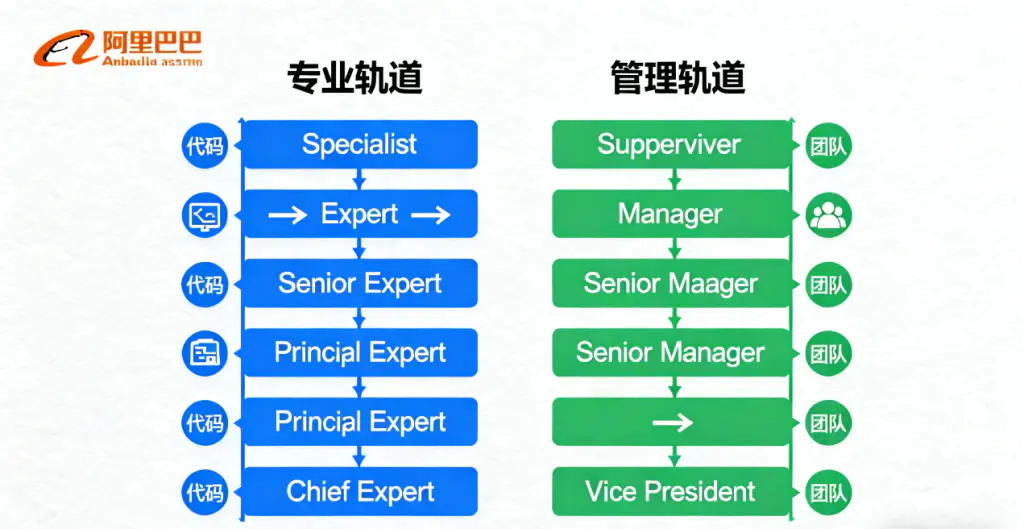
Professional Track: “In-Depth Specialization Path” for Ecosystem Career Development
The professional track is suitable for foreign employees who focus on a specific field and aspire to become technical or business experts. Its ecosystem career development path is divided into five levels: “Specialist – Expert – Senior Expert – Principal Expert – Chief Expert.” The core responsibilities and competency requirements for each level are as follows:
Specialist Level (0-2 years of experience): This is the foundational stage of ecosystem career development. Core responsibilities include executing specific tasks, such as a Cross-Border E-Commerce Operations Specialist responsible for daily product listing and order processing on overseas platforms, or a Technical Support Specialist responsible for answering basic technical questions for clients. Competency requirements include: possession of basic skills required for the position (e.g., proficiency in e-commerce operation tools, basic technical knowledge), ability to complete tasks assigned by superiors, and basic Chinese-English bilingual communication skills. The focus of ecosystem career development at this stage is “familiarizing with the business processes and tools of the Alibaba Ecosystem.” Foreign employees need to accumulate experience through extensive practice. For example, an AliExpress Operations Specialist needs to master platform traffic optimization tools (e.g., Zhitongche placement, keyword ranking) within 6 months and achieve a 10% monthly sales growth for the store they manage.
Expert Level (2-5 years of experience): This is the growth stage of ecosystem career development. Core responsibilities include independently managing work in a specific sub-field, such as a Cross-Border E-Commerce Market Expert responsible for formulating market strategies for a specific region, or a Technical Solutions Expert responsible for designing technical solutions for clients. Competency requirements include: ability to independently solve complex problems (e.g., responding to sudden policy changes in overseas markets, resolving complex technical issues for clients), ability to propose optimization suggestions (e.g., optimizing operation strategies, improving technical solutions), and certain cross-departmental collaboration skills. The focus of ecosystem career development at this stage is “forming professional advantages in a specific sub-field.” For example, an Alibaba Cloud International Technical Solutions Expert needs to accumulate experience in designing solutions for more than 10 cross-border e-commerce clients within 3 years and lead 1-2 benchmark projects (e.g., building an end-to-end cloud architecture for a large cross-border e-commerce platform).
Senior Expert Level (5-8 years of experience): This is the mature stage of ecosystem career development. Core responsibilities include leading business innovation in a specific field, such as a Senior Cross-Border E-Commerce Operations Expert responsible for formulating innovative operation strategies for platforms, or a Senior Digital Marketing Expert responsible for developing new marketing tools or methods. Competency requirements include: business innovation capabilities (e.g., designing new operation models, developing new marketing plans), ability to train team members (e.g., guiding the growth of Expert-level employees), and cross-segment collaboration capabilities (e.g., coordinating resources between Alibaba Cloud and the cross-border e-commerce segment). The focus of ecosystem career development at this stage is “becoming a leader in a specific field.” For example, a Senior Alimama Overseas Digital Marketing Expert needs to lead the development of a “social + e-commerce” marketing tool tailored to the Southeast Asian market and promote its implementation on platforms like AliExpress and Lazada, increasing merchants’ marketing ROI by 20%.
Principal Expert & Chief Expert Level (8+ years of experience): This is the top-tier stage of ecosystem career development. Core responsibilities include formulating strategic plans and technical standards for a field, such as a Principal Cross-Border E-Commerce Expert responsible for formulating global operation strategies for platforms, or a Chief Alibaba Cloud Technical Expert responsible for defining the development direction of cloud computing technology. Competency requirements include: strategic thinking (e.g., predicting industry trends, formulating long-term development plans), industry influence (e.g., delivering speeches at international industry conferences, participating in industry standard-setting), and global perspective (e.g., coordinating internal and external resources of the Alibaba Ecosystem). The focus of ecosystem career development at this stage is “driving the overall development of the field.” For example, a Principal Cainiao International Logistics Expert needs to predict global cross-border logistics trends (e.g., green logistics, smart warehousing) and formulate long-term logistics strategies for Cainiao International, improving the overall logistics efficiency within the ecosystem.
Management Track: “Global Coordination Path” for Ecosystem Career Development
The management track is suitable for foreign employees with leadership abilities who aspire to lead teams and drive business development. Its ecosystem career development path is divided into six levels: “Supervisor – Manager – Senior Manager – Director – Senior Director – Vice President.” The core responsibilities and competency requirements for each level are as follows:
Supervisor Level (1-3 years of experience): This is the initial management stage of ecosystem career development. Core responsibilities include leading a small team of 3-5 people to achieve specific goals, such as a Cross-Border E-Commerce Operations Supervisor responsible for leading a team to meet sales targets in a specific region, or a Technical Support Supervisor responsible for leading a team to handle clients’ technical issues. Competency requirements include: basic team management skills (e.g., task assignment, performance evaluation), ability to motivate team members (e.g., formulating team incentive plans), and goal management skills (e.g., breaking down goals and tracking progress). The focus of ecosystem career development at this stage is “mastering basic management methods.” For example, an Alibaba Operations Supervisor needs to lead the team to achieve a $5 million sales target within 1 year and increase the average performance of team members by 15%.
Manager Level (3-6 years of experience): This is the growth stage of management in ecosystem career development. Core responsibilities include leading a team of 10-20 people to manage a specific business module, such as a Cross-Border E-Commerce Marketing Manager responsible for leading a team to formulate and implement market strategies for a specific region, or an Alibaba Cloud Technical Manager responsible for leading a team to develop a specific technical product. Competency requirements include: business planning capabilities (e.g., formulating annual business plans for the team), team building capabilities (e.g., recruiting and training team members), and cross-departmental communication skills (e.g., coordinating resources from supply chain and logistics departments). The focus of ecosystem career development at this stage is “driving sustained growth of the business module.” For example, an AliExpress Marketing Manager needs to lead the team to increase market share in a specific region by 10% within 2 years and create 1-2 best-selling products (with monthly sales exceeding 100,000 units).
Senior Manager Level (6-10 years of experience): This is the mature stage of management in ecosystem career development. Core responsibilities include leading a team of 30-50 people to manage a specific business line, such as a Senior Cross-Border E-Commerce Manager responsible for leading a team to oversee the overall operations of an overseas platform, or a Senior Cainiao International Logistics Manager responsible for leading a team to manage the logistics network in a specific region. Competency requirements include: business innovation capabilities (e.g., promoting business model upgrades, optimizing operation processes), team management skills (e.g., establishing team management systems, training middle managers), and risk management capabilities (e.g., responding to market risks, supply chain risks). The focus of ecosystem career development at this stage is “building a high-performance business line.” For example, a Senior Cainiao International Logistics Manager needs to lead the team to improve logistics timelines in a specific region by 30% within 3 years while reducing logistics costs by 15%.
Director Level (10-15 years of experience): This is the senior management stage of ecosystem career development. Core responsibilities include overseeing regional business for a specific segment, such as an Alibaba Europe Director responsible for overseeing the overall operations of the European market, or an Alibaba Cloud Asia-Pacific Technical Director responsible for overseeing technical service business in the Asia-Pacific region. Competency requirements include: regional strategic planning capabilities (e.g., formulating long-term development strategies for regional business), resource integration capabilities (e.g., coordinating internal and external resources of the ecosystem to support regional business), and cross-cultural management skills (e.g., managing multi-national teams). The focus of ecosystem career development at this stage is “achieving breakthroughs in regional business.” For example, an Alibaba Europe Director needs to increase the number of merchants in the European market by 50% within 5 years and achieve a 40% annual sales growth.
Senior Director & Vice President Level (15+ years of experience): This is the top-tier management stage of ecosystem career development. Core responsibilities include overseeing global business for a specific segment of the Alibaba Ecosystem or collaborative business across multiple segments, such as a Global Senior Cross-Border E-Commerce Director responsible for overseeing the global operations of all Alibaba’s cross-border e-commerce platforms, or a Vice President of Alibaba Ecosystem International Business responsible for overseeing the overall development of international business within the ecosystem. Competency requirements include: global strategic thinking (e.g., predicting global e-commerce trends, formulating global business layouts), ecosystem collaboration capabilities (e.g., promoting collaborative development between cross-border e-commerce, Alibaba Cloud, and Cainiao), and industry influence (e.g., representing Alibaba in global e-commerce industry cooperation). The focus of ecosystem career development at this stage is “leading the global expansion of ecosystem business.” For example, a Vice President of Alibaba Ecosystem International Business needs to promote the Alibaba Ecosystem’s expansion into emerging markets (e.g., the Middle East, Africa) and achieve an annual growth rate of over 30% for the ecosystem’s international business.
Skill Requirements and Growth Resources for Foreign Employees’ Ecosystem Career Development in Hangzhou
To advance in ecosystem career development within the Alibaba Ecosystem, foreign employees need to possess specific skill sets and make good use of the growth resources provided by Alibaba to continuously enhance their competitiveness. This can be divided into two parts: “core skill requirements” and “key growth resources.”
Core Skill Requirements for Ecosystem Career Development: Competency Building in Three Dimensions (H3)
The business characteristics of the Alibaba Ecosystem determine that foreign employees need to possess core skills in three dimensions: “cross-cultural communication,” “professional technology,” and “ecosystem collaboration.” These skills are key supports for ecosystem career development:
Cross-Cultural Communication and Localized Operation Abilities: This is the core advantage of foreign employees in the Alibaba Ecosystem and a foundational skill for ecosystem career development. Specifically, it includes: proficiency in Chinese-English bilingual communication (third language proficiency may be required for some positions, such as Indonesian or Malay for positions in the Southeast Asian market), in-depth understanding of local market culture (e.g., privacy protection awareness in the European market, social shopping habits in the Southeast Asian market), and localized operation capabilities (e.g., designing promotional activities based on local festivals, optimizing product detail pages according to local consumer preferences). For example, a foreign employee responsible for cross-border e-commerce operations in the Middle East needs to understand the religious culture of the region (e.g., consumption habits during Ramadan), design promotional activities that meet local needs, and optimize product descriptions in Arabic to improve conversion rates. Cross-cultural communication skills not only help foreign employees better connect with overseas clients and teams but also provide key support for the localization of ecosystem business, making them indispensable for ecosystem career development.
Professional Technology and Business Scenario Integration Abilities: Different segments have different professional technology requirements for ecosystem career development, but the core lies in “integration of technology and business scenarios.” For example, foreign employees in the cross-border e-commerce segment need to master e-commerce operation tools (e.g., Alibaba’s “Foreign Trade Zhitongche,” AliExpress’s “Business Advisor”) and data analysis tools (e.g., Excel, Tableau) to optimize operation strategies through data. Foreign employees in the Alibaba Cloud segment need to master cloud computing technologies (e.g., server deployment, cloud security) and hold relevant technical certifications (e.g., Alibaba Cloud ACP, ACE certifications) to provide technical solutions for clients. Foreign employees in the digital marketing segment need to master operation tools for overseas social platforms (e.g., TikTok Ads, Facebook Business Manager) and be familiar with marketing data analysis (e.g., ROI calculation, user profiling) to design precision marketing plans. Professional technical capabilities are the core for foreign employees to advance in ecosystem career development. Only by integrating technology with the business scenarios of the Alibaba Ecosystem can they create practical value.
Ecosystem Collaboration and Resource Integration Abilities: As ecosystem career development advances, foreign employees need to possess stronger ecosystem collaboration capabilities to coordinate resources across different segments and drive business implementation. For example, a Cross-Border E-Commerce Brand Marketing Manager needs to coordinate advertising resources from Alimama (e.g., Zhitongche placement), logistics resources from Cainiao (e.g., overseas warehouse fulfillment), and technical resources from Alibaba Cloud (e.g., user data analysis) to create an end-to-end “marketing – logistics – data” support system for brands. An Alibaba Cloud International Solutions Consultant needs to coordinate business experts from the cross-border e-commerce segment (who understand clients’ e-commerce needs) and compliance experts from the FinTech segment (who ensure payment solution compliance) to design comprehensive digital solutions for clients. Ecosystem collaboration capabilities not only help foreign employees improve work efficiency but also allow them to accumulate more resources within the ecosystem, laying the foundation for higher-level ecosystem career development (e.g., management positions).
Key Growth Resources for Ecosystem Career Development: Four Support Systems Provided by Alibaba
Alibaba provides foreign employees with four major growth resources—”training system,” “mentorship program,” “project practice,” and “industry exchange”—to support their ecosystem career development:
Systematic Training System: Alibaba has established a full-cycle training system covering “onboarding – advancement – senior level” to provide knowledge support for foreign employees’ ecosystem career development. The onboarding stage includes “new employee orientation training,” which introduces the business structure, corporate culture, and work processes of the Alibaba Ecosystem. The advancement stage includes “professional skill training,” such as “Overseas Market Operation Practical Courses” for the cross-border e-commerce segment and “Cloud Computing Technology Advancement Courses” for the Alibaba Cloud segment, taught by senior internal experts with practical case studies. The senior level includes “leadership training,” such as the “Alibaba Management Three Axes” course for employees on the management track, which teaches team management and business planning methods. In addition, Alibaba collaborates with world-renowned institutions (e.g., Harvard Business School, MIT) to provide “Global Business Leadership Courses” for senior foreign employees, enhancing their global strategic thinking.
One-on-One Mentorship Program: Alibaba assigns a senior mentor to each foreign employee (especially new employees and management trainees). Mentors are usually experts or managers with more than 5 years of experience in the ecosystem and are responsible for guiding foreign employees’ ecosystem career development. The core responsibilities of mentors include: formulating personalized career development plans (e.g., planning professional or management track development paths based on employees’ interests and abilities), answering work-related questions (e.g., guiding how to handle cross-cultural collaboration issues, how to optimize business solutions), and providing resource support (e.g., recommending participation in core projects, connecting cross-departmental resources). For example, a new foreign employee from the UK, under the guidance of a mentor, participated in the European market expansion project at Alibaba. Not only did they accumulate project experience, but they also clarified the direction of “cross-border e-commerce regional operations” for their ecosystem career development and were promoted to Operations Expert within 1 year of onboarding.
Diversified Project Practice Opportunities: Alibaba provides foreign employees with rich project practice opportunities, including “cross-departmental projects,” “global innovation projects,” and “benchmark client projects.” These opportunities allow employees to enhance their abilities through practice and drive ecosystem career development. Cross-departmental projects such as the “Alibaba Ecosystem Cross-Border E-Commerce Integration Project” involve employees from cross-border e-commerce, Alibaba Cloud, and Cainiao to design an integrated “cloud + logistics + e-commerce” solution. Global innovation projects such as the “Alibaba Emerging Market Incubation Project” explore new e-commerce models (e.g., social e-commerce, live-streaming e-commerce) for emerging markets like the Middle East and Africa. Benchmark client projects such as the “Global Top 100 Cross-Border Merchant Service Project” provide customized services for the world’s top 100 cross-border merchants, accumulating high-end client service experience. Participating in these projects not only enhances foreign employees’ professional and collaborative abilities but also adds impressive experiences to their resumes, contributing to the advancement of their ecosystem career development.
International Industry Exchange Platforms: Alibaba regularly organizes foreign employees to participate in industry exchange events such as the “Global E-Commerce Summit,” “Alibaba Cloud Developer Conference,” and “Cainiao Global Logistics Forum.” It also invites experts from the global e-commerce, technology, and logistics fields to give internal sharing sessions, providing foreign employees with opportunities to expand their industry perspective and accumulate professional networks. For example, at the annual “Alibaba Global Cross-Border E-Commerce Summit,” Alibaba invites entrepreneurs and scholars from the global cross-border e-commerce field to participate. Foreign employees can learn about global e-commerce trends and communicate with industry leaders at the summit. At the “Alibaba Cloud Developer Conference,” international renowned technical experts are invited to share the latest technologies in cloud computing and artificial intelligence, helping foreign technical employees maintain technical sensitivity. These industry exchange activities not only help foreign employees update their knowledge systems but also allow them to accumulate industry resources for their ecosystem career development, creating opportunities for future career breakthroughs.
Challenges and Coping Strategies for Foreign Employees’ Ecosystem Career Development in Hangzhou
Although the Alibaba Ecosystem provides abundant opportunities for foreign employees’ ecosystem career development, foreign employees still face challenges such as “cultural differences,” “insufficient local awareness,” and “career competition pressure” in their actual development. Targeted coping strategies are needed to achieve continuous advancement in ecosystem career development.
Collaboration Challenges Caused by Cultural Differences and Coping Strategies

Chinese workplace culture emphasizes “collectivism,” “hierarchical communication,” and “implicit expression,” which differ from the “individualism,” “equal communication,” and “direct expression” cultures familiar to some foreign employees. This may lead to cross-departmental collaboration difficulties and affect ecosystem career development. For example, a foreign manager from the United States, who is accustomed to directly pointing out team members’ work problems, may make Chinese employees feel uncomfortable and reduce team cohesion. A foreign employee from Europe who directly rejects other departments’ proposals in cross-departmental meetings may trigger conflicts between departments.
Coping Strategies: First, proactively learn about Chinese workplace culture. Through Alibaba’s “cultural integration courses” and reading books like Alibaba Style, understand Chinese workplace communication methods and collaboration habits (e.g., respecting superiors, emphasizing team consensus). Second, adjust communication methods. When pointing out problems, use a “praise-first, suggestion-later” approach (e.g., “Your plan is excellent in XX aspect; it would be even better if optimized in XX aspect”). In cross-departmental communication, listen to others’ opinions first before putting forward your own views. Third, build “cultural bridges.” Establish personal friendships with Chinese colleagues, and understand their work habits and ways of thinking through daily communication. For example, actively participate in team dinners and team-building activities to enhance mutual trust. Through these strategies, foreign employees can better integrate into Chinese teams, reduce cultural conflicts, and create a favorable collaborative environment for ecosystem career development.
Business Challenges Caused by Insufficient Local Awareness and Coping Strategies
Some foreign employees have insufficient understanding of China’s supply chain, local consumer needs, and Chinese policies and regulations, which may lead to incorrect business decisions and affect ecosystem career development. For example, a foreign employee responsible for cross-border e-commerce product selection may choose products with insufficient production capacity due to a lack of understanding of China’s supply chain capacity, resulting in stockouts during peak promotion periods. A foreign employee responsible for digital marketing may have their marketing plan rejected due to a lack of understanding of Chinese advertising regulations (e.g., advertising content review requirements), delaying the promotion schedule.
Coping Strategies: First, conduct in-depth research on the Chinese market. Use tools like Alibaba’s “Business Advisor” and “Cainiao Logistics Data” to analyze China’s supply chain capacity, logistics timelines, and changes in local consumer needs. Second, strengthen policy learning. Pay attention to policy releases from Chinese government departments such as the Ministry of Commerce and General Administration of Customs, and participate in “cross-border e-commerce compliance training” organized by Alibaba to ensure business compliance with Chinese policies. Third, seek support from local teams. Before making business decisions, fully communicate with Chinese colleagues (especially those familiar with the local market) and listen to their suggestions. For example, consult sales managers of Chinese suppliers to understand product capacity and market popularity before selecting products; confirm with Alibaba’s compliance specialists whether the plan meets regulatory requirements before designing marketing plans. Through these strategies, foreign employees can enhance their local awareness, reduce business mistakes, and promote the smooth advancement of ecosystem career development.
Growth Challenges Caused by Career Competition Pressure and Coping Strategies
The Alibaba Ecosystem attracts outstanding talents from around the world. Foreign employees face competitive pressure from both Chinese employees and other foreign employees. If they fail to continuously enhance their competitiveness, they may face career bottlenecks and affect ecosystem career development. For example, a foreign technical employee may lose a promotion opportunity because they fail to keep up with the latest Alibaba Cloud technologies and are surpassed by Chinese technical employees. A foreign marketing employee may lose the competition for a regional manager position to a Chinese employee familiar with the market due to insufficient understanding of emerging markets (e.g., Southeast Asia).
Coping Strategies: First, formulate a continuous learning plan. Based on the goals of ecosystem career development, regularly learn new skills and knowledge. For example, technical employees can take the latest Alibaba Cloud certification courses, and marketing employees can learn research methods for emerging markets. Second, build differentiated advantages. Leverage their cross-cultural backgrounds and international experience to find unique career positions in the ecosystem. For example, a foreign employee from Southeast Asia can focus on localized operations in the Southeast Asian market and become an expert in this field. Third, proactively seek challenges. Apply to participate in core projects and difficult tasks to enhance abilities through practice. For example, proactively apply to be responsible for emerging market development projects to accumulate scarce project experience. Through these strategies, foreign employees can enhance their competitiveness, stand out in career competition, and achieve continuous breakthroughs in ecosystem career development.
Conclusion: Opportunities and Future Outlook for Foreign Employees’ Ecosystem Career Development in Alibaba Ecosystem
As the core city of the Alibaba Ecosystem, Hangzhou provides foreign employees with unique opportunities for ecosystem career development. The diversified business segments of the Alibaba Ecosystem (cross-border e-commerce, Alibaba Cloud, Cainiao Network, etc.) build multi-dimensional career entry points for foreign employees. The clear career advancement paths (professional track and management track) point out the growth direction for them. The comprehensive growth resources (training, mentorship, project practice) provide support for their ability enhancement. For foreign employees, ecosystem career development in Hangzhou is not only a process of realizing personal value but also a process of participating in the development of global e-commerce and digital economy. By connecting Chinese supply chains to the global market, they promote the international expansion of the Alibaba Ecosystem while accumulating valuable cross-cultural and cross-domain experience in the process.
In the future, with the continuous development of China’s cross-border e-commerce (it is expected that the transaction scale of China’s cross-border e-commerce will exceed 20 trillion yuan by 2025), the accelerated expansion of Alibaba Cloud’s international business (planning to cover 100 countries and regions worldwide by 2025), and the improvement of Cainiao Network’s global logistics network (aiming to achieve 72-hour delivery to any location in the world by 2025), the Alibaba Ecosystem will provide more opportunities for foreign employees’ ecosystem career development in Hangzhou, especially in areas such as emerging market development, digital technology innovation, and ecosystem collaborative operations. If foreign employees can continuously enhance their cross-cultural communication, professional technology, and ecosystem collaboration abilities, make good use of Alibaba’s growth resources, and overcome challenges such as cultural differences and insufficient local awareness, they will surely achieve a transformation from “workplace newcomer” to “industry expert” or “global manager” in their ecosystem career development within the Alibaba Ecosystem.
For foreigners interested in developing their careers in Hangzhou, ecosystem career development in the Alibaba Ecosystem is not just a job but a career that allows them to engage with world-leading e-commerce models and participate in global business layout. Choosing Hangzhou and the Alibaba Ecosystem means choosing a path of ecosystem career development full of opportunities and challenges. As long as they stay committed to their goals and continue to grow, they will surely realize their career dreams in this e-commerce fertile land of Hangzhou and contribute to the development of the global digital economy.