
Learn key policies, eligibility criteria, compliance steps, tax rules & future trends for remote work. A comprehensive guide for foreigners working remotely in China to navigate legal and practical requirements.
Introduction
Driven by the dual forces of the digital revolution and globalized division of labor, remote work has evolved from an “emergency option” to a normalized model in the global workplace. A growing number of enterprises are breaking free from geographical constraints to adopt flexible remote work arrangements, while skilled foreigners are increasingly interested in the possibility of working remotely in China. As a key player in the global digital economy, China has continuously adjusted and improved its policies for foreigners engaging in remote work in recent years, providing clearer compliance pathways for cross-border remote workers. This article comprehensively interprets the policy details, practical key points, compliance boundaries, and development trends of foreigners working remotely in China, helping global talents establish effective connections with the Chinese market.
Global Positioning and Core Framework of China’s Remote Work Policies

China’s Policy Orientation Amid the Globalization of Remote Work
The rise of remote work has restructured the spatial logic of traditional workplaces. According to Gartner data, in 2024, over 40% of enterprises worldwide adopted a “hybrid remote work” model, and the number of cross-border remote workers increased by 189% compared to 2019. Against this backdrop, China has not adopted a closed stance toward foreigners working remotely; instead, it has sent signals of openness through policy optimizations. The 2023 revised Measures for the Administration of Work Permits for Foreigners Coming to China first explicitly mentioned the compliance scope of “cross-border remote work,” and the Guidelines for the Administration of Foreigners Working in China issued by China’s National Immigration Administration in 2024 further refined the qualification standards for remote work, forming a remote work policy framework characterized by “classified management and targeted measures.”
The core logic of this framework lies in distinguishing between two scenarios: “domestic remote work” and “cross-border remote work.” The former refers to foreigners providing remote services within China for Chinese enterprises or Chinese branches of foreign enterprises, while the latter refers to foreigners providing cross-border remote services for foreign enterprises within China. The policy requirements for these two scenarios differ significantly, but both take “compliance” as the core prerequisite. For foreigners, understanding this framework is the foundation for engaging in remote work and the key to avoiding policy risks.
Connection Between Remote Work Policies and the Existing Immigration System
China’s management system for foreigners working in the country centers on the “work permit + visa” model. Remote work policies are not independent of the existing system but are deeply integrated with it. According to the Implementation Regulations of the Exit and Entry Administration Law of the People’s Republic of China, foreigners engaging in work (including remote work) within China must first meet two conditions: “legal residence” and “compliant work,” both of which are indispensable.
Specifically, if a foreigner plans to engage in remote work in China, they must first obtain a residence permit that meets the requirements. For cross-border remote workers, they can enter China with a non-work visa such as an M visa (for commercial and trade activities), F visa (for visits), or Q visa (for family reunion). After entry, they can engage in cross-border remote work within the validity period of their residence permit but are not allowed to directly provide services for Chinese domestic enterprises. For domestic remote workers, they must first apply for a Z visa (for work) and a Foreigner’s Work Permit, clearly define the employer and work content, and only then can they engage in remote work. This integrated model not only ensures the flexibility of remote work but also maintains the order of the job market, making it a distinctive feature of China’s remote work policies.
Notably, starting from 2024, some pilot cities in China (such as Shanghai, Shenzhen, and Hangzhou) have launched “facilitation measures for residence permits for remote workers,” allowing eligible cross-border remote workers to apply for residence permit extensions online 30 days before expiration without having to visit the exit and entry administration authorities in person. This measure has significantly improved the policy experience for remote workers and accumulated experience for the subsequent nationwide promotion of the policy.
Qualification Requirements and Certification Standards for Foreigners Working Remotely in China
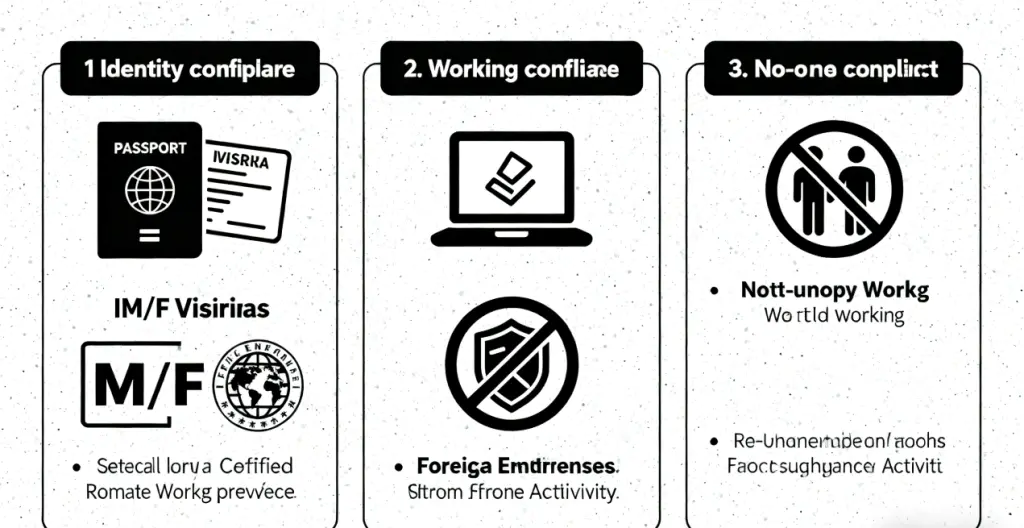
Eligibility Thresholds and Core Requirements for Cross-Border Remote Work
Cross-border remote work is currently the most common form of remote work for foreigners in China, and its qualification certification mainly revolves around three cores: “identity compliance,” “work scenario compliance,” and “no employment conflicts.” According to the guidelines issued by China’s National Immigration Administration in 2024, foreigners applying to engage in cross-border remote work in China must meet the following conditions:
First, in terms of identity qualifications, they must hold a valid non-work residence permit (such as M/F/Q visa), and the purpose of residence must match the remote work scenario. For example, foreigners holding an M visa can engage in cross-border remote work related to commercial and trade activities, while those holding an F visa can engage in remote work related to academic exchanges, but they must not exceed the scope specified in the residence permit. At the same time, foreigners must provide a Remote Work Certificate issued by their foreign employer, specifying work content, working hours, salary payment methods, and other information, and this certificate must be authenticated by a Chinese embassy or consulate abroad.
Second, in terms of work scenarios, the service recipient of cross-border remote work must be a foreign enterprise, and the work content must not involve physical business activities in China. For example, an American designer remotely designing products for the U.S. headquarters while in China falls within the compliant scope, but if the designer simultaneously designs a logo for a Chinese technology company, it constitutes “illegal employment.” In addition, the remote work location must be consistent with the place of residence specified in the residence permit. If a change of remote work location is required (such as moving from Beijing to Shanghai), the foreigner must file for record with the local exit and entry administration authority in advance.
Third, in terms of no employment conflicts, foreigners must not engage in other paid work in China simultaneously, nor may they use the name of remote work to carry out offline activities (such as holding commercial lectures or participating in on-site project implementation). China’s exit and entry administration authorities will monitor the use of residence permits through big data, and if any abnormalities are found, the residence permit will be revoked in accordance with the law, and entry restrictions may be imposed.
Application for Permits and Qualification Verification for Domestic Remote Work
Unlike cross-border remote work, domestic remote work requires foreigners to hold a Z visa and a Foreigner’s Work Permit. The qualification requirements are basically the same as those for traditional offline work, but the provisions on “work location” are more flexible. According to the Operation Guide for the Foreigner Work Permit Administration Service System, the focus of qualification certification for domestic remote work includes the following aspects:
First, educational background and work experience requirements. Foreigners applying for domestic remote work must meet the basic standard of “bachelor’s degree or above + 2 years or more of relevant work experience” (Class A high-end talents may be appropriately exempted), and must provide educational certification reports, work experience certificates, and other materials. For example, a British software engineer applying to provide remote development services for a Chinese internet company must submit the authentication of their British university degree, a software development work certificate issued by their previous employer, as well as the business license and employment contract of the Chinese company.
Second, application for “remote work notation” in the work permit. When a Chinese enterprise employs a foreigner to engage in remote work, it must check the “remote work” option when applying for the Foreigner’s Work Permit and specify the specific form of remote work (such as full-time remote work or hybrid remote work), work schedule, and management mechanism. The competent authority will verify whether the enterprise has the ability to manage remote work (such as whether it has a sound online attendance and performance assessment system). If the enterprise fails to provide relevant proof, the permit application may be rejected.
Third, dynamic management of work locations. Domestic remote workers can flexibly change their work locations within the province specified in their residence permit, but changes across provinces require filing with the authority that issued the work permit in advance. For example, a remote worker holding a work permit issued in Shanghai can change their work location within Jiangsu Province but must complete the filing procedure if moving to Guangdong Province. This dynamic management model not only adapts to the flexibility needs of remote work but also facilitates supervision by the competent authorities.
Practical Procedures and Compliance Key Points for Foreigners Working Remotely in China
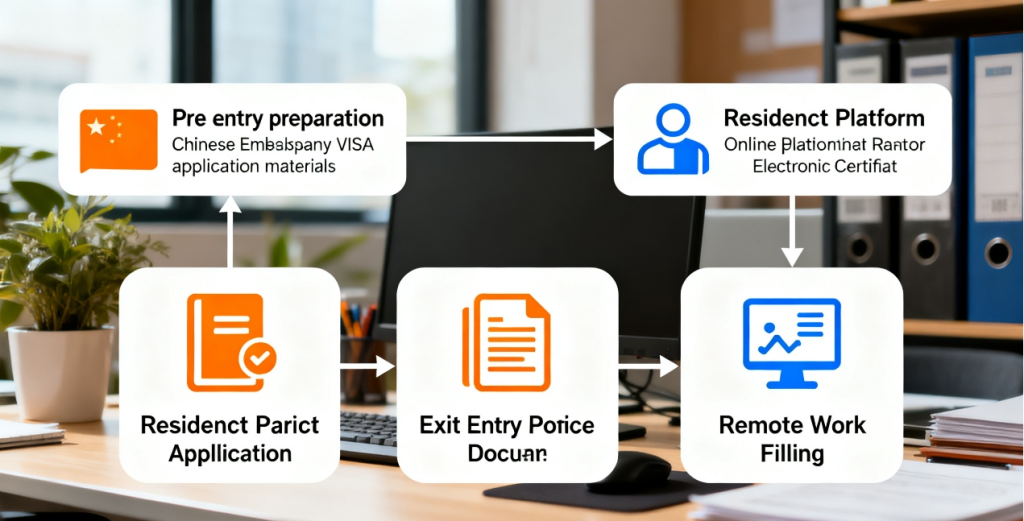
Entry and Filing Procedures for Cross-Border Remote Work
Foreigners planning to engage in cross-border remote work in China must follow the full-process norms of “pre-entry preparation → residence application → remote work filing,” with specific steps as follows:
Step 1: Pre-entry preparation stage. Foreigners must first apply for the corresponding type of non-work visa (such as M/F visa) from a Chinese embassy or consulate abroad. When applying, they need to submit a Letter of Intent for Remote Work issued by the foreign employer, their passport, travel itinerary, and other materials. Citizens of some countries can apply for a port visa, but they must confirm with the exit and entry administration authority at the port of entry in advance whether it supports matters related to remote work.
Step 2: Residence permit application stage. Within 15 days of entry, foreigners must apply for a residence permit from the exit and entry administration authority in their place of residence, submitting the Application Form for Foreigner’s Residence Permit, the authenticated Remote Work Certificate issued by the foreign employer, medical examination certificate, rental contract or accommodation certificate, and other materials. If the remote work involves sensitive industries (such as finance and technology), a letter of consent issued by the competent industry authority must also be provided.
Step 3: Remote work filing stage. Within 30 days of obtaining the residence permit, foreigners must submit an online application for remote work filing through the “National Immigration Administration Government Service Platform,” with filing content including information about the foreign employer, a summary of work content, and information about the salary payment account. After the filing is completed, the system will generate an electronic filing certificate, which foreigners must keep properly for subsequent inspections.
In practical operations, common compliance risks include: incomplete information in the Remote Work Certificate (such as unspecified working hours), a mismatch between the purpose of the residence permit and the content of remote work, and failure to complete filing on time. Once these problems occur, foreigners may face penalties such as revocation of the residence permit, fines, or even deportation. Therefore, foreigners must prepare materials in strict accordance with the procedural requirements and may consult professional exit and entry service agencies if necessary.
Permit Application and Daily Management for Domestic Remote Work
The procedures for domestic remote work are “enterprise-led and individual-coordinated,” with Chinese enterprises assuming primary compliance responsibilities as employers. The specific procedures are as follows:
Enterprise-side procedures: First, enterprises must submit a work permit application through the “Foreigners Working in China Administration Service System,” uploading materials such as the enterprise’s business license, employment contract (specifying remote work clauses), and certificates of the foreigner’s educational background and work experience. Second, after accepting the application, the competent authority will conduct online review and offline verification (such as random checks of the enterprise’s remote work management system). Upon passing the review, a Notice of Foreigner’s Work Permit will be issued. Finally, the enterprise must send the Notice of Foreigner’s Work Permit to the foreigner to assist them in applying for a Z visa for entry, and complete the application for the Foreigner’s Work Permit within 30 days of the foreigner’s entry.
Individual-side procedures: Foreigners must cooperate with enterprises in preparing materials, including providing educational certification, notarial certificate of no criminal record (authenticated), medical examination report, etc. After entry, they must collect biometric information at the designated institution within the specified time and obtain the Foreigner’s Work Permit. After engaging in remote work, they must comply with the enterprise’s online attendance requirements, submit work results regularly, and promptly inform the enterprise of any changes in work content or location, so that the enterprise can complete the relevant filing procedures.
In terms of daily management, enterprises must establish remote work files, recording the foreigner’s attendance, work results, salary payment records, etc., which must be kept for at least 2 years. Foreigners must properly keep the Foreigner’s Work Permit and apply for replacement within 10 days if it is lost or damaged. In addition, the competent authority will conduct random inspections quarterly, focusing on verifying whether enterprises have “nominal remote work” (i.e., claiming remote work but actually engaging in offline work) and whether foreigners work beyond the scope of their permits. If verified, the enterprise will be included in the “list of untrustworthy entities,” and the foreigner’s work permit will be revoked.
Tax and Social Security Compliance Issues for Foreigners Working Remotely in China
Tax Handling and Declaration Norms for Cross-Border Remote Work
Tax compliance is a core issue that cannot be ignored for foreigners working remotely in China. In particular, cross-border remote work involves two key tax determination factors: “cross-border income” and “length of stay in China,” which must be handled in accordance with the Individual Income Tax Law of the People’s Republic of China and relevant international tax treaties.
First, determination of tax liability. According to Chinese tax laws, foreigners who stay in China for 183 days or more in a tax year are considered “tax residents” and must pay individual income tax on their global income in China. If they stay for less than 183 days, they only need to pay individual income tax on income derived from China. For cross-border remote workers, if their salaries are paid by a foreign employer and derived from abroad, they generally do not need to pay individual income tax in China if they stay in China for less than 183 days. If they stay for 183 days or more, they must pay individual income tax on “comprehensive income” at a progressive tax rate of 3% to 45%.
Second, declaration procedures and material requirements. Cross-border remote workers who are tax residents must complete the annual final settlement through the “Individual Income Tax APP” or the competent tax authority between March 1 and June 30 of the following year. When declaring, they need to submit salary certificates issued by foreign employers, overseas tax payment certificates (if tax has been paid overseas, they can apply for a credit in accordance with international tax treaties), and other materials. Failure to declare on time will result in late payment fees (0.05% per day) and fines (50% to 5 times the unpaid tax amount).
Notably, in 2024, China’s State Taxation Administration issued the Guidelines for the Administration of Individual Income Tax on Cross-Border Remote Work, clarifying the criteria for determining the “source of remote work income.” If the content of remote work is directly related to business activities in China (such as providing remote services for a foreign enterprise’s Chinese project), the income will be deemed “income derived from China” and subject to tax in accordance with the law, even if the salary is paid overseas. This regulation further refines the boundaries of tax administration, which cross-border remote workers must pay special attention to.
Social Security Contribution and Rights Protection for Domestic Remote Work
Domestic remote workers enjoy the same social security rights as traditional offline workers. According to the Social Insurance Law and the Interim Measures for Foreigners Employed in China to Participate in Social Insurance, Chinese enterprises employing foreigners to engage in remote work must pay basic pension insurance, basic medical insurance, work-related injury insurance, unemployment insurance, and maternity insurance for them, while foreigners themselves bear the individual contribution portion.
The specific procedure for social security contribution is as follows: Within 30 days of handling the Foreigner’s Work Permit for a foreigner, the enterprise must go to the local social security agency to handle the insurance registration, submitting materials such as the foreigner’s passport, work permit, and employment contract. After verification by the social security agency, a social security account will be established for the foreigner, and the enterprise will withhold and pay social security fees on a monthly basis. The social security contribution base for foreigners is determined based on their actual salary but must not be lower than the minimum social security contribution base (usually 60% of the average salary of employees in urban units in the local area in the previous year).
In terms of rights protection, domestic remote workers can enjoy the same social security benefits as Chinese citizens: those who have paid contributions for a cumulative period of 15 years when reaching the statutory retirement age can receive basic pensions on a monthly basis; those who fall ill or are injured non-work-related can enjoy basic medical insurance benefits; those who are injured at work can apply for work-related injury insurance benefits. If a foreigner resigns and returns to their home country, their social security account can be sealed, or social security transfer can be handled in accordance with relevant bilateral agreements (China has signed social security mutual exemption agreements with 12 countries, such as Germany and South Korea).
It should be noted that some enterprises refuse to pay social security for foreigners on the grounds that “remote work does not require on-site attendance,” which is illegal. Foreigners can file complaints and reports with the local labor security supervision department to safeguard their legitimate rights and interests.
Challenges and Solutions for Foreigners Working Remotely in China
Policy Perception Bias and Information Access Issues
Currently, the primary challenge faced by foreigners working remotely in China is policy perception bias. Many foreigners lack an understanding of the policy differences between “cross-border remote work” and “domestic remote work,” mistakenly believing that engaging in remote work with a tourist visa is compliant or that cross-border remote work does not require filing, thereby triggering compliance risks. According to statistics from China’s National Immigration Administration in 2024, 32% of the cases of illegal employment by foreigners investigated throughout the year were related to misunderstandings of remote work policies.
The core solution to this problem lies in expanding access to authoritative information. Currently, foreigners can obtain remote work policy information through three official channels: first, the “Foreigner Services” column on the official website of the National Immigration Administration, which provides one-stop services such as policy texts, operation guides, and frequently asked questions; second, the “Immigration Administration” APP and mini-program, which support multi-language inquiries and allow online submission of consultation applications; third, the “foreigner service hotlines” set up by exit and entry administration authorities in various provinces and cities (such as the Beijing 12367 hotline), which provide 24-hour multi-language policy consultation services.
In addition, some pilot cities have begun to launch “remote work policy briefings,” regularly inviting experts from exit and entry, taxation, social security, and other departments to interpret policies. Foreigners can register through the foreign-related service centers in their places of residence. For enterprises, it is recommended to cooperate with professional foreign-related legal service agencies to establish a regular policy training mechanism, ensuring that both HR personnel and remote workers can accurately understand policy requirements.
Cross-Border Payment and Work Communication Efficiency Issues
The flexibility of remote work relies on efficient digital support, but foreigners working remotely in China often face two practical challenges: cross-border payment and communication efficiency. In terms of cross-border payment, due to foreign exchange control policies, when foreign employers pay salaries to foreigners in China, they must go through banks with foreign exchange settlement qualifications and submit materials such as the Remote Work Certificate and Salary Payment Agreement. The process is cumbersome and time-consuming, and some small and medium-sized enterprises experience delayed salary payments due to unfamiliarity with the procedures.
To address this issue, the People’s Bank of China further optimized the facilitation measures for cross-border salary payments in 2024: for foreigners who have completed remote work filing, foreign employers can submit payment applications online through the “Cross-Border Financial Blockchain Service Platform,” reducing the bank verification time from 3-5 working days to 1 working day. At the same time, eligible foreign-invested enterprises are allowed to use RMB to pay salaries to foreigners engaged in domestic remote work without going through foreign exchange verification procedures. Foreigners and enterprises can give priority to banks that have accessed the platform (such as Bank of China and Industrial and Commercial Bank of China) for payment business to improve efficiency.
In terms of communication efficiency, due to language barriers and network environment restrictions, some foreigners face obstacles in remote communication with foreign employers. Solutions include: first, using domestically compliant video conferencing tools (such as Tencent Meeting International Edition and Lark International Edition) to ensure communication stability; second, enterprises assigning bilingual assistants to foreigners to assist in resolving language issues in work communication; third, hiring professional translation services through “foreign-related talent service platforms” to meet the needs of complex scenarios such as technical communication.
Policy Stability and Regional Difference Issues
Currently, China’s remote work policies are still in the stage of dynamic improvement, and some provisions are adjusted relatively frequently, posing challenges to the compliance arrangements of foreigners and enterprises. For example, from 2023 to 2024, the requirements for filing materials for cross-border remote work were fine-tuned three times, and some enterprises failed to complete filing due to not timely grasping policy changes. In addition, there are differences in policy implementation standards among different cities. For example, Shanghai has relatively loose authentication requirements for the Remote Work Certificate for cross-border remote work, while Beijing requires the original certificate authenticated by a Chinese embassy or consulate abroad. Such regional differences increase the compliance difficulty of cross-city remote work.
To address policy stability issues, it is recommended that foreigners and enterprises establish a “policy tracking mechanism”: regularly check policy updates on the official website of the National Immigration Administration, subscribe to the officially released Policy Dynamics of Foreigners Working in China; at the same time, establish regular communication with the local exit and entry administration authority to timely understand the latest policy implementation requirements. For cross-city remote work, it is necessary to confirm policy differences with the competent authorities of both places in advance and select the city with clearer policy implementation as the main work location.
In the long run, with the continuous development of China’s digital economy, remote work policies will gradually become stable and unified. In October 2024, the National Development and Reform Commission explicitly proposed “establishing a national unified management and service platform for foreigners’ remote work” in the Draft Law on Promoting the Digital Economy. In the future, digital means will be used to achieve unified policy standards, online procedures, and precise and efficient supervision, which will provide a more stable policy environment for foreigners working remotely in China.
Future Trends and Policy Outlook for Foreigners Working Remotely in China

Further Improvement and Refinement of the Policy System
In the next 3-5 years, China’s policies on foreigners working remotely will develop in the direction of “systematization, refinement, and digitalization.” In terms of systematization, it is expected that the Regulations on the Administration of Foreigners Working Remotely in China will be introduced, integrating the current scattered policies across various departments to form a unified legal framework, clarifying the definition, classification, rights, and obligations of remote work, and ending the current “fragmented policy” situation.
In terms of refinement, differentiated policies will be formulated for different types of remote workers: for Class A high-end talents (such as Nobel Prize winners and top international scientific and technological talents), restrictions on residence permits for cross-border remote work will be further relaxed, allowing them to engage in cross-border remote work in China without time limits and without the need for filing procedures; for Class B professional talents, the “remote work notation” process for work permits will be optimized to achieve “one application, nationwide validity”; for Class C skilled talents, the industry scope for their remote work will be clarified (such as remote operation and maintenance in manufacturing and remote customer service in the service industry) to avoid conflicts with the domestic job market.
In terms of digitalization, the “national unified management and service platform for foreigners’ remote work” will be put into operation by the end of 2025, realizing the whole-process online handling of “permit application, filing, payment, and inspection.” At the same time, a “risk early warning model” will be established through big data and artificial intelligence technologies to conduct real-time monitoring of data such as the residence status, work content, and salary payment of remote workers, achieving precise supervision of “facilitating compliant individuals and restricting non-compliant ones.”
In-depth Integration of Remote Work and Talent Introduction
China is in a critical stage of industrial upgrading and high-quality development, with an increasingly urgent demand for global high-end talents. Remote work will become an important “flexible channel” for talent introduction. In the future, remote work policies will be deeply integrated with talent introduction policies to form a flexible talent introduction model of “online remote cooperation + offline short-term exchanges.” For example, high-end talents who are temporarily unable to work in China full-time can first provide services for Chinese enterprises through remote work, and after a certain period of cooperation, they can be given priority in applying for the “talent visa” (R visa) and permanent residence qualification.
In 2024, Shanghai took the lead in launching this pilot: eligible cross-border remote workers who have worked in China for 6 months can apply for an R visa with the Remote Work Achievement Evaluation Report issued by the enterprise, reducing the approval time from 15 working days to 5 working days. At the same time, their salaries during the remote work period can be included in the calculation base of the “talent introduction housing subsidy.” This pilot experience is expected to be promoted nationwide in 2025, further enhancing China’s attractiveness to global talents.
In addition, targeting the emerging group of “digital nomads,” some tourist cities (such as Sanya and Xiamen) have begun to explore the policy combination of “remote work + tourism,” launching “digital nomad visas” that allow foreigners to engage in cross-border remote work while traveling in China within the validity period of their residence permits. This innovative measure not only enriches remote work scenarios but also drives the development of local cultural and tourism economies, and is expected to become an important direction for future policy innovation.
Continuous Deepening of International Cooperation in Cross-Border Remote Work
The cross-border nature of remote work determines that its development requires the support of international cooperation. In the future, China will further strengthen policy coordination with other countries in the field of remote work. At the bilateral cooperation level, China will sign “remote work mutual recognition agreements” with more countries to achieve mutual recognition of work qualifications, tax handling, and social security connection. For example, a consensus has been reached with the European Union that starting from 2025, EU citizens holding remote work certificates issued by their home countries can directly engage in cross-border remote work in China without going through repeated authentication procedures. At the same time, China and the EU will establish a “cross-border remote work tax credit mechanism” to avoid double taxation.
At the multilateral cooperation level, China will actively participate in the construction of the “Asia-Pacific Remote Work Alliance,” promoting the formulation of regional remote work standards, including qualification certification standards, data security standards, and salary payment standards, to improve the facilitation level of remote work in the Asia-Pacific region. In addition, relying on the “Belt and Road” Initiative, China will carry out remote work skills training cooperation with countries along the route, helping local talents improve their remote work capabilities while providing support for Chinese enterprises to recruit remote workers from these countries, achieving mutual benefit and win-win results.
In terms of data security, a “security assessment mechanism for cross-border remote work data transmission” will be established to clarify the scope and procedures of data outbound, providing convenience for data transmission required for remote work while ensuring national security. For example, enterprises will be allowed to transmit remote work-related data through compliant cloud service platforms without going through complex data outbound security assessment procedures, further reducing the operating costs of cross-border remote work.
Conclusion
With the continuous development of digital technology and the deepening of global division of labor, foreigners working remotely in China has evolved from a “possibility” to a “reality.” China’s remote work policies are also constantly improving in practice, gradually forming distinct characteristics of “compliance-oriented, flexible and efficient, and open and inclusive.” For foreigners, to successfully engage in remote work in China, they must accurately grasp the policy framework, strictly abide by qualification requirements and practical procedures, and properly handle compliance issues such as taxation and social security. For enterprises, they must assume their main responsibilities, establish a sound remote work management system, and strengthen policy learning and risk prevention and control.
Looking to the future, China’s remote work policies will become more improved, open, and international, providing a better development environment for global talents and stronger support for Chinese enterprises to absorb global wisdom and achieve high-quality development. In this process, the improvement of policies, the participation of enterprises, and the compliance of individuals will form a synergy, promoting the sustained and healthy development of the market for foreigners working remotely in China and contributing Chinese strength to the construction of a global workplace.
*Policies are subject to change over time. This document is for reference only. Please consult the relevant official authorities for the most current and accurate information.