
Learn the core responsibilities, skill requirements, and market value of a Business Development Manager in China’s B2B technology sector, plus how they collaborate with B2B Technical Sales Role to drive 1+1>2 results—your go-to guide for building high-performance sales teams.
Introduction
Amid the sweeping wave of digital transformation in China, the B2B technology sector is experiencing explosive growth—from industrial internet and cloud computing to artificial intelligence (AI) solutions, enterprises’ demand for efficient technical tools is surging. In this trend, the **Business Development Manager** serves as a core link connecting enterprises to the market. Not only do they take on the responsibility of driving the implementation of technical products, but they also collaborate closely with the “B2B Technical Sales Role” to jointly support the expansion of China’s B2B technology market. This article will comprehensively analyze the positioning, responsibilities, and skill requirements of Business Development Managers in China, as well as their collaboration model with B2B Technical Sales Roles. It aims to help enterprises build teams accurately and provide practitioners with a clear career development path.
Current Status of China’s B2B Technology Market: Core Value Scenarios for Business Development Managers
The scale of China’s B2B technology market has maintained a year-on-year growth rate of over 15% for five consecutive years, exceeding RMB 5 trillion in 2024. Among this, digital transformation in manufacturing, enterprise-level SaaS services, and intelligent supply chain technology have become the three core growth drivers. In this context, the key challenges enterprises face are no longer “whether the technology is advanced,” but “how to align technology with market demand” and “how to convert technical solutions into long-term partnerships”—and the Business Development Manager is the critical role in addressing these challenges.
Unlike traditional sales roles, Business Development Managers need to possess not only market insight but also a deep understanding of the underlying logic of B2B technology. They must be able to identify customers’ potential needs from an enterprise strategic perspective. For example, when a Business Development Manager at a cloud computing company engaged with an auto parts manufacturer, they did not simply promote cloud servers. Instead, they researched the customer’s production processes, identified the pain point of “delayed cross-factory data synchronization,” and then collaborated with the B2B Technical Sales Role to design an integrated solution incorporating cloud storage and edge computing. Ultimately, this led to a annual cooperation agreement worth over RMB 10 million. This model of “needs identification + customized solution development” embodies the core value of Business Development Managers in the B2B technology sector.
Furthermore, China’s policy orientation provides a broad stage for Business Development Managers. The “14th Five-Year Plan” explicitly emphasizes “promoting in-depth integration of the digital economy with the real economy.” Local government policies such as subsidies and tax incentives for enterprise digital transformation have become important catalysts for Business Development Managers to drive cooperation. Business Development Managers need to accurately interpret policy details and convert policy dividends into “catalysts” for customer collaboration. For instance, when a Business Development Manager engaged with small and medium-sized manufacturing enterprises, they proactively organized local “digital transformation subsidy policies,” helped customers calculate cost savings and subsidy amounts after adopting AI quality inspection technology, and ultimately facilitated cooperation agreements with over 30 enterprises. In this process, the Business Development Manager acted as both a “policy interpreter” and a “needs matcher,” making their role irreplaceable.

Core Responsibilities of a Business Development Manager: End-to-End Actions in B2B Technical Sales Scenarios
Within the B2B technical sales system, the responsibilities of a Business Development Manager span the entire lifecycle of “market research → customer development → solution implementation → long-term maintenance.” At each stage, close collaboration with the B2B Technical Sales Role is essential to ensure that technical solutions accurately meet needs and drive efficient cooperation conversion.
Market Research and Trend Forecasting: Providing Direction for B2B Technical Sales Roles
The primary responsibility of a Business Development Manager is to gain insight into market dynamics and define precise target customer groups and sales directions for B2B Technical Sales Roles. In China’s B2B technology market, demand varies significantly across industries and enterprise sizes—for example, large state-owned enterprises prioritize technology security and compliance, while internet startups focus on cost and flexibility. Business Development Managers need to conduct multi-dimensional research to produce detailed market analysis reports, including: the digital penetration rate of target industries, customers’ core pain points, competitors’ technical advantages and pricing strategies, and technical demand trends over the next 1–3 years.
Take the field of AI customer service technology as an example: Through research, a Business Development Manager discovered that during peak sales periods such as “618” and “Double 11,” the e-commerce industry faces a 30% shortage of customer service staff, and traditional manual customer service suffers from delayed responses and inconsistent scripts. Based on this insight, the Business Development Manager identified “AI customer service for the e-commerce industry” as a core focus and provided B2B Technical Sales Roles with a clear customer profile: e-commerce enterprises with annual GMV exceeding RMB 100 million, customer service teams of over 50 people, and obvious peak-period pressure. Leveraging this guidance, B2B Technical Sales Roles prepared targeted AI customer service demonstration solutions—including peak concurrent processing capabilities and customized script functions—boosting the sales conversion rate by 28%. This demonstrates that the market research capabilities of Business Development Managers directly determine the work efficiency and results of B2B Technical Sales Roles.
Customer Development and C-level Engagement: Opening the Door for B2B Technical Sales Roles
One of the core challenges in B2B technical sales is “how to reach customer decision-makers.” B2B Technical Sales Roles often face hierarchical barriers that prevent them from engaging with key decision-makers such as CEOs and CTOs. In contrast, Business Development Managers—with their strategic perspective and business acumen—serve as a “bridge” connecting to enterprise leadership. Customer development by Business Development Managers is not “blind outreach,” but rather targeting high-matching potential customers based on preliminary market research. They establish initial connections with customer decision-makers through industry exhibitions, executive summits, and referrals from third-party partners.
Consider a Business Development Manager at an industrial internet company who was developing a large machinery manufacturing enterprise. Instead of directly promoting the industrial internet platform, they participated in the “China Manufacturing Digital Transformation Summit” and engaged in discussions with the enterprise’s CTO about industry pain points such as “high equipment maintenance costs and delayed fault warnings.” The Business Development Manager then proposed a preliminary concept for an “IoT-based equipment health management solution,” which sparked the CTO’s interest. Subsequently, the Business Development Manager coordinated the B2B Technical Sales Role to participate in follow-up communications. The B2B Technical Sales Role provided a detailed demonstration of technical details—such as sensor data collection frequency and AI fault warning accuracy—ultimately leading to a 3-year cooperation agreement worth RMB 20 million. In this process, the Business Development Manager opened the door to cooperation through C-level engagement, while the B2B Technical Sales Role handled in-depth technical communications—neither role could have achieved this alone.
Solution Customization and Resource Coordination: Providing Implementation Support for B2B Technical Sales Roles
B2B technical sales is not about “promoting standardized products,” but rather “delivering customized solutions.” Customers often have personalized needs, such as compatibility with existing systems or functional adaptation for specific scenarios. At this point, Business Development Managers must act as “solution coordinators,” linking internal technical R&D, product, and legal teams to provide comprehensive support for B2B Technical Sales Roles. This ensures that solutions meet both customer needs and the enterprise’s technical capabilities and risk control requirements.
For example, when a Business Development Manager at an enterprise-level SaaS software company engaged with a financial institution, the customer raised two specific requirements: “the software must comply with CBIRC data encryption standards” and “real-time data integration with existing core business systems.” While the B2B Technical Sales Role understood the needs, they could not independently adjust the solution. The Business Development Manager immediately organized a special meeting with the technical R&D team to clarify technical standards for data encryption and the timeline for developing system integration interfaces. They also coordinated the legal team to review compliance clauses in the solution to avoid potential legal risks. The final customized solution was then presented in detail to the customer by the B2B Technical Sales Role. Throughout this process, the Business Development Manager resolved “worries” for the B2B Technical Sales Role through resource coordination, ensuring the smooth implementation of the solution with a customer satisfaction rate of 92%.
Long-Term Relationship Maintenance and Secondary Development: Extending the Cooperative Value of B2B Technical Sales Roles
The lifecycle of B2B technical cooperation typically lasts 3–5 years or longer. Therefore, the responsibilities of Business Development Managers extend beyond “securing contracts” to “long-term maintenance and secondary development.” Business Development Managers need to engage with customers regularly to understand the effectiveness of technical solutions, collect feedback, and convert this into opportunities for secondary cooperation. This not only enhances customer loyalty but also opens up new sales avenues for B2B Technical Sales Roles.
A Business Development Manager at a data security technology company discovered that a major internet client had added overseas server nodes due to business expansion, but the existing data security solution only covered domestic scenarios. The Business Development Manager immediately shared this need with the B2B Technical Sales Role and collaborated with the technical team to design a “global data security protection solution,” adding firewall configurations for overseas nodes and encrypted cross-border data transmission functions. Leveraging the demand information provided by the Business Development Manager, the B2B Technical Sales Role quickly engaged with the customer’s technical department, ultimately facilitating secondary cooperation with a 60% increase in contract value compared to the initial agreement. This model of “driving development through maintenance” not only positions the Business Development Manager as a trusted “partner” to the customer but also supports sustained performance growth for the B2B Technical Sales Role.

Collaboration Model Between Business Development Managers and B2B Technical Sales Roles: A 1+1>2 Cooperation System
In the B2B technical sales field, Business Development Managers and B2B Technical Sales Roles are not in a “primary-secondary” relationship, but rather “complementary partners.” Business Development Managers focus on “strategic needs identification and relationship building,” while B2B Technical Sales Roles focus on “tactical solution demonstration and technical implementation.” Together, they form a 1+1>2 cooperation system.
Early Stage: Alignment on Target Customers and Collaborative Demand Forecasting
Before engaging with customers, Business Development Managers and B2B Technical Sales Roles hold a “pre-engagement meeting” to clarify three core questions: First, “what are the target customer’s core pain points?” The Business Development Manager provides industry trends and potential needs based on market research, while the B2B Technical Sales Role supplements technical pain points from past cases. Second, “who are the key stakeholders in the customer’s decision-making chain?” The Business Development Manager maps the customer’s organizational structure, identifying decision-makers (e.g., CEO, CTO) and implementers (e.g., technical supervisors, procurement managers), while the B2B Technical Sales Role clarifies technical contacts. Third, “what are the core selling points of the preliminary solution?” The Business Development Manager defines the solution’s differentiated advantages (e.g., lower costs, faster implementation) from a market competition perspective, while the B2B Technical Sales Role highlights core product functions (e.g., stronger compatibility, higher security) from a technical perspective.
For example, before engaging with a logistics enterprise, the Business Development Manager identified “low warehouse sorting efficiency and high labor costs” through research, while the B2B Technical Sales Role supplemented that “similar logistics enterprises had reported delays in integrating traditional sorting systems with WMS systems.” Combining these insights, they defined the core selling point of the preliminary solution as: “The intelligent sorting system seamlessly integrates with existing WMS systems, increasing sorting efficiency by 40% and reducing labor costs by 25%.” They also clarified that engagement was needed with the customer’s CTO (decision-maker) and warehouse technical supervisor (implementer). This early collaboration ensured that subsequent communications were targeted, avoiding the disconnect of “Business Development Managers lacking technical knowledge and B2B Technical Sales Roles lacking market understanding.”
Mid-Stage: Collaborative Customer Engagement and Solution Demonstration
During customer communications, Business Development Managers and B2B Technical Sales Roles adopt a “clear division of labor” model: When engaging with decision-makers, the Business Development Manager leads the discussion, focusing on explaining the solution’s business value to the customer (e.g., cost reduction, efficiency improvement, enhanced competitiveness). The B2B Technical Sales Role acts as “technical support,” briefly addressing decision-makers’ technical questions (e.g., “What is the implementation timeline?” “Is additional hardware investment required?”). When engaging with implementers (e.g., technical teams), the B2B Technical Sales Role leads the demonstration, providing detailed explanations of the solution’s technical architecture, functional details, and implementation steps. The Business Development Manager supplements the solution’s commercial advantages (e.g., “flexible payment terms,” “post-implementation maintenance guarantees”).
A cloud computing company adopted this collaborative model when engaging with a chain retail enterprise: When communicating with the retail enterprise’s CEO, the Business Development Manager focused on analyzing “how cloud services help reduce IT hardware investment and support rapid store expansion,” while the B2B Technical Sales Role only briefly explained that “bank-level encryption technology is used, and data storage complies with national Level 3 Cyber Security Grade Protection Standards” when the CEO asked about data security. When engaging with the retail enterprise’s IT team, the B2B Technical Sales Role provided a detailed demonstration of “cloud platform deployment processes, API documentation, and fault emergency plans,” while the Business Development Manager supplemented that “7×24 maintenance services will be provided after cooperation, and free technical training will be offered for the initial deployment.” This “layered communication” model not only addresses decision-makers’ focus on “business value” but also resolves implementers’ concerns about “technical implementation,” ultimately accelerating cooperation.
Late Stage: Collaborative Project Implementation and Problem Resolution
After the cooperation agreement is signed, collaboration between Business Development Managers and B2B Technical Sales Roles does not end. Business Development Managers are responsible for “overall project progress tracking and customer relationship maintenance,” while B2B Technical Sales Roles focus on “technical solution implementation and issue response.” Together, they ensure the smooth delivery of the project.
For example, when an AI quality inspection technology company implemented a project for an electronics factory, a problem arose: “The AI model had insufficient accuracy in identifying parts made of certain special materials.” The B2B Technical Sales Role immediately reported the issue to the internal R&D team and updated the Business Development Manager. The Business Development Manager then engaged with the customer’s production director to explain the cause of the problem (“Surface texture differences in parts made of special materials are minimal, requiring optimization of model training data”) and committed to a timeline for the solution (“Model iteration will be completed within 7 working days”). During this process, the B2B Technical Sales Role focused on “technical problem-solving,” while the Business Development Manager focused on “managing customer expectations.” The issue was ultimately resolved smoothly, and the customer did not file any complaints. This late-stage collaboration not only ensures project quality but also strengthens the customer’s trust in the enterprise, laying the foundation for future secondary cooperation.

Skill Requirements for Business Development Managers in China’s B2B Technology Sector: Mastery of Both Hard and Soft Skills
To excel as a Business Development Manager in China’s B2B technology sector, one must possess both “hard skills” and “soft skills.” Hard skills ensure a deep understanding of technology and the market, while soft skills ensure effective collaboration with customers and internal teams.
Hard Skills: Technical Comprehension + Market Analysis + Business Negotiation
Technical Comprehension: Ability to “Understand” and “Explain Clearly”
Business Development Managers do not need to be technical experts, but they must possess basic technical comprehension—ability to understand technical team explanations and translate complex technical jargon into customer-friendly “business language.” For example, when engaging with manufacturing customers, Business Development Managers should translate “edge computing nodes in industrial internet platforms” into “real-time shop-floor equipment data collection without relying on the cloud, reducing latency.” When engaging with financial customers, they should translate “blockchain’s distributed ledger” into “transaction data shared across multiple parties, immutable, and enhancing compliance.”
Technical comprehension is developed through two channels: First, internal training—regularly participating in product briefings by the technical team to understand the core logic, advantages, and limitations of technical solutions. Second, industry learning—following authoritative B2B technology media (e.g., 36Kr Enterprise Services Channel, IDC China Reports) and attending technical exhibitions (e.g., Shanghai Industry Fair, Shenzhen High-Tech Fair) to accumulate industry knowledge. A Business Development Manager, in their early tenure, participated in the technical team’s “weekly product meetings” for three consecutive months and read over 10 industry analysis reports. This allowed them to quickly master basic concepts of cloud computing and big data, enabling them to independently explain the core value of technical solutions to customers within six months. The customer conversion rate for their portfolio increased by 35% compared to their initial tenure.
Market Analysis: Ability to “Forecast” and “Focus”
Business Development Managers need sharp market analysis skills—ability to forecast industry trends and focus on precise customer groups. In China’s B2B technology market, “bandwagon-style” customer development often leads to resource waste. For example, one enterprise blindly promoted AI marketing technology in the traditional agriculture sector, but achieved minimal results due to weak digital infrastructure and limited budgets among agricultural enterprises. In contrast, Business Development Managers with strong market analysis skills use “data + experience” to select target markets: First, they use industry reports (e.g., iResearch, Analysys) to understand the digital penetration rate and budget scale of various industries. Then, they combine the enterprise’s technical advantages to target niche areas with “low penetration, sufficient budgets, and urgent needs.”
For example, a Business Development Manager at a SaaS ERP company analyzed data and discovered: “The digital penetration rate in the chain catering industry is only 30%, but leading enterprises have annual digital budgets exceeding RMB 10 million, and face pain points such as ‘decentralized store management and slow inventory turnover.’” They thus focused on “chain catering enterprises with over 50 stores.” Through this precise positioning, their team secured 8 customers within six months, with an average contract value exceeding RMB 5 million—far above the industry average.
Business Negotiation: Ability to “Defend Bottom Lines” and “Achieve Win-Win Outcomes”
Negotiations for B2B technical cooperation often involve large amounts of money and long cycles. Business Development Managers need professional business negotiation skills—ability to defend the enterprise’s cost bottom lines and interests while meeting customers’ reasonable needs to achieve “win-win outcomes.” The core of negotiation is not “price haggling,” but “value exchange.” Business Development Managers need to identify customers’ core demands (e.g., “extending payment terms,” “increasing free maintenance duration”) and propose corresponding exchange conditions based on enterprise policies (e.g., “If payment terms are extended by 1 month, the contract value must increase by 10%,” “If 3 months of free maintenance are added, a 2-year+ renewal agreement must be signed”).
A Business Development Manager at a data services company was negotiating with an internet firm. The customer requested “reducing the down payment ratio from 50% to 30%” and “shortening the project delivery timeline by 1 month.” Through analysis, the Business Development Manager identified the customer’s core demand as “alleviating cash flow pressure,” while the enterprise’s bottom lines were “a minimum 40% down payment and a shortest 4-month delivery timeline.” The Business Development Manager thus proposed: “The down payment ratio can be reduced to 40%, but payment must be made within 15 days of project initiation; the delivery timeline can be shortened to 4.5 months, and if delivered ahead of schedule, the customer must pay an additional 5% ‘fast delivery bonus.’” The customer ultimately accepted the proposal, and the cooperation was successfully finalized. In this process, the Business Development Manager defended the enterprise’s core interests while meeting the customer’s cash flow needs, achieving a win-win outcome.
Soft Skills: Communication & Coordination + Stress Resistance + Strategic Thinking
Communication & Coordination: Ability to Engage “Upward” and “Downward”
Business Development Managers interact with multiple stakeholders—reporting to enterprise leadership (e.g., presenting market plans, applying for resource support), coordinating internal technical, product, and legal teams, and engaging with customer decision-makers and implementers. This requires Business Development Managers to have “empathetic” communication skills: When engaging with leadership, they report using “data + results” (e.g., “Plans to develop manufacturing customers, expected to generate RMB 20 million in revenue within six months”). When engaging with technical teams, they communicate using “needs + goals” (e.g., “The customer requires deployment within 3 months—can R&D priorities be adjusted?”). When engaging with customers, they communicate using “pain points + value” (e.g., “Regarding the inventory turnover issue you mentioned, our solution can help reduce your inventory costs by 20%”).
A Business Development Manager encountered a challenge while advancing a large-scale project: The internal technical team “could not adjust the solution on time due to heavy R&D workload.” Instead of demanding overtime from the technical team, they first engaged with the technical lead: “This customer is a leading enterprise in the industry. If the project succeeds, it may bring in over 5 similar customers, providing the technical team with more practical scenario-based demand feedback to optimize the product.” At the same time, they applied to enterprise leadership for a “project-specific R&D subsidy” to provide additional incentives for the technical team. Ultimately, the technical team adjusted their work schedule, completed the solution adjustment on time, and the project was successfully implemented. This “goal-oriented, stakeholder-centric” communication and coordination ability is the core guarantee for Business Development Managers to advance their work.
Stress Resistance: Ability to “Endure Pressure” and “Break Through Difficulties”
China’s B2B technology market is highly competitive, and Business Development Managers often face multiple pressures—high performance targets, changing customer needs, and project delays. For example, one Business Development Manager faced the risk of “failing to meet performance assessments” after a customer changed requirements midway, causing project delays. In such situations, Business Development Managers with strong stress resistance calmly analyze the problem: First, they engage with the customer to clarify the core reasons and priorities for the requirement changes. Then, they negotiate with internal teams to develop a new project plan. Finally, they report the situation to leadership and apply for a “performance assessment grace period.” Ultimately, this Business Development Manager adjusted the solution and worked overtime to complete project delivery within the grace period, not only preserving their performance but also gaining customer recognition for “flexibly adapting to requirement changes.”
Stress resistance is not developed overnight but through practical experience: On one hand, Business Development Managers should develop the habit of “goal decomposition,” breaking down large targets into monthly or weekly small goals to reduce pressure perception. On the other hand, they should learn to “integrate resources,” proactively seeking support from teams and leadership when facing difficulties instead of bearing the burden alone.
Strategic Thinking: Ability to “Look Ahead” and “Implement Effectively”
Business Development Managers must focus not only on “immediate performance” but also possess “long-term strategic thinking”—ability to forecast industry trends, lay out future markets in advance, and translate strategies into actionable plans. For example, in 2023, a Business Development Manager observed the “application potential of generative AI in enterprise services” and proposed to the enterprise: “Proactively lay out generative AI + SaaS solutions,” developing a phased plan: Phase 1 (within 3 months): Research customer demand for generative AI; Phase 2 (within 6 months): Collaborate with the technical team to develop a prototype product; Phase 3 (within 12 months): Pilot promotion in key industries. When generative AI technology boomed in 2024, the enterprise quickly captured market share with its early-stage solutions, and the annual revenue of the team led by this Business Development Manager increased by 200%.
The core of strategic thinking is “foresight + feasibility”—it requires both judgment of industry trends and the ability to convert trends into actual business results. Business Development Managers can enhance their strategic thinking by regularly reading industry whitepapers (e.g., Gartner, McKinsey China Reports), participating in executive strategy seminars, and engaging with industry experts.
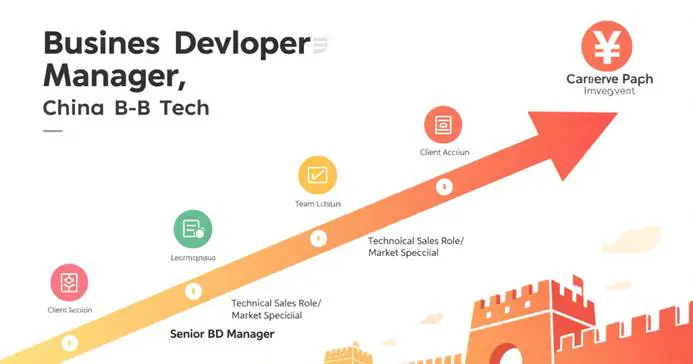
How to Become a Business Development Manager in China’s B2B Technology Sector? Career Path and Growth Advice
For practitioners aspiring to enter China’s B2B technology sector, becoming a Business Development Manager is a gradual process that involves “foundation building → ability enhancement → role transition.” Below is a detailed career path and growth advice.
Career Path: Starting as a “B2B Technical Sales Role” or “Marketing Specialist”
The core competencies required of a Business Development Manager—”understanding the market, understanding technology, understanding customers”—make the “B2B Technical Sales Role” or “Marketing Specialist” the most suitable entry-level positions:
Starting as a B2B Technical Sales Role: This role allows direct customer engagement, accumulating experience in “needs understanding + solution demonstration” while familiarizing oneself with the core advantages and implementation processes of technical products. Practitioners can work in this role for 2–3 years, accumulate customer resources and industry knowledge, and then transition to a Business Development Manager role. For example, a B2B Technical Sales Specialist managed sales for over 10 manufacturing customers in 3 years, gaining a deep understanding of digital needs in the manufacturing sector. After transitioning to a Business Development Manager, they quickly engaged with manufacturing customers, achieving over RMB 15 million in performance in their first year.
Starting as a Marketing Specialist: This role involves market research, industry analysis, and brand promotion, building “market insight + resource integration” capabilities. Practitioners can work in this role for approximately 2 years, gain in-depth understanding of B2B technology market trends and competitive landscapes, and then transition to a Business Development Manager role through internal transfers or external job searches. A Marketing Specialist once responsible for writing industry reports on B2B cloud computing accumulated extensive market data and customer profiles through report writing. After transitioning to a Business Development Manager, they accurately identified target customers, and their customer development efficiency was 40% higher than that of peers who joined at the same time.
Ability Enhancement: Targeted Learning and Practical Experience
Learning Resources: Courses + Certifications + Industry Events
Course Learning: Take courses such as “B2B Sales Strategy,” “Market Analysis and Forecasting,” and “Business Negotiation Skills” on online platforms (e.g., Coursera, NetEase Cloud Classroom). Participate in internal technical training to enhance technical comprehension.
Certification: Obtain certifications related to the B2B technology sector, such as “Digital Marketing Specialist,” “Cloud Computing Engineer (Entry Level),” and “Project Management Professional (PMP).” These certifications not only enhance professional capabilities but also increase employability.
Industry Events: Regularly attend B2B technology exhibitions (e.g., Beijing International Enterprise IT Application Expo, Guangzhou B2B Technology Expo) and seminars (e.g., China Enterprise Digital Transformation Forum) to expand professional networks and stay updated on industry trends.
Practical Experience: From “Small Projects” to “Major Customers”
In the initial stage, practitioners can start with “small-value, short-cycle” projects to accumulate practical experience. For example, B2B Technical Sales Roles can first engage with small and medium-sized customers to familiarize themselves with solution presentations and contract signing processes. Marketing Specialists can first conduct research on a specific niche and produce small-scale analysis reports. As capabilities improve, gradually take on “large-value, long-cycle” projects, such as engaging with industry-leading customers or leading large-scale cross-departmental solution implementations. In practice, develop a “review” habit: After each project, summarize successful experiences (e.g., “Higher conversion rates through industry association referrals during customer development”) and lessons learned (e.g., “Lost cooperation due to failure to understand customer budget, leading to overpricing”), continuously optimizing work methods.
Network Building: Establishing a “Three-Dimensional Network” of Customers, Industry, and Internal Teams
The work of Business Development Managers relies heavily on networks. They need to build a three-dimensional network consisting of “customer networks,” “industry networks,” and “internal networks”:
Customer Networks: Engage with customers regularly, focusing not only on cooperation progress but also on their business dynamics (e.g., enterprise expansion or transformation plans). Become a trusted “business partner” to customers, not just a “salesperson.”
Industry Networks: Join B2B technology industry associations (e.g., China Enterprise Services Alliance) and online communities (e.g., LinkedIn industry groups) to exchange experiences with peers and access industry information. Engage with industry media and analysts to obtain the latest market reports and trend analyses.
Internal Networks: Build good relationships with colleagues in technical, product, legal, and financial departments. For example, regularly have meals with the technical team to understand their work rhythm and needs; proactively support other departments during project advancement (e.g., providing customer feedback to the technical team) to lay the foundation for future collaboration.
Future Trends and Challenges for Business Development Managers in China’s B2B Technical Sales Sector
As China’s B2B technology market continues to develop, the role of Business Development Managers will face more opportunities and new challenges. Only by adapting to trends and addressing challenges can they maintain competitiveness in the industry.
Future Trends: Deepening Technology Integration + Intensifying Industry Segmentation + Global Expansion
Deepening Technology Integration: Business Development Managers Need “Cross-Technology Comprehension”
In the future, the “integration trend” in the B2B technology sector will become more pronounced—for example, the integration of cloud computing and AI, industrial internet and blockchain, and big data and IoT. This requires Business Development Managers to understand not only single technologies but also possess “cross-technology comprehension,” enabling them to explain the overall value of “integrated solutions” to customers. For example, a Business Development Manager may need to explain an “integrated cloud computing + AI + industrial internet solution” to manufacturing customers: Cloud computing provides storage and computing power support, AI enables equipment fault prediction, and industrial internet enables real-time data collection—together, they help customers achieve “smart manufacturing.”
Intensifying Industry Segmentation: Business Development Managers Need to Become “Industry Experts”
As market competition intensifies, B2B technology enterprises will focus more on “industry deepening”—for example, some enterprises specialize in “AI solutions for the healthcare industry,” while others focus on “intelligent supply chain technology for the logistics industry.” This requires Business Development Managers to evolve from “generalists” to “industry experts”—they must gain in-depth understanding of an industry’s business processes, pain points, and policies/regulations, and be able to provide “customized, in-depth” solutions to customers. For example, a Business Development Manager specializing in the healthcare industry needs to understand hospital HIS systems, electronic medical record standards, and medical insurance policies to design AI diagnosis solutions that meet healthcare industry needs.
Global Expansion: Business Development Managers Need “Cross-Border Business Capabilities”
As Chinese B2B technology enterprises expand globally (e.g., the overseas expansion of Huawei Cloud and Alibaba Cloud), Business Development Managers will face “cross-border business” demands. They need to understand overseas market policies/regulations (e.g., the EU’s GDPR data compliance requirements), cultural differences, and competitive landscapes, and possess cross-border business negotiation capabilities. For example, when engaging with European customers, a Business Development Manager needs to be familiar with GDPR requirements for data storage, adjust the solution’s data processing processes, and understand the characteristics of European enterprises (e.g., focusing on long-term cooperation and having long decision-making cycles) to adjust customer development strategies and avoid cooperation setbacks due to cultural differences.
Challenges: Rapid Technology Updates + Intense Competition + Evolving Customer Needs
Rapid Technology Updates: Need for Continuous Learning to Avoid “Outdated Knowledge”
Technology in the B2B technology sector updates at an extremely fast pace—for example, after the boom in generative AI technology in 2023, multiple new application scenarios and technical architectures emerged within six months. This requires Business Development Managers to maintain a “continuous learning” habit; otherwise, they risk “outdated knowledge.” One Business Development Manager failed to learn about generative AI technology in a timely manner and was unable to answer a customer’s question about “how generative AI improves customer service efficiency,” leading the customer to question the enterprise’s technical capabilities and ultimately lose the cooperation. Therefore, Business Development Managers must incorporate “technical learning” into their daily work, spending at least 5 hours per week learning new technologies and trends.
Intense Competition: Need to Build “Differentiated Competitiveness”
The B2B technology market in China has more and more participants—including leading enterprises (e.g., Tencent Cloud, UFIDA) and a large number of emerging startups—leading to increasingly fierce market competition. Business Development Managers who rely solely on “conventional sales methods” will struggle to stand out; they need to build “differentiated competitiveness.” For example, some Business Development Managers excel at “policy interpretation” and can provide customers with accurate policy subsidy planning; others excel at “industry resource integration” and can connect customers with upstream and downstream partners (e.g., connecting manufacturing enterprises with raw material suppliers). This differentiated competitiveness is key to Business Development Managers winning customers.
Evolving Customer Needs: Need to Transition from “Solution Providers” to “Strategic Partners”
As customers’ digital maturity improves, their needs are no longer limited to “purchasing technical solutions.” Instead, they expect enterprises to become “strategic partners”—providing long-term digital transformation planning, technical support, and resource connections. This requires Business Development Managers to transition from “solution providers” to “strategic partners.” They must gain in-depth understanding of customers’ long-term development goals and design “phased, end-to-end” digital solutions for them. For example, a Business Development Manager designed not just an “intelligent cash register system” for a retail enterprise, but an end-to-end digital solution incorporating “intelligent cash registers + membership management + supply chain optimization.” They also helped the customer develop a “3-year digital transformation plan,” ultimately signing a long-term strategic cooperation agreement worth over RMB 30 million.
FAQ: Common Questions About Business Development Managers and B2B Technical Sales Roles in China
What is the Salary Level for Business Development Managers in China’s B2B Technology Sector?
Salaries for Business Development Managers in China’s B2B technology sector follow a “tiered” structure: In first-tier cities (Beijing, Shanghai, Shenzhen), junior Business Development Managers (1–3 years of experience) earn approximately RMB 15k–25k per month, with an annual income (including commissions) of RMB 250k–400k. Mid-level Business Development Managers (3–5 years of experience) earn RMB 25k–40k per month, with an annual income (including commissions) of RMB 500k–800k. Senior Business Development Managers (over 5 years of experience, leading teams) have an annual income (including commissions) of RMB 1 million–2 million, and some leading enterprises offer even higher salaries. Salary levels are closely related to the industry (e.g., higher salaries in cloud computing and AI than in traditional ERP), enterprise size (larger enterprises offer higher salaries than small and medium-sized enterprises), and individual performance (commissions can account for 30%–50% of annual income).
What is the Core Difference Between Business Development Managers and B2B Technical Sales Roles?
The core difference lies in “positioning” and “responsibilities”: In terms of positioning, Business Development Managers are “strategic roles” focused on “long-term business growth and customer relationship maintenance,” while B2B Technical Sales Roles are “tactical roles” focused on “short-term solution sales and technical implementation.” In terms of responsibilities, Business Development Managers are responsible for market research, C-level engagement, strategic planning, and long-term maintenance; B2B Technical Sales Roles are responsible for solution demonstrations, technical Q&A, project execution, and customer feedback collection. For example, a Business Development Manager will consider “how to develop a new market in a specific industry,” while a B2B Technical Sales Role will consider “how to sell existing solutions to a specific customer in that industry.”
Can Practitioners with No Experience Become Business Development Managers in the B2B Technology Sector?
Practitioners with no experience can become Business Development Managers in the B2B technology sector, but they need to go through a “longer growth cycle”: First, choose a suitable entry-level position (e.g., B2B Technical Sales Assistant, Marketing Assistant) and start with basic tasks (e.g., organizing customer data, assisting in solution writing) to accumulate industry knowledge. Second, proactively learn technical knowledge and market skills, and quickly fill capability gaps through training, courses, and practice. Third, find a “mentor” (e.g., a senior Business Development Manager within the company) to provide career guidance. One practitioner with no experience started as a B2B Technical Sales Assistant. Through 2 years of learning and practice, they mastered basic cloud computing concepts and customer development skills, successfully transitioning to a Business Development Manager role. In their first year, they achieved RMB 8 million in performance.
What is the Biggest Challenge Faced by Business Development Managers in China’s B2B Technology Market?
Currently, the biggest challenge faced by Business Development Managers in China’s B2B technology market is the “dual pressure of rapid technology updates and evolving customer needs”: On one hand, rapid technological iteration requires continuous learning to avoid outdated knowledge; on the other hand, customer needs are shifting from “single solutions” to “end-to-end services,” requiring more comprehensive capabilities (e.g., strategic planning, resource integration). Additionally, customers in some industries (e.g., traditional manufacturing) have weak digital infrastructure and low acceptance of technical solutions, increasing the difficulty of customer development for Business Development Managers. To address this challenge, Business Development Managers must enhance their capabilities through “continuous learning + industry deepening” and adjust customer development strategies—starting with “educating customers” (popularizing the value of digitalization) to gradually drive cooperation.
How Can Business Development Managers Help B2B Technical Sales Roles Improve Performance?
Business Development Managers can help B2B Technical Sales Roles improve performance in three ways: First, “precise customer positioning”—providing B2B Technical Sales Roles with clear target customer profiles through market research to avoid blind development. Second, “C-level relationship building”—helping B2B Technical Sales Roles reach customer decision-makers to shorten the sales cycle. Third, “resource coordination support”—linking internal teams to resolve issues faced by B2B Technical Sales Roles, such as solution adjustments and project delays, ensuring smooth cooperation. One Business Development Manager provided the B2B Technical Sales team with “manufacturing customer profiles” and assisted in engaging with the CTOs of 3 leading manufacturing enterprises, increasing the team’s customer conversion rate by 45% and performance by 60%.
Conclusion: Business Development Managers—The “Growth Engine” of B2B Technical Sales in China
Amid the development of China’s B2B technology market, Business Development Managers are not just “salespeople,” but also “market insight providers,” “customer partners,” and “team collaborators.” Through deep understanding of technology and the market, they identify customers’ potential needs, collaborate closely with B2B Technical Sales Roles, drive the implementation of technical solutions, and create sustainable growth value for enterprises.
As digital transformation deepens, the role of Business Development Managers will become even more important, and their capability requirements will continue to rise. For enterprises, it is essential to invest in building a strong Business Development Manager team and provide them with training and resource support. For practitioners, it is crucial to continuously develop both hard and soft skills, adapt to industry trends, and realize their professional value in the B2B technology sector. In the future, the growth of China’s B2B technology market will undoubtedly be driven by outstanding Business Development Managers and B2B Technical Sales teams, injecting stronger momentum into the development of China’s digital economy.